
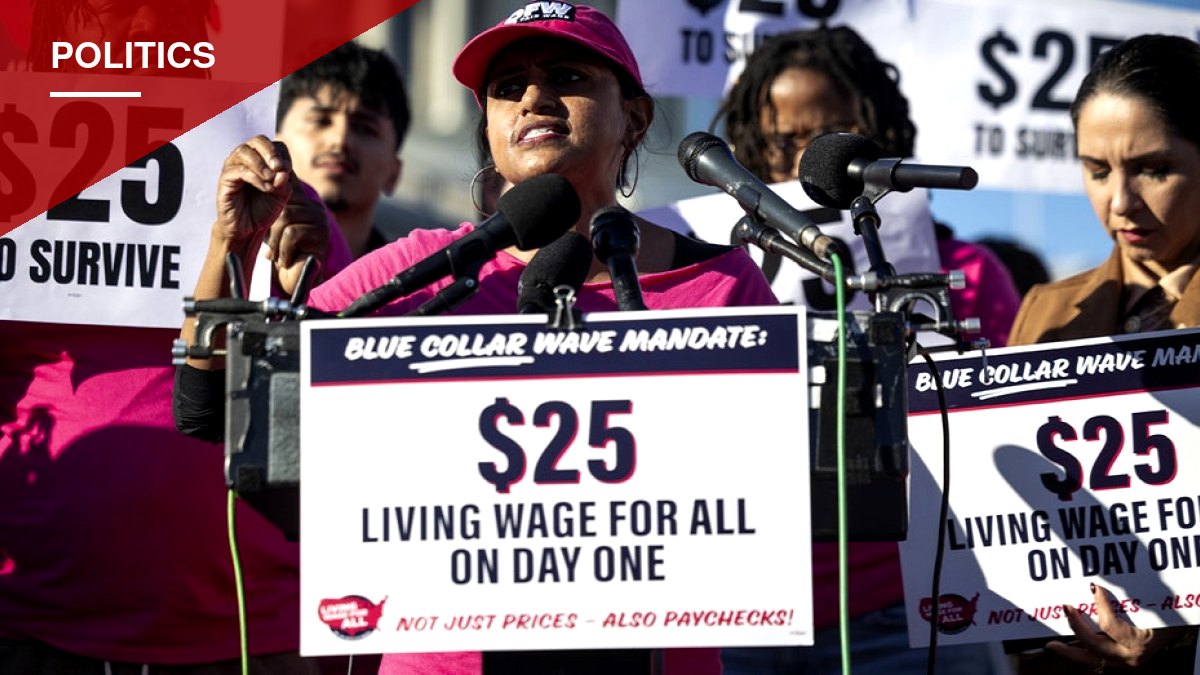

Advocates for a $25 federal minimum wage are pointing to Democrats’ sweeping midterm victories as evidence that voters want Congress to act fast on raising pay, even as the party lacks the votes to override a presidential veto.
Saru Jayaraman, president of One Fair Wage, joined House Democrats and restaurant workers at a Capitol Hill press conference on Nov. 18 to press the incoming 120th Congress to make the Living Wage for All Act a “Day One priority.”
“We’re saying it’s actually not a blue wave, it’s a blue-collar wave. It’s working people who didn’t necessarily turn into Democrats but are demanding change so that they can meet the cost of living,” Jayaraman said.
She argued the results transcend party lines. “I don’t care what their political affiliation [is], people are looking for help and change and relief because the cost of living is out of control,” Jayaraman said. “Nobody can live on the wages. Most people’s pay doesn’t meet the cost of living in America right now.”
One Fair Wage co-leads the Living Wage for All coalition, a group of more than 100 organizations — including major teachers unions and progressive advocacy groups — pushing to more than triple the federal minimum wage, which has stood at $7.25 an hour since 2009.
What the bill would do
The Living Wage for All Act was introduced in April by Rep. Delia Ramirez, D-Ill., with 35 House cosponsors and a Senate companion from Sen. Chris Murphy, D-Conn. The legislation would phase in a $25 hourly minimum wage by 2031 for large employers and by 2038 for smaller businesses. It would also eliminate the $2.13 federal subminimum wage for tipped workers and tie future increases to the national median wage.
One of the bill’s House co-leads, Rep. Analilia Mejia, D-N.J., won an April special election and then secured a full term on Nov. 3 with backing from Rep. Alexandria Ocasio-Cortez, D-N.Y., and Sen. Bernie Sanders, I-Vt. Mejia has also campaigned on Medicare for All, a wealth tax and abolishing U.S. Immigration and Customs Enforcement.
Business groups push back
Small-business advocates and restaurant industry groups have repeatedly warned that a sharp federal wage increase could force employers to cut staff, raise prices or shut down, particularly in rural states where living costs are far lower than in major coastal cities.
Rep. Everton Blair Jr., D-Ga., who attended the Nov. 18 press conference, dismissed those concerns, arguing that $25 should serve as a nationwide floor rather than a ceiling.
“We should be rallying around $25 at minimum, and it should be cost-adjusted for inflation, so that people can have a job that enables them to survive and thrive,” Blair said, adding that the wage “should be higher in places with a higher cost of living.”
Blair acknowledged worries that a higher mandated wage could add to inflation but said lawmakers need to find a way to raise earnings while “keeping people afloat.”
Limited power despite majorities
Democrats won majorities in both the House and Senate in the Nov. 3 midterms, but they will fall well short of the two-thirds supermajorities needed in each chamber to override a presidential veto when the new Congress convenes in January. That means the wage push is likely to function as a messaging effort aimed at pressuring President Donald Trump to reject it publicly rather than a bill with a realistic path to becoming law.
Jayaraman rejected the idea that the lack of veto-proof majorities undercuts the push, insisting voters delivered a clear message on wages.
“There’s a mandate from working people based on this election to deliver on raising wages closer to the cost of living,” she said. “Most people do not care about parties. Most people care about results. They want to see electeds deliver on the cost of living, and that means raising wages to the least you need to live anywhere in the U.S.”





You must be logged in to post a comment Login