
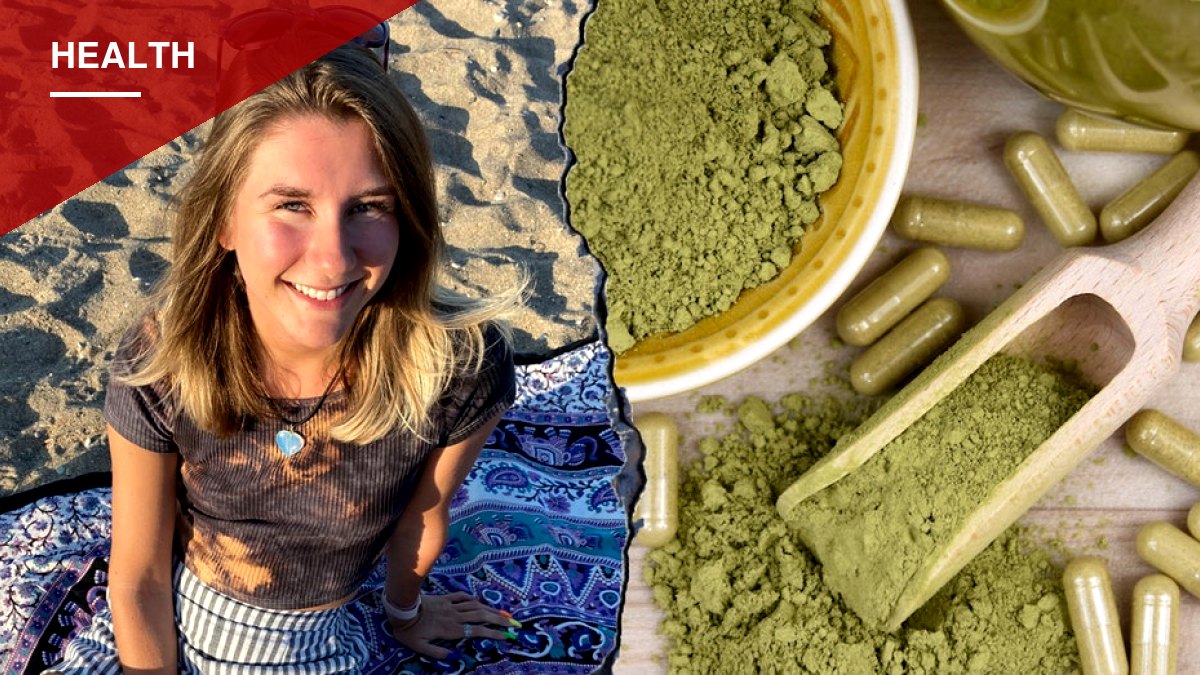

Hilary Tesluck started with four kratom capsules at age 21. Within a few years, the 30-year-old Michigan woman was taking 100 a day, losing nearly 40 pounds and struggling to stand in the shower because, she said, “my body was so wasted away.”
Her story comes as the Centers for Disease Control and Prevention reports a roughly 1,200% rise in kratom-related calls to U.S. poison centers between 2015 and 2025, reaching a record 3,434 last year.
Tesluck told Fox News Digital she first tried leaf kratom capsules in 2017 after a friend recommended them as a natural alternative to her anxiety medication. “It was introduced to me by a friend who knew that I was someone who suffered from anxiety and took prescription medication for it,” she said. “I wanted to be more holistic and natural in what I was consuming.”
She said she didn’t recall seeing dosing guidance on the label and simply followed her friend’s suggestion to take four capsules. The amount crept upward from there. “Very slowly, over time, I had to take just one more capsule or just one more dose, and then went all the way up to 100,” she said.
As her use grew, so did the fallout. She was written up at work for performance issues and saw her weight and energy collapse. Because she believed kratom was natural and legal, she said it took about a year and a half before she accepted she needed help.
A rocky path to recovery
When Tesluck first sought treatment in 2020, she said a urine test failed to detect her kratom use and staff seemed unfamiliar with the substance. “They were confused why I was there,” she said. “So I left after just a few days because I felt kind of humiliated, and I went right back to my use.”
She found more support in 2021 through an online recovery meeting. “It changed everything for me to hear other people telling my story for the first time,” she said.
She relapsed in 2023 after her grandmother’s death, and later again after the death of her cat and the end of a relationship on the same night — this time with concentrated 7-OH, a compound found in trace amounts in natural kratom leaf but sold in far more potent, concentrated form in some products. “The 7-OH was very strong,” she said. “I stayed on that for just a few months because of how intense it was.” She returned to her recovery group and got clean again.
Tesluck now sees leaf kratom and 7-OH as linked. “It’s one problem at two strengths,” she said.
Industry pushes back on comparison
Mac Haddow, senior fellow on public policy for the American Kratom Association, disputed that framing, telling Fox News Digital that the body’s natural conversion of kratom’s mitragynine into 7-OH does not produce exposure equivalent to concentrated 7-OH products. He also suggested the capsules Tesluck first took may have contained more than natural leaf kratom.
Haddow did acknowledge the substance’s risks. “Kratom can cause physical dependence, and some consumers have reported they develop addiction to kratom,” he said. He said the association backs clearer warning labels, stronger enforcement, excise taxes to fund that enforcement, and age restrictions limiting sales to adults 21 and older.
A patchwork of state rules
Regulation varies widely by state. Florida bars sales to anyone under 21. Washington’s health department says kratom products there are largely unregulated, with no age limits, labeling standards or ingredient-testing requirements. Texas requires labels to include directions and a recommended serving size.
“It’s really been a patchwork,” Tesluck said. “It’s different from state to state. Some states ban it, some states regulate it.”
The FDA says it has not approved any kratom drugs and that kratom cannot legally be marketed as a dietary supplement or added to food. In December 2025, federal authorities seized roughly 73,000 concentrated 7-OH products worth about $1 million from three Missouri companies, according to the FDA.
Warning signs
Tesluck urged people using kratom to watch for signs the substance is dictating their schedule — including planning trips around a smoke shop’s closing time. Other warning signs, according to the National Institute on Drug Abuse, include cravings, using more than intended, failed attempts to quit, and continuing use despite problems at work or home.
She described feeling unable to reduce her dose without getting sicker, and experiencing sedation, numbness and irritability. “I was kind of like a zombie shell of myself overall,” she said. “I wasn’t really the same person, personality-wise. I was irritable. I was mean.”
Tesluck now describes herself as in long-term recovery from both kratom and 7-OH addiction. She serves as executive director of End Kratom Addiction, a Virginia-based nonprofit that raises awareness of kratom risks and pushes for stronger regulation. “My advocacy looks a lot like meeting one-on-one with families … and coordinating resources for those who are still in addiction,” she said.






You must be logged in to post a comment Login