
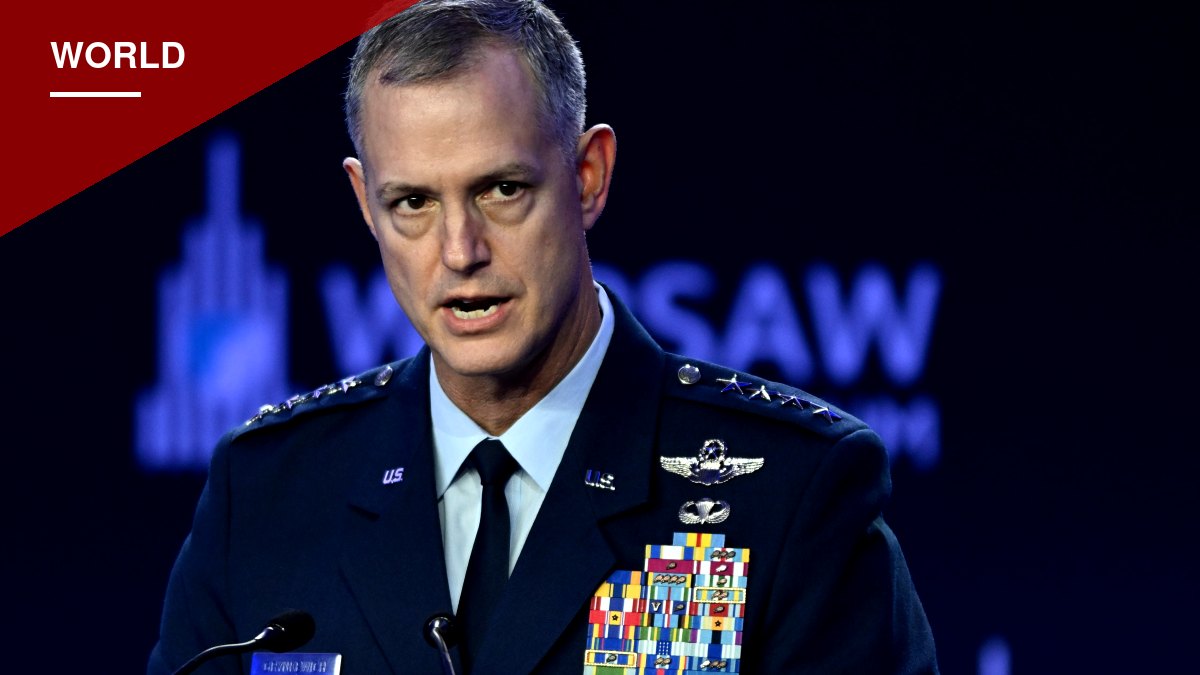

NATO’s top military commander delivered a blunt warning on Monday that the alliance would dismantle anything supporting an attack on its territory, speaking at the Warsaw Security Forum in Poland.
US Air Force Gen. Alexus Grynkewich, NATO’s supreme allied commander in Europe, told a panel titled “Theory of Victory: How Do We Achieve Military Success Against Russia in Deterrence and Defence?” that the alliance stood ready to respond decisively to any assault on its 32 members.
“Should the adversary choose to press the attack or commit his reserves, we will break the warfighting system engaged against us. This includes not just the attacking force itself, but anything and everything that supports, sustains, and controls that force.”
Grynkewich outlined what he described as a three-part strategy of “blocking, blunting and breaking” enemy forces, stressing that NATO remains defensive in posture but will not hesitate to act if provoked.
“If someone is foolish enough to attack us, we will fight. We will stop the attack and deny them the ability to achieve their objectives, whatever those might be. We will, in short, ensure any attack, against any ally, proves utterly futile.”
He did not name Russia directly, but the warning came against a backdrop of mounting friction between Moscow and Western nations, including drone incursions and suspected sabotage that European governments have linked to Russia. NATO’s 2022 Strategic Concept identifies Russia as the alliance’s most significant and direct threat.
“We stand here together in Poland today stronger than ever united in our common vision of a more balanced, more ready and more lethal alliance,” Grynkewich said.
A pattern of incursions
In 2025, multiple Russian drones entered Polish airspace during a large-scale attack on Ukraine, prompting Polish and allied aircraft to respond. NATO subsequently launched Operation Eastern Sentry to reinforce its eastern flank. Romania has also reported Russian drone incursions, and Estonia has accused Russian military aircraft of violating its airspace.
Grynkewich’s remarks followed a tense weekend in which Russia launched fresh strikes on Ukrainian energy infrastructure despite diplomatic efforts to ease hostilities. President Donald Trump had separately announced an agreement with Russian President Vladimir Putin to boost Russian diesel supplies to the US and global markets, including a waiver of certain US sanctions on Russian energy exports. Ukrainian President Volodymyr Zelensky has accused Russia of continuing to strike energy facilities, casting doubt on prospects for a broader ceasefire.
Nuclear warnings from Moscow
The tensions have come alongside recent nuclear threats from Russia. On Sept. 30, Moscow warned NATO it could use nuclear weapons if the alliance attempted to isolate Kaliningrad, its heavily militarized Baltic Sea exclave between Poland and Lithuania. In a diplomatic note obtained by Reuters, Russia accused NATO of pursuing a “dangerous and reckless course” carrying “high risks of the outbreak of a direct armed conflict,” and raised the possibility of strikes against decision-making centers in NATO countries at the outset of a conflict.
NATO Secretary-General Mark Rutte rejected the threats. “Putin knows that he can never win from NATO,” he said at the Euronews Defence and Space Summit on Sept. 30. Putin, for his part, has maintained that Russia has no plans to attack European countries and seeks peaceful coexistence with its neighbors.
Readiness and reassurance
Grynkewich said NATO’s strategy was already being put into practice through military exercises, enhanced readiness and new capability investments. “If attacked, we are ready to fight tonight, but we are not complacent,” he said, adding that any response would not be limited to troops directly involved in an assault but could extend to the broader infrastructure enabling it.
Trump has pressed European allies to raise defense spending and has questioned whether countries falling short of their obligations should expect US protection. Grynkewich sought to ease concerns about Washington’s commitment, recalling Trump’s remarks at the 2025 NATO summit in The Hague.
“I was in the room and I felt the love. What I want to do is assure the one billion citizens of our alliance that we’ve got this. We know what we need to do. We know how we would do it.”
He also said he was open to discussing suspected hybrid attacks publicly if individual member governments wanted him to. “If a nation wants me to, I’m happy to talk about it,” he said.
The Warsaw Security Forum gathered European political and defense leaders as the continent continues to confront Russia’s war in Ukraine and rising tension along NATO’s eastern flank.





You must be logged in to post a comment Login