
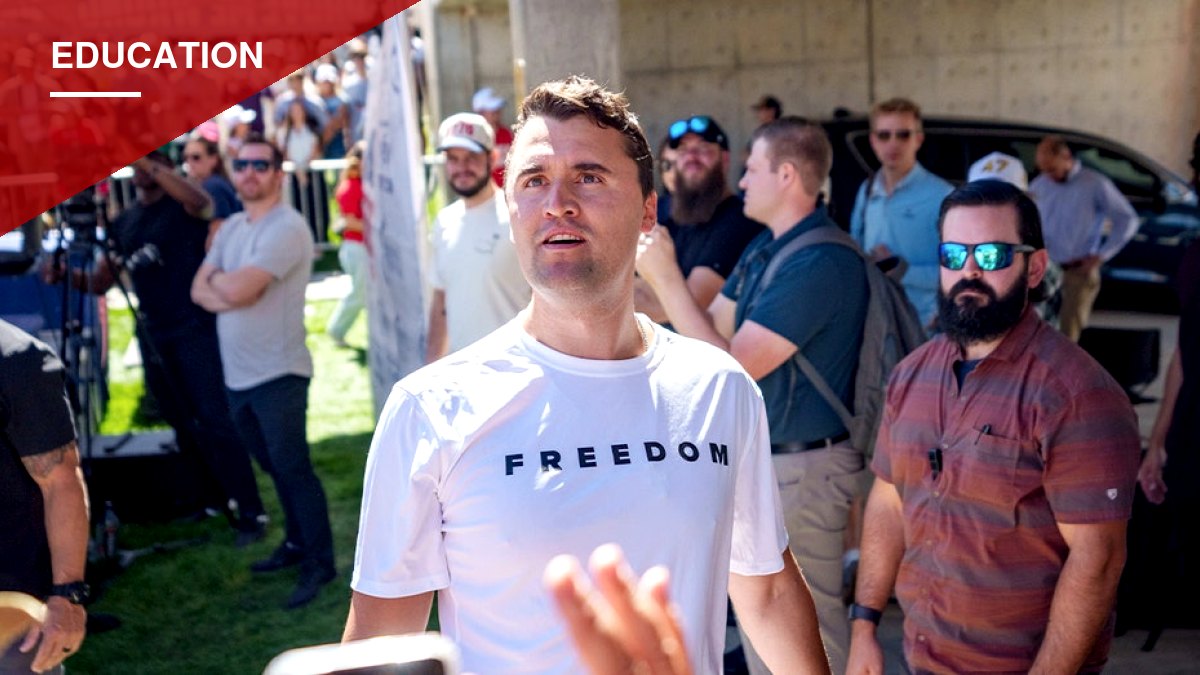

One year after conservative activist Charlie Kirk was shot and killed during a campus debate in Orem, Utah, a university president is calling on American higher education to take up the cause of open debate that Kirk championed before his death.
Kirk, 31, was killed on Sept. 10 at Utah Valley University while sitting under a tent in front of roughly 3,000 people, answering a question from a student who disagreed with him. He was shot in the middle of his response.
In an op-ed published by Fox News, Dr. Kent Ingle, president of Southeastern University, wrote that the detail from that day he cannot stop thinking about is the tent itself. Kirk, he said, had to bring his own stage, microphone and security to hold an open debate on a college campus, even though every campus in the country already has halls built for exactly that purpose.
Ingle said he met with Kirk in 2022 at Southeastern University, where the two discussed the state of American higher education and where the next generation of leaders would come from. According to Ingle, Kirk wanted to know whether institutions like his were still forming leaders or had settled for simply processing students through.
Rather than revisit the killing itself, Ingle used the anniversary to argue that universities have failed to defend the value of open disagreement on campus, ceding that ground to outside figures like Kirk. He wrote that universities were built to be places of friction, where students learn to think by defending their beliefs in front of people who disagree with them, but that over the last two decades campuses instead built speech codes and bias-reporting systems meant to shield students from unsettling ideas.
What the data shows
Ingle cited a survey by the Foundation for Individual Rights and Expression of 68,510 students at 257 colleges conducted in the first half of 2025. The survey found that 36% of students said shouting down a campus speaker is sometimes or always acceptable, and 15% said the same about using violence to stop a speech. The survey was conducted before Kirk’s death.
Ingle said he was not claiming the survey explains the killing, but that it describes a campus climate that institutions like his helped create.
Southeastern’s approach
Ingle pointed to his own university, which he described as unapologetically Christian, as a model for engaging rather than avoiding controversial speakers. Over the past year, Southeastern University hosted former White House press secretary Karoline Leavitt and Pastor Lucas Miles, senior director of TPUSA Faith, the ministry arm of the organization Kirk founded.
Ingle wrote that his goal is not for students to simply admire Kirk, but to become leaders capable of walking into a hostile room, making an argument on its merits, and persuading people who disagree with them.
He called on other university presidents marking the anniversary to adopt concrete free-expression policies, defend those policies even when they cost donors, stop canceling speakers in response to petitions, and require students to argue positions they personally reject as part of their coursework.
Ingle closed by noting that Kirk was killed not in a war zone but on a college campus in the middle of the day while taking a question — something he said should be among the safest activities in American life.




You must be logged in to post a comment Login