
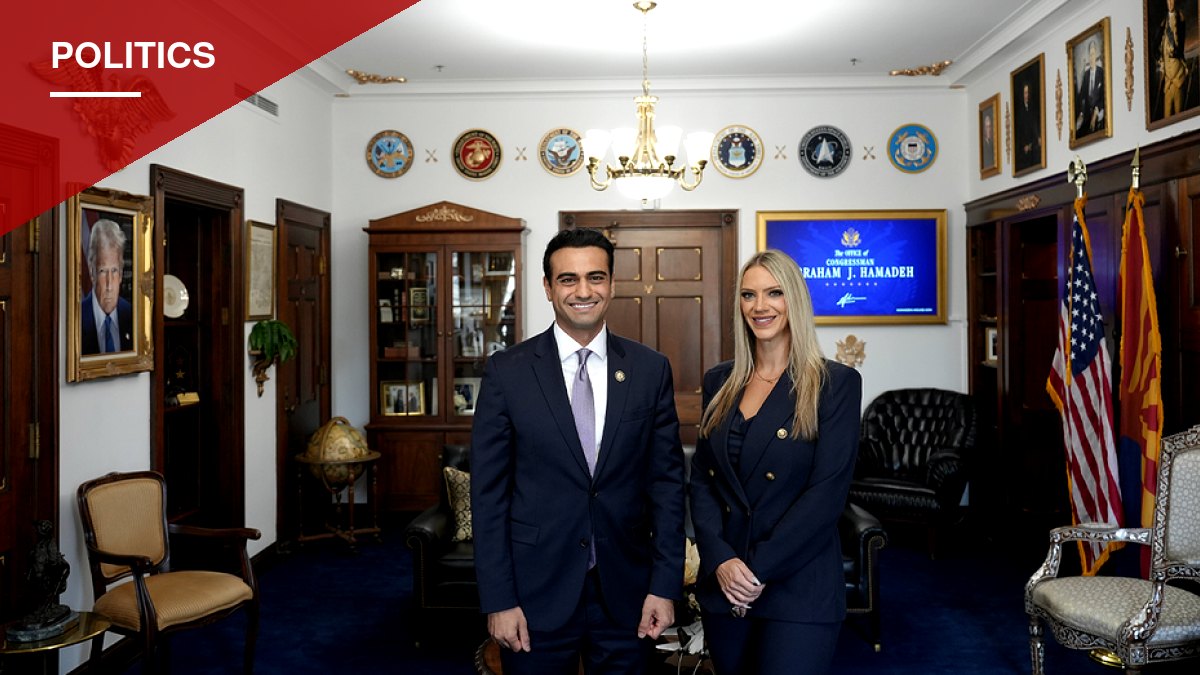

The U.S. House unanimously passed a bill this week that would require federal courts to issue lifetime no-contact orders against people convicted of sex crimes and violent felonies, ending a legal process that has forced some survivors back into courtrooms decades after their abuse.
The measure, known as the Kayleigh’s Law Act of 2026 and introduced as H.R. 8481 by Rep. Abe Hamadeh, R-Ariz., now moves to the Senate. It is named for Kayleigh Kozak, an Arizona mother of five from the Phoenix area who was sexually abused as a child and later had to return to court when her abuser sought to have his no-contact protection lifted.
“Protect the victim. Stop the predator. End the revolving door,” Hamadeh wrote on X after the vote. “When a predator is convicted, the court issues a lifetime no-contact order. Not until probation ends. Not until some judge decides he’s ‘moved on.’ For life.”
Under current law, no-contact protections tied to a criminal sentence can expire or be revisited once probation or supervised release ends, sometimes forcing survivors back into court to defend those protections. Hamadeh’s bill would prohibit a convicted offender from contacting the victim, directly or indirectly, for the rest of the offender’s life.
Kozak’s Case in Maricopa County
Kozak’s abuser, Joshua Jacobsen, was a former teacher and soccer coach who pleaded guilty to sexual abuse and luring a minor for sexual exploitation. Kozak was 12 years old and one of his students at the time, according to FOX 10 Phoenix. Jacobsen was sentenced to six months in jail and lifetime probation.
Nearly two decades later, Jacobsen asked a Maricopa County judge to end his probation, arguing his conduct over 18 years showed he had reformed. Hamadeh said Kozak was pulled back into court 13 years after the abuse to oppose that request, and again the following year when Jacobsen made a second attempt.
“Can you imagine that you have to sit across the room from this man?” Hamadeh said. “That’s something a victim should never have to do.”
Kozak told the court, “I am living proof that he is capable of sexually harming children. He consciously chose to violate me, and he was convicted of committing a dangerous crime against a child while he was in a position of power.”
A Maricopa County judge denied Jacobsen’s request in June, citing probation violations including unauthorized contact with children and breaches of chaperone restrictions, according to Arizona’s Family. Jacobsen remains on lifetime probation under supervision of Maricopa County Adult Probation.
Kozak celebrated the House vote on X, saying the country was “one step closer” to permanent protection for survivors. “No victim should ever have to endure the hell I had to walk through,” she wrote. “When I discovered protection wasn’t permanent, I knew it had to change.”
A Personal Promise
Hamadeh, a former prosecutor and Army veteran, met Kozak about five years ago while running for Arizona attorney general. He later promised her outside an In-N-Out Burger that the bill would be among his first priorities in Congress.
“I told Kayleigh, I said, ‘Kayleigh, the moment I get to Congress, it’s going to be one of my first bills that I get done,'” Hamadeh recalled. Kozak and her children joined him at the Capitol for the House vote. “Promise made, promise kept,” he said.
Asked about due-process concerns for defendants, Hamadeh said the restrictions apply only after conviction. “This is not about the due process beforehand,” he said. “They ultimately have to be found guilty of a crime.” He added, “The victim shouldn’t be re-traumatized over and over again. At that point, they should have no ability to contact the victim ever in their lifetime.”
Versions of Kayleigh’s Law have already passed in Arizona and Wisconsin. Hamadeh said more than 1,000 Arizona survivors secured lifetime protection during the state law’s first year.
The bill now heads to the Senate, where Sen. Mike Lee, R-Utah, is leading the push to advance it, according to Hamadeh. He also credited Rep. Andy Biggs, R-Ariz., with helping move the measure through the House Judiciary Committee.
“It passed unanimously in the House. It should pass unanimously in the Senate,” Hamadeh said. He said he hopes the bill reaches President Donald Trump’s desk before November. “Call your senators,” he said. “Ask them to bring up Kayleigh’s Law to the floor.”





You must be logged in to post a comment Login