
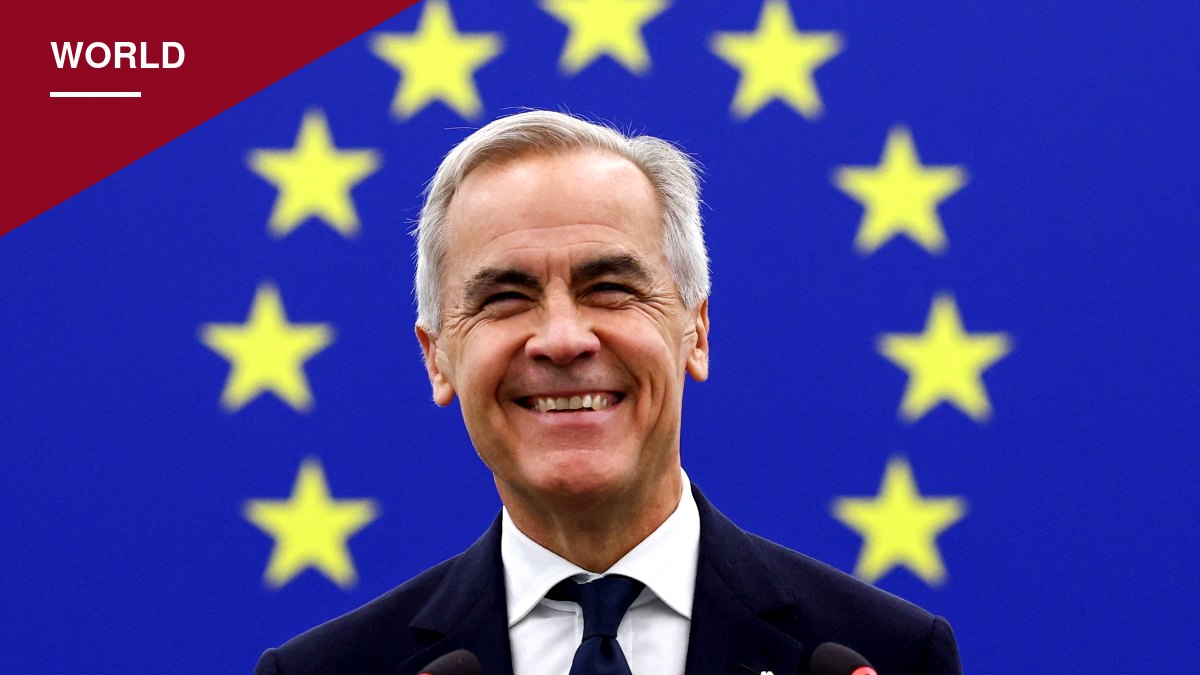

Prime Minister Mark Carney has welcomed a proposal that would make Canada the European Union’s first associate member, a status that does not currently exist under EU treaties and would need to be created from scratch. The plan is expected to be a central topic when Carney hosts European Union leaders in Montreal for a Canada-EU summit on Oct. 29-30.
The proposal, unveiled Wednesday by European Commission President Ursula von der Leyen, calls for Canada and the EU to move beyond their existing free trade agreement toward what she described as an “Alliance for the Future” — a shared space for prosperity and economic security. Speaking to the European Parliament on Thursday, Carney said, “We welcome this ambition,” while emphasizing that deeper cooperation would span trade, defense, critical minerals, artificial intelligence, energy, space, research and financial services.
He was careful to frame the effort as defensive rather than confrontational. “I am not proposing a third bloc in order to become a great-power rival — only with better manners,” Carney told lawmakers. “We do not seek power to dominate others.” He said the aim is to build resilience so no country can control Canada’s markets, undermine its sovereignty or dictate its choices.
The push comes as President Donald Trump has criticized the proposed arrangement, calling it a potential “hostile act” and dismissing the idea as “laughable,” while threatening steep tariffs on Europe if he concludes the bloc is acting unfriendly toward Washington.
Canada has long built its economy around close ties with the United States, which still receives roughly 70% of Canadian exports. But Trump’s tariffs, demands for economic concessions and repeated suggestions that Canada become the 51st state have pushed Ottawa to look elsewhere to reduce that dependence.
Europe, by contrast, largely avoided retaliating against Trump’s trade measures, instead accepting tariffs of up to 15% on most of its exports to the U.S. Canada took a different route, imposing retaliatory measures and rejecting demands Carney has said would compromise Canadian sovereignty. He has repeatedly argued that middle powers negotiating alone with a dominant power do so “from weakness,” a point he raised at the World Economic Forum in Davos in January, saying such countries simply “accept what is offered.”
Jonathan Wilkinson, Canada’s ambassador-designate to the EU, said Wednesday that Canada is not pursuing full EU membership, since that would mean giving up some sovereignty. Instead, he said, Ottawa wants “to get as close as we possibly can” to Europe while strengthening Canada’s independence. The precise scope of associate membership has yet to be negotiated.
Canada has already moved toward closer integration with European institutions this year by becoming the first non-European country to join the EU’s $173-billion SAFE defense procurement program, which gives Canadian firms access to joint procurement as European defense spending rises. The two sides have also held talks on energy, critical minerals, artificial intelligence and digital trade.
Daniel Béland, a political-science professor at McGill University in Montreal, said the shift reflects broader unease about relying on Washington. “The policies and rhetoric of the Trump administration are clearly pushing both Canada and the EU to imagine a world without strong US leadership and to act accordingly,” he said, adding that Carney may avoid naming Trump directly even as his message is clearly aimed at Washington. “He knows that, beyond Europe, the world will be watching, including the White House,” Béland said.
Nelson Wiseman, a professor emeritus at the University of Toronto, said Carney’s approach to Trump has drawn particular attention in Europe. “Carney’s shrewdness in dealing with Trump has captured Europe’s attention,” Wiseman said, noting that Europeans have long viewed Canada as especially familiar with the United States given their deep economic and political ties.
With the framework still to be worked out, the Montreal summit at the end of October is expected to be the next major venue for defining what an EU-Canada associate relationship would actually involve.






You must be logged in to post a comment Login