
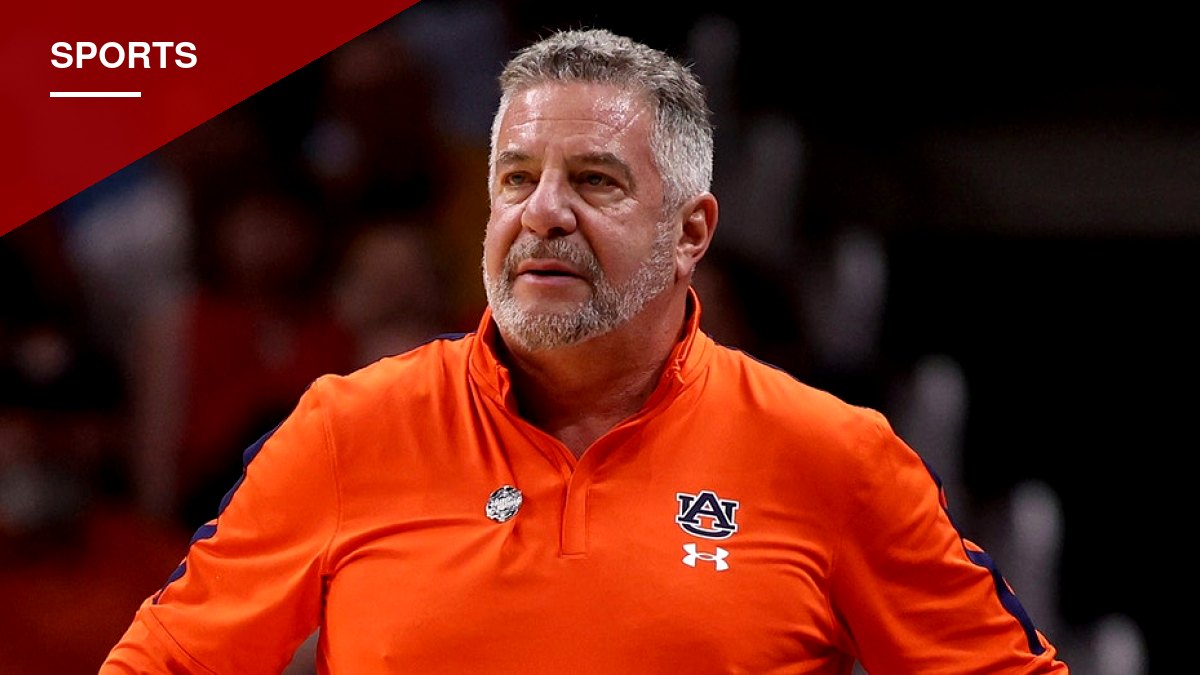

Former Auburn men’s basketball coach Bruce Pearl has publicly backed New England Patriots owner Robert Kraft’s decision to ban rapper Macklemore from Gillette Stadium, calling the move an act of leadership against antisemitism.
Pearl, who is Jewish and has spoken frequently about antisemitism in sports, made the comments during an appearance on “Don’t @ Me with Dan Dakich.” He described Kraft as a “hero and a patriot” for taking action rather than staying silent.
The controversy stems from Macklemore’s appearance during Ed Sheeran’s tour stop at MetLife Stadium in New Jersey, where the rapper delivered anti-Israel remarks and performed his protest song “Hind’s Hall.” Kraft responded by banning Macklemore from Gillette Stadium in Foxborough, Massachusetts, citing what he described as a pattern of antisemitic tropes from the artist, including a 2014 costume in Seattle that was widely criticized as a caricature of Hasidic Jews. Kraft’s decision led other venues to follow suit, and tour promoters ultimately dropped Macklemore from further stops.
Pearl argued that slogans commonly heard at pro-Palestinian demonstrations carry meaning beyond political protest.
“Here’s where I want to go with what he said, because it wasn’t just about hating the Jews. ‘Free Palestine,’ to Palestinians or to Arabs, means free Palestine of the Jews. How would you free Palestine of the Jews? Well, you either scare them off, run them off, or murder them,” Pearl said.
He said many people repeat activist language without understanding its historical roots.
“Free of colonization or free of genocide or whatever terms people use, that’s not what this means. This simply means we’re going to do to the Jews in Palestine like we did to them in Egypt, Lebanon, Syria, Iran, or Iraq,” Pearl said.
Pearl also addressed chants to “globalize the Intifada,” pointing to past Intifadas that included violent attacks on civilians in buses, hotels and streets.
“Asking for somebody’s death is not free speech. It is hate speech, and it should not be allowed,” Pearl said.
Drawing a comparison to Martin Luther King Jr.’s teachings on silence and complicity, Pearl said coaches and leaders have an obligation to speak up when they witness hate.
“We grew up in a time where Dr. King talked about silence as complicity. Therefore, as a coach, when we see something wrong… we take action because our silence as teachers and educators is complicity,” Pearl said.
Pearl closed his comments by framing Kraft’s decision as a model of responsible leadership.
“Robert Kraft is the owner of a business. He has a responsibility as a leader in the community. When given the opportunity, he did not remain silent and he went and did something. You know what? Sometimes actions have consequences, but sometimes inaction is actually worse. Robert Kraft is not a coward. He is a hero, and he is a patriot,” Pearl said.




You must be logged in to post a comment Login