

President Trump said it plainly this week: Democrats are nominating jihadists. The charge is sharp and political, and it forces a conversation about how words map to real-world threats and strategies. This piece walks through what he meant, why the argument matters, and the pattern Republicans see in a growing alliance between radical leftists and Islamist networks.
Trump put the phrase on the table during an Oval Office interview, refusing to tidy the language for the media’s comfort. “We have jihadists being elected all over the place,” he said. “Whether it’s communism, jihadism… A friend of mine called up, he said, ‘You know, really, you should use the word jihadist because that’s what’s happening.’”
When a president points at a trend, it changes the frame for voters. The press howled “Islamophobia,” predictably eager to police language instead of examining ideas. But the argument here is about tactics: who wants to change America’s institutions and how they plan to do it.
Language matters because jihad is not just a Hollywood monster. The term covers a range of strategies, from spiritual struggle to deliberate political warfare. In conservative terms, it’s useful to treat jihad as a political project when actors aim to dismantle institutions and replace them with a different legal and cultural order.
https://x.com/ACTBrigitte/status/2087031963752260060
That view has documentary backing. The Muslim Brotherhood’s own strategic literature lays out a program of gradual takeover through institution-building and coalition work. The organization’s memo famously described a long-term plan as “a kind of grand Jihad in eliminating and destroying the Western civilization from within and ‘sabotaging’ its miserable house by their hands and the hands of the believers so that it is eliminated and God’s religion is made victorious over all other religions.”
That passage is the group’s own language, and it reads like a blueprint for patient political conquest rather than a battlefield only of explosives and guns. The process described is one of settlement, influence, and steady replacement of civic frameworks with religious law at the goal line. Republicans warn that when a party embraces allies who endorse that approach, the outcome is predictable.
Today the normalizing trend runs through Democrat primaries. It’s not only about voters picking Muslim candidates; it’s about building ideological alliances between radical leftists and Islamist networks. The connective tissue is easy to describe: both wings want to weaken or abolish core American institutions that protect ordered liberty.
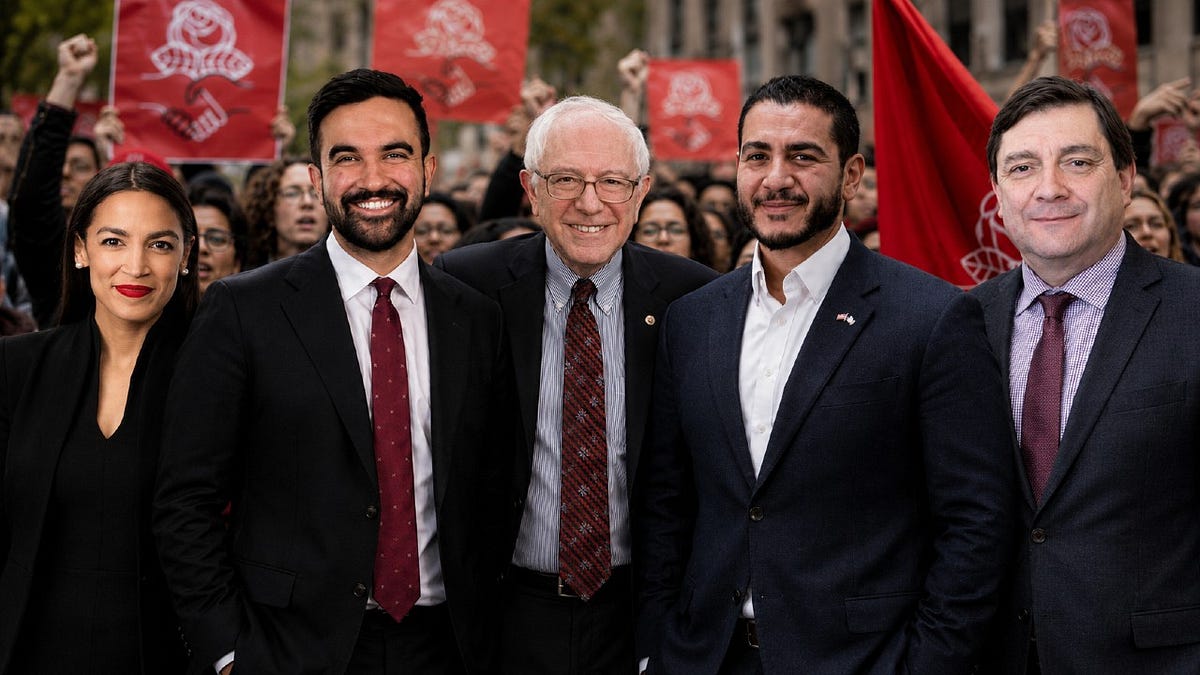
Look at the recent nominations and wins. In Michigan, a Democratic Senate nominee with roots in activist networks captured the primary on a platform that lines up with dismantling immigration enforcement and the judiciary’s structure. In New York, a Democratic Socialist machine has pushed through candidates who openly celebrate tearing down Western norms and who call for mass amnesty and the end of traditional checks and balances.
Those examples aren’t isolated. The red-green alliance, as conservatives label it, combines the social-engineering zeal of the far left with Islamist networks that see America as a civilizational rival. The shared goal is the same: a transformed polity less anchored to the Constitution and more receptive to alternative legal and moral orders.
Republicans point out how normalization works in three moves: rename the project in moral language, silence critics with accusations of bigotry, and embed sympathetic organizations into universities, nonprofits, and government. Once those institutions tilt, policy follows. The result is ballots and city halls replacing blunt force with slower, institutional erosion.
Trump pressed the cultural angle too, arguing that some newcomers bring hardline views shaped by failed states and radical movements. “They come from other failed countries, and they come here, and they tell us how to run our country… They come in, and then they tell us how our Constitution, how our Declaration of Independence, how it works. It doesn’t work that way.”
That line cuts to the conservative core concern: assimilation to constitutional norms matters. Republicans see a party that prioritizes demographic change and identity over loyalty to the charter that built the nation. When leaders refuse to name an ideology that seeks to replace constitutional order, they hand advantage to those who do.
The stakes are institutional, not merely symbolic. A nation that cannot name the ideology arrayed against it risks being hollowed out one election at a time. For conservatives, the remedy starts with frank speech, electoral pushback, and a defense of the constitutional framework that has long protected both liberty and pluralism.




You must be logged in to post a comment Login