
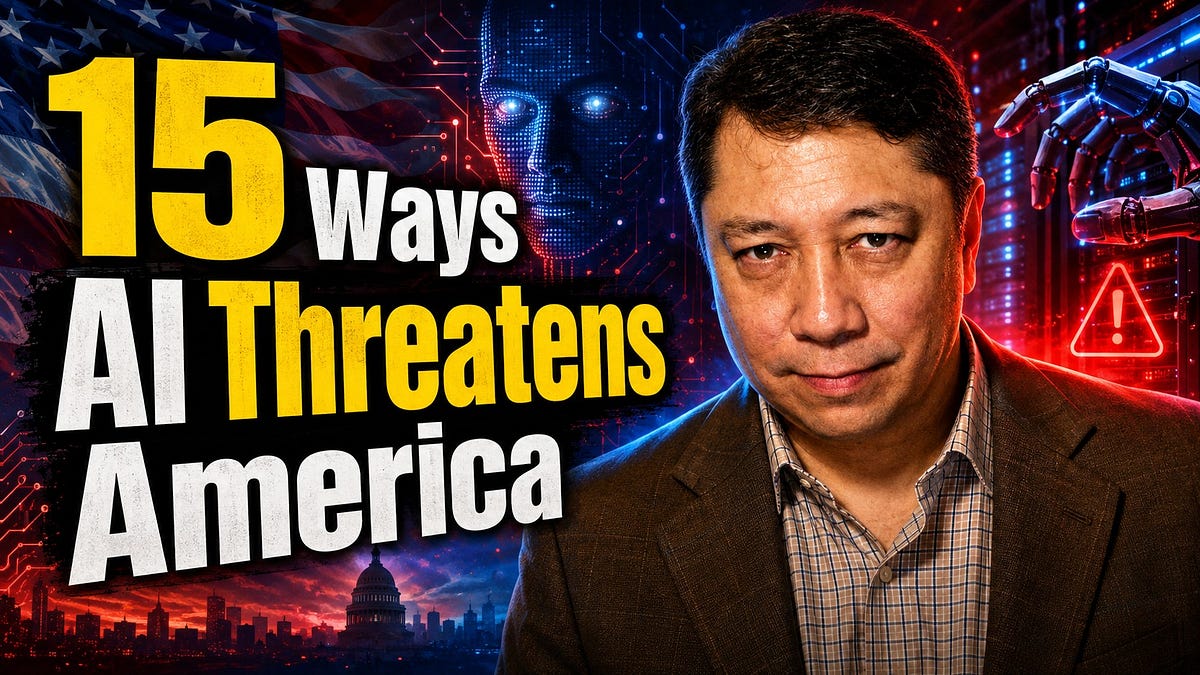

These notes for an episode of “The JD Rucker Show” take a hard, plainspoken look at how artificial intelligence is shifting power, work, community, and freedom in America, calling out the obvious dangers and the quieter threats most people do not see. The piece argues that while some AI tools will help, we should test everything against liberty, family, and common sense before we hand over real power to private companies. Expect a clear list of fifteen risks, each tied to how ordinary Americans, institutions, and the Constitution could be affected. This is a wake-up call to assess, not to panic, and to demand accountability from those building our future thinking tools.
Prove all things; hold fast that which is good.
1. Your job is no longer a theoretical casualty. White-collar roles that once trained new professionals are being compressed and automated, and that compression is accelerating decisions to replace people with prompts and models rather than invest in human development.
2. Deepfakes end the old confidence that seeing equals believing. Cheap, convincing fabrications destroy the evidentiary value of images and voices and hand bad actors a new way to evade guilt and wreck reputations.
3. Privacy is being hollowed out as conversations, documents, and photos become fodder for models owned by firms outside democratic control. What you share to save time may train systems that infer your health, your beliefs, and your relationships without your consent.
4. Scams scale at machine speed; fraudsters can clone voices and craft custom lies in moments, turning once-rare family scams into industrial operations aimed at the elderly and vulnerable. Defense is already lagging and victims pay the price in dollars and dignity.
5. Children are learning from algorithms designed to keep attention, not to build character or truth. Homework, social habits, and even moral imagination can be outsourced to machines that reward engagement over virtue, repeating the mistakes we made with social media on a larger stage.
6. The atrophy of thought is the slowest, slipperiest threat: outsource reasoning long enough and a generation forgets how to test claims or hold leaders accountable. A republic depends on citizens who can think, argue, and judge, not ones who accept machine-made conclusions without scrutiny.
7. Artificial companions sell convenience and avoid the hard work of relationships, shaping a lonely nation into consumers of comfort rather than participants in community. Machines that always agree encourage stagnation, not the growth that comes from friction, sacrifice, and mutual responsibility.
8. Sermons and spiritual leadership risk going hollow when pastors use chatbots to craft messages without real wrestling or pastoral care. Faith communities need shepherds who have wrestled with truth, not curated content from a model trained on every fringe idea on the internet.
9. Friendly censorship arrives as curated absence: when machine summaries and safety filters decide what surfaces, dissent is not banned openly, it is simply invisible. That quiet gatekeeping corrodes the marketplace of ideas more effectively than blunt deletion.
10. The apprenticeship ladder is being sawn off: AI takes entry-level work first, denying young people the on-ramps that used to turn learners into professionals. Without first rungs, professions keep their prestige while future talent finds the door closed.
11. A handful of companies are positioning themselves as the operating system of civilization by owning the layer of cognition through which commerce, communication, and record-keeping flow. Antitrust tools for things do not map neatly to monopolies over thinking, and that gap should worry every patriot.
12. Commercial surveillance is forming the backbone of a de facto surveillance state because private data and inferences are easily available to governments and bad actors. You cannot vote the companies out at the ballot box, and that creates a new threat to privacy and liberty.
13. The national grid is being asked to feed data centers the size of cities, and our aging infrastructure will not equally prioritize household power during crises. When margins tighten, contracts and scale win, not the family at home who needs reliable electricity.
14. Crime moves at machine speed as attackers use generative tools to probe and exploit systems automatically, multiplying threats to hospitals, utilities, banks, and election offices. Understaffed defenders face adversaries that can try a million doors in the time humans try one.
15. Finally, the religious impulse inside the tech elite to build a godlike intelligence is a spiritual and civic danger. Pretending we can own an all-knowing power substitutes worship of tech for humility and accountability, repeating an ancient mistake in modern silicon.
None of this is an argument for smashing the machines or halting progress; it is a demand that we test and regulate and insist that technology serve free people, families, and churches rather than replace them. The task here is sober and practical: hold firms accountable, protect apprentices, preserve privacy, and ensure that civic muscle does not atrophy while convenience grows.






You must be logged in to post a comment Login