
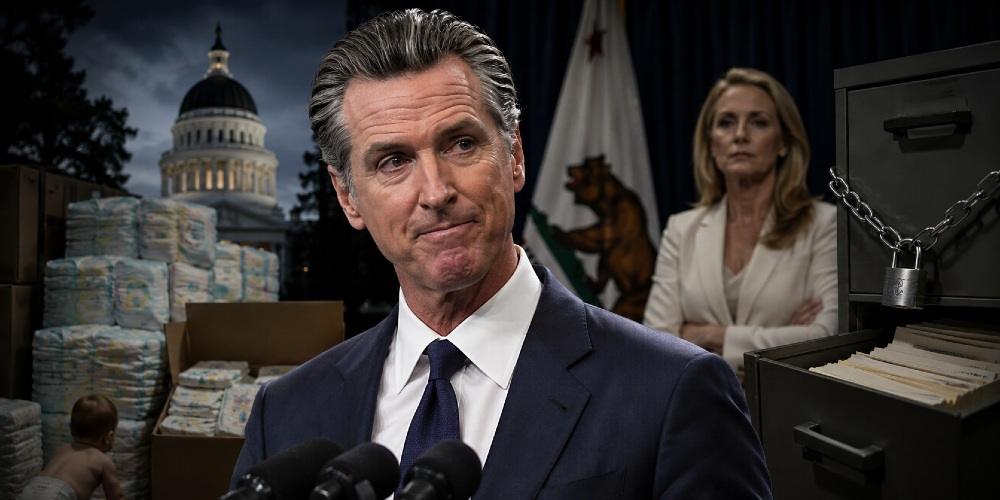

Governor Gavin Newsom rolled out a splashy plan to give free diapers to every new parent in California, but the paper trail behind that promise has been locked away for months. This article follows the timeline of delay, the questions that contract documents would answer, the nonprofit ties to the governor’s family orbit, and how Sacramento’s maneuvering around public records raises real concerns about accountability. It’s about a governor who loves the spotlight yet seems to resist the paperwork that would let taxpayers check the facts. Voters deserve to see contracts and scoring documents, and the delays tell you something important about priorities in Sacramento.
The rollout was noisy and theatrical, yet the actual contract has been treated like a secret. State officials took weeks beyond the legal response window just to admit the records are public, then kept pushing deadlines until the public was left waiting. A program announced on camera with fanfare deserves the same level of transparency the moment it’s announced, not some slow-drip reveal designed to blunt scrutiny.
Why does this matter? Because the contract and the bid scoring sheets would show how the vendor was chosen and whether the state paid a fair price. The nonprofit that won the deal has a leader who sits on a board connected to the governor’s wife, which creates a perception problem at minimum. Perception matters in politics, and when a government slow-walks documents, it gives people reason to suspect favoritism.
Baby2Baby’s leadership has said the board role was unpaid and that the governor’s family’s nonprofit did not influence the diaper program. They also provided a cost figure that, if accurate, makes the per-diaper price much lower than some critics feared. Those are testable claims, and proving them requires the actual procurement records, not talking points or press releases.
Instead of immediate transparency, the state appears to have taken a different route: delay, then partial promises, then more delay timed around holidays and quiet moments. Each postponement stretches the gap between the governor’s public celebration and the public’s ability to verify what he celebrated. That gap is the story; it transforms ordinary procurement questions into a political problem.
There is a sequence worth noting: an initial award granted through an information request process critics say lacked competitive rigor, followed by a proposed extension that sought to avoid formal bidding. That pattern raises straightforward questions about why traditional procurement safeguards were relaxed and whether taxpayers got the best deal. If everything is above board, releasing the documents immediately would settle doubts. The choice to withhold them does the opposite.
At the same time, lawmakers moved a bill to change how public records requests are handled, altering response deadlines from calendar days to business days and at one point proposing fees and litigation options against requesters. The worst parts were removed after pushback, but the episode shows a broader inclination to make public records harder to get. That shift matters when the administration itself is slow-walking a high-profile contract.
People shouldn’t have to pay to get information from public officials.
That is a sentiment even some in the majority could endorse, and it gets to the heart of the dispute: information is not a privilege to be rationed. When government announces a multimillion-dollar program with balloons and hashtags, the contract should be available the same day. The law and the technology already allow that to happen.
You should’ve had it in your hand the day they were talking about it.
That comment captures the obvious expectation most Californians have. The state’s public records law sets strict timelines for a reason — to prevent this kind of drawn-out opacity. Dodging those timelines, or seeking to blunt them through rule changes, signals a system more interested in shielding deals than in showing the math.
There is a line in Scripture that fits the moment: “For there is nothing covered, that shall not be revealed; neither hid, that shall not be known. Therefore whatsoever ye have spoken in darkness shall be heard in the light” (Luke 12:2-3). It is a reminder that secrecy rarely survives scrutiny, and that faith in government rests on openness, not announcements alone.
The documents will likely surface eventually, and when they do they will either validate the state’s process or expose a troubling shortcut. Until that day arrives, every extra week of stonewalling shifts the story from a policy rollout to a question about judgment and priorities. Californians should get the records now, not after the political noise has faded.




You must be logged in to post a comment Login