
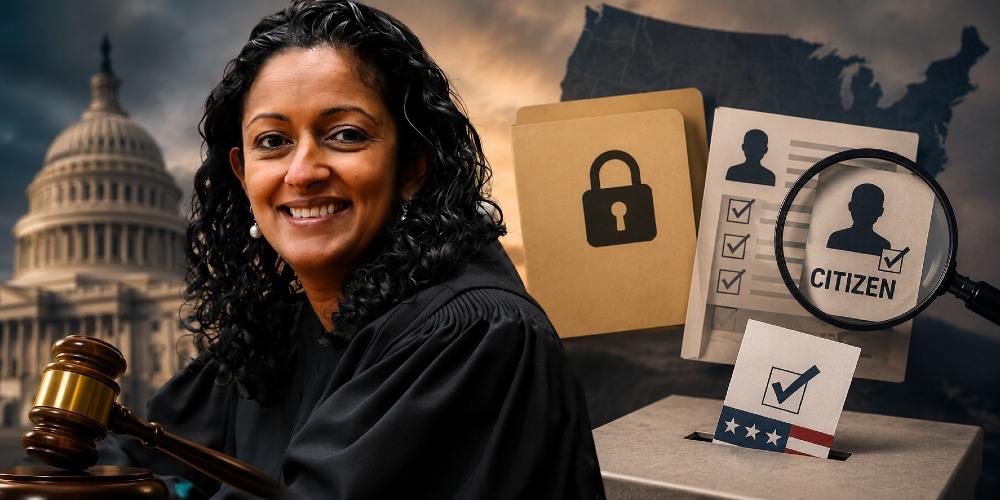

The court’s decision to block the federal overhaul of the SAVE citizenship database has left the basic question of how America checks voter eligibility unresolved, sparking a debate over privacy, accuracy, and who gets to set election policy when a single judge can halt a nationwide system months before midterms.
Last week U.S. District Judge Sparkle Sooknanan, a Biden appointee, threw out the administration’s plan to expand the Systematic Alien Verification for Entitlements, or SAVE, in a lengthy opinion. She said the government “knowingly trampled on the privacy rights of American citizens in a manner that threatens the sacred right to vote.” That language landed hard in headlines and on cable, and it’s easy to see why people on both sides reacted strongly.
The ruling is narrower than the press frenzy suggests. Sooknanan did not declare that noncitizens can vote or wipe SAVE off the books entirely; she stopped the 2025 expansion that would have let states cross-check voter rolls with citizenship and Social Security records. Her central finding was that the agencies exceeded their authority and breached several statutes, including the Privacy Act and the Social Security Act.
There’s real reason to be skeptical of the rollout the administration proposed. In Texas the revamped process flagged people who were in fact citizens, forcing naturalized Americans to prove their status and, in at least one reported case, leading to a registration that vanished without the registrant’s knowledge. A verification system that misidentifies citizens is a political and moral problem, not a solution.
Conservatives who care about election integrity shouldn’t pretend the court pulled its concerns from thin air. The goal here is simple: accurate checks, not tools that induce errors that the other side can exploit. When verification yields false positives, it hands opponents the symbols and stories they need to claim voter suppression.
But the remedy the judge chose is blunt and consequential. By enjoining the entire overhaul rather than ordering corrections, the court effectively took the most practical federal cross-checking method off the table with five months to go before the midterm elections. That timing matters. Fixes take time, and the ruling leaves election officials with fewer federal resources to guard against ineligible registrations.
The privacy theory Sooknanan relies on stretches thin when you look at the facts. The federal government already holds the Social Security numbers and citizenship records at issue. Treating a government check of its own records as a novel invasion of privacy is a position that rings true mainly for those who wanted this particular outcome from the start.
Homeland Security general counsel James Percival captured the tension plainly: “It’s amazing how hard the Left will fight to stop us from solving problems they insist do not exist. Judge Sparkle Sooknanan’s latest ruling preventing DHS from addressing alien voting is just the latest example!” That statement frames the decision as a partisan barrier to practical fixes rather than a neutral safeguard.
The League of Women Voters and the Electronic Privacy Information Center called the ruling “a resounding victory for voters,” while critics see it as a judicial overreach that substitutes a single courthouse for policy set by elected officials. Both reactions expose the deeper conflict: whether election safeguards should be shaped by voters and their representatives or by litigants who find favorable judges in a particular jurisdiction.
“That thou shalt have a perfect and just weight, a perfect and just measure shalt thou have” (Deuteronomy 25:15). That verse shows why this matter stirs strong feelings across the country. The nation needs systems that count people accurately without stripping the names of legitimate voters, and the current crisis reveals how poorly that balance is being protected.
The structural problem is not limited to SAVE. The broader question is who decides how we protect the vote and who gets to enforce those rules. When an unelected judge can pause a nationwide verification scheme, the will expressed by voters and carried out by elected officials is second-guessed by a single courtroom’s judgment pending appeal.
Fixing technical flaws in a verification database is realistic. Abandoning federal tools that could help states with cross-checks is not. If our aim is secure, trustworthy elections, the right approach is to improve the accuracy of the checks, tighten safeguards against mistakes, and keep the process subject to democratic oversight rather than to the idiosyncrasies of a single ruling.
Donation
Buy author a coffee



You must be logged in to post a comment Login