
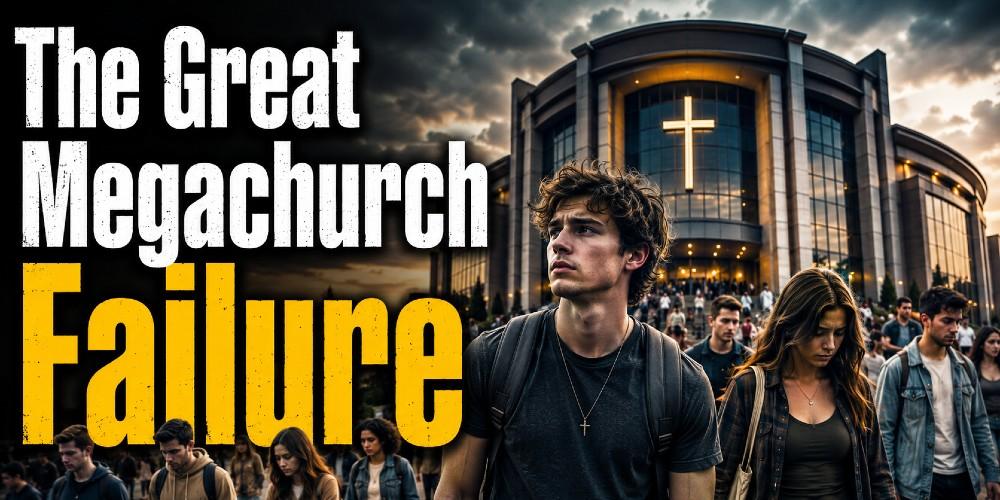

This piece argues that the seeker-friendly megachurch model won the front door but lost the long haul, and that many earnest young Christians are leaving for liturgical traditions because they want depth, history, and a faith that forms them over a lifetime.
For decades the dominant strategy in American church planting aimed to make Christianity feel less like Christianity, swapping creeds and collars for stage lighting and playlists. It scaled brilliantly by its own metrics, expanding buildings, brands, and celebrity pastors while turning worship into consumer content. That success hid a structural weakness: the model was engineered to be easy to enter, not to form people for decades of real life.
Now the predictable fallout is visible. The generation raised in that environment is not abandoning faith wholesale, they are migrating to older, weightier liturgical expressions. Latin Masses, Divine Liturgies, and prayer-book Anglican services are drawing serious seekers who want something that changes them. They are chasing a sacramental, historical Christianity that the seeker model never intended to supply.
It is tempting to dismiss these moves as aesthetic or superficial, saying people left because of incense or vestments. That misses the point. For many of these young adults the aesthetic is a symptom, not the disease. They found that the environment they were nurtured in lacked tools for suffering, theological depth, and connection to two thousand years of Christian thought.
The seeker-friendly church optimized around a single question: what will convince a skeptical neighbor to walk through our front door on Sunday? Everything else followed from that metric, from the sermon length to the soundtrack. That marketing focus produced excellent first impressions but insufficient formation for moments when life turns hard or theology becomes urgent.
So these young people went looking for answers online and discovered a vastly different story. They encountered Augustine and Aquinas, the Cappadocian Fathers, Athanasius, and the liturgical contours of worship that predate modern marketing. Instead of a tidy sermon series, they found a historical backbone that made modern consumer Christianity look thin by comparison. The gap between what they grew up with and what they found online felt like a chasm.
Bringing those discoveries back home often exposed another problem: leadership that was not equipped to engage. Youth ministers, worship leaders, and senior pastors frequently lacked a durable grasp of church history, sacraments, or the theological debates that shaped the faith. A young person armed with months of reading could out-argue the leadership not because of brilliance, but because the leaders had been left unarmed by an institutional design that prioritized attraction over discipleship.
This is not primarily the convert’s failure. It is a failure of a model that never intended to do deep formation. The Reformers themselves did not found an entertainment-driven Sunday product, they built churches centered on preaching, catechesis, sacramental life, and a sense of continuity with the past. Modern American evangelicalism, in many places, inherited a thin, commercial echo of that tradition with the load-bearing structures removed.
When a serious young Christian looks at an average church and says the Reformation failed, they are often misreading the target. They are reacting to a domesticated, revival-driven version of Protestantism that has been shaped by pragmatism and marketing, not to the theological achievements of the Reformers. That distinction matters because the core convictions of the Reformation remain theologically significant.
So what needs to change? Start with preaching the whole counsel of Scripture, including the hard texts pastors sometimes avoid. If a pulpit shies away from difficult passages, it has already lost a key chance to form people for real life. Depth in preaching signals that the congregation is serious about being shaped by Scripture, not just entertained by application.
Sing old songs that have carried doctrine through generations, because hymnody is catechesis set to music. Singing “A Mighty Fortress Is Our God”, “Holy, Holy, Holy”, and “When I Survey the Wondrous Cross” repeatedly embeds a theology that short-lived contemporary tracks rarely do. That is not about nostalgia, it is about using time-tested tools to teach what Christians believe.
Restore a serious view of the Lord’s Supper. Whatever a church’s specific theology about the table, treating communion like casual snack time concedes ground that scripture and history warn against. Paul’s rebuke in 1 Corinthians about abusing the table should be taken as a sobriety check on how churches handle this central practice.
Recover real catechesis, not a one-off membership class. Long-term, multi-year formation that uses the riches of Protestant confessionals and catechisms will train members in what Christians have always believed and why. There is a library of historic material ready to be used, from the Heidelberg Catechism to the Westminster Standards, and these resources can rebuild a strong doctrinal spine.
Read the church fathers. Protestants especially should engage Augustine, Athanasius, and others who wrestled with Scripture closer to the apostles than we do. Letting the fathers be part of the conversation equips congregations to answer historical claims without ceding the past to other traditions.
Teach church history with seriousness. Too many churchgoers cannot place key councils and controversies on a timeline, while seekers who leave often can. That asymmetry matters because history is an argument and if you do not teach it, you give the argument away.
This is not a call to mimic Rome or import surface liturgy as a marketing angle. Shallow copycat aesthetics fail when doctrine is absent. The work needed is slower, less glamorous, and less measurable by attendance charts, but it is the work that can keep serious young people in Protestant congregations that are actually serious about forming disciples.
The question facing local churches is practical and immediate: will leaders trade short-term growth metrics for long-term depth? The future of a robust Protestant witness in America depends on congregations willing to invest in formation, catechesis, doctrinal teaching, and worship that endures beyond the front door.





You must be logged in to post a comment Login