
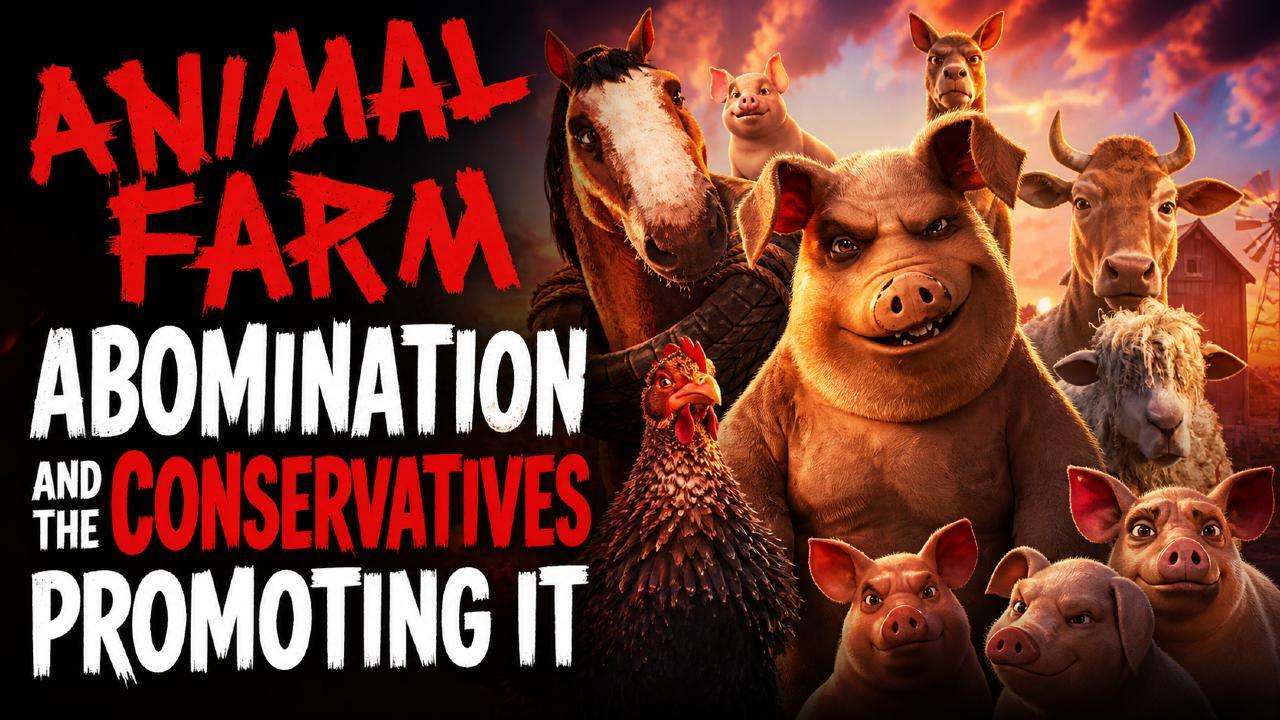

Angel Studios has released an animated Animal Farm, but conservatives should pause before buying a ticket; a far better, cost-free option is to read Orwell’s novella with your kids and use the book as a tool to teach the real lesson about power and corruption. The film recasts the story as a struggle ruined by outside capitalism instead of showing the revolution eating itself, and that change matters. This piece explains why the adaptation is an inversion, why the book still serves as the superior civic lesson, and why conservative influencers who promoted the movie deserve scrutiny.
George Orwell’s Animal Farm was a focused, brutal diagnosis of how revolutions can become the thing they once opposed, not a parable about capitalists wrecking good intentions. The book’s power comes from its refusal to offer a tidy, hopeful fix, and from the image of pigs becoming indistinguishable from the farmers they overthrew. That bleak clarity is the point, not an optional mood to be softened.
Director Andy Serkis decided to change that point. As he said at Annecy, “We wanted some hope,” and the film obliges by giving the animals a successful second uprising and a new corporate-style villain named Freida Pilkington, voiced by Glenn Close, who drives something like a Tesla Cybertruck. That is not a faithful adaptation; it is a reimagining that swaps Orwell’s indictment of concentrated revolutionary power for a tale about outside corporate interference.
Swapping the thesis is not a fresh artistic take; it is an inversion that reshapes the moral entirely. Orwell’s pigs did not turn into businessmen in the original, they became the new ruling class who mirrored the old, proving the revolution’s structure contained its own corruption. Turning the moral inside out absolves the revolution and pins failure on capitalism instead, which is the opposite of the book’s argument.
Orwell’s novella tells a clear sequence. The animals overthrow the drunken Mr. Jones, set down Seven Commandments of Animalism, and celebrate equality. The smart animals, the pigs, assume leadership, and promises are gradually hollowed out as the pigs manipulate language and law to consolidate power.
Commandments are rewritten, slogans are repurposed, and loyal workers like Boxer are betrayed when they are no longer useful. The pigs move into the farmhouse, drink whiskey, sleep in beds, and eventually walk upright, until the final scene where animals cannot tell pigs from humans. That ending is the book’s moral argument; it is not a mistake to be fixed by a Hollywood rewrite.
Removing that ending removes Orwell’s point that the seizure of power carries the seeds of its own corruption, regardless of original intent. There is no incorruptible vanguard in the book, and substituting one is a categorical change. If your adaptation undoes the thesis, you no longer have Animal Farm, you have a different story wearing its clothes.
Serkis defended his version in an op-ed, claiming his characters “enthusiastically embrace capitalism” and only rebel against corruption, which misreads the target of Orwell’s satire. Orwell’s animals rebelled against a human oppressor and later became oppressors themselves; the criticism was about the pattern of power, not a plea for capitalism. Recasting the villain as a billionaire businesswoman is a political choice with predictable consequences.
One viewer on X summed up the result bluntly: “It’s 2025. And Animal Farm is a movie about communism working, and being ruined by capitalism.” That reaction captures how the film’s jokes and design choices, from slapstick Napoleon to a “laughterhouse” gag, turn a grave fable into a cartoon where the real threat is a corporation. Those are not neutral aesthetic decisions; they are narrative decisions that shift blame away from the revolution itself.
For conservative parents who want their children to learn the real lesson, the book is unbeatable. Sit down with your kids, read a chapter at a time, and stop to explain what propaganda, slogans, and co-opted language look like in practice. Those conversations develop political judgment in a way that a sanitized, feel-good cartoon cannot.
Children can handle an unhappy ending, and they benefit from it because it teaches that slogans and leaders are not shortcuts to justice. The pressure to shield kids from bleakness often backfires, leaving them unprepared to recognize real political danger. Orwell’s stark ending is a tool for developing discernment, not a cruelty to avoid.
There is also an accountability angle for conservative commentators who promoted the movie after receiving payment. Disclosure is required, but disclosure does not answer the deeper question of whether endorsing a product aligns with the principles that built your audience. An endorsement signals belief, and audiences expect consistency from voices they trust.
Sponsorships are legitimate, but they are still endorsements, and endorsements matter more in politics than they do in consumer culture. If a commentator who warns about cultural manipulation recommends a film that reframes a classic anti-collectivist story into anti-capitalist messaging, that matters to their credibility. Trust is not an infinite resource and it erodes fast when endorsements conflict with prior positions.
My husband and I got an early access screening to Animal Farm, an animated adaptation of George Orwell's novel made by Angel Studios.
Incredibly well done. They do a perfect job of reminding viewers that Marxism always has and always will fail.
In theaters May 1st!… pic.twitter.com/DvLamy02qM
— Riley Gaines (@Riley_Gaines_) April 28, 2026
People pay attention to commentators because they expect judgment, not advertising copy. When that expectation is monetized without regard to principle, audiences are the ones who lose out and the commentator’s platform degrades.
Tim Pool refused Angel Studios’ buy, arguing the film was offensive and ideologically skewed, and that refusal reflects a simple principle: some checks should not be cashed. Others accepted money and now find themselves promoting a picture that argues the opposite of what their viewers trusted them to say.
Angel Studios cultivated an audience by serving conservative and Christian viewers who felt ignored by Hollywood, so choosing to distribute this adaptation is a decision the studio owns. Distribution is not neutral; putting the logo and marketing muscle behind this project signals an alignment or at least a tolerance for its altered message. Releasing the film around May Day amplifies the problem because timing is part of how politics communicates.
Skip the theater and read the novella instead, preferably with your children. Let them sit with a hard ending that refuses to soften the truth, and teach them to notice when the pigs begin walking. That kind of civic formation beats any animated gloss and serves a conservatism that prizes clear-eyed judgment about power.




You must be logged in to post a comment Login