
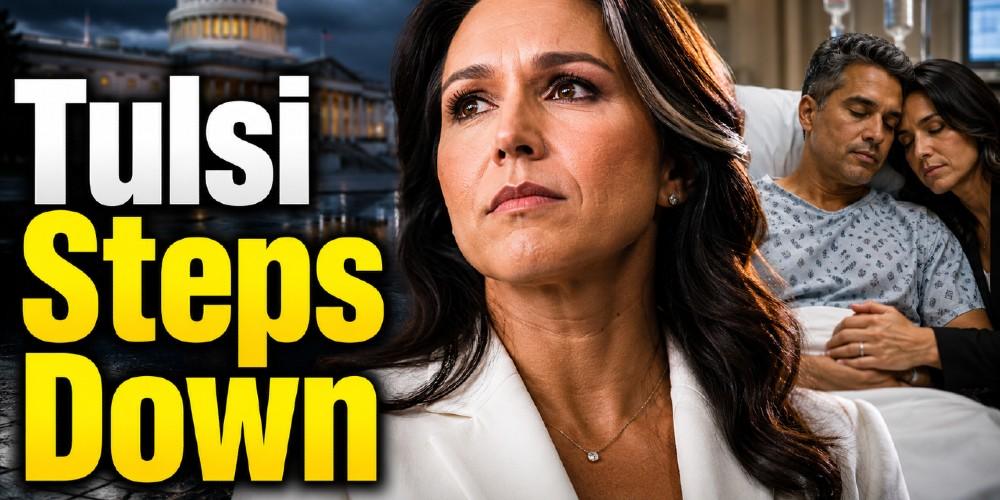

Tulsi Gabbard has announced she will step down as Director of National Intelligence effective June 30, 2026, choosing to support her husband Abraham after his diagnosis with a rare bone cancer; her departure follows a tenure marked by aggressive reforms, large-scale declassification, and efforts to curb politicization inside the intelligence community.
Gabbard informed President Trump directly in the Oval Office and framed the choice as a family decision, not a political maneuver. Her resignation underscores a simple point: sometimes the demands of public office must yield to the needs of home and marriage. That tone was made personal when she called Abraham “my rock” in her message.
On substance, her time at the Office of the Director of National Intelligence shifted the balance toward accountability and thrift. She carried out workforce reductions that the office says saved hundreds of millions annually and moved quickly to remove divisive diversity, equity, and inclusion programs from the intelligence community. Those were not cosmetic moves; they aimed to reset priorities around mission, merit, and taxpayer respect.
Perhaps her most consequential action was the declassification push that released more than half a million pages of records. Those documents brought sunlight to past abuses, including the Trump-Russia probe and other long-standing controversies tied to the JFK and RFK assassinations. Transparency was treated as policy, not performance art.
Gabbard also established a Weaponization Working Group designed to detect and deter politicization across federal agencies. Under her watch, the National Counterterrorism Center and related efforts blocked over 10,000 individuals tied to narco-terrorism and added many more to watchlists. That focus on threats to public safety and national security reflected a shift away from the institutional rot that had settled into some corners of the bureaucracy.
The resignation letter itself read with restraint and gravity, avoiding theater. She wrote, “I cannot in good conscience ask him to face this fight alone while I continue in this demanding and time-consuming position,” and made clear this was a decision rooted in marital duty and shared sacrifice. The tone left little room for partisan spin and more for personal responsibility.
Expect the usual critics on the left to suggest there were other motives, pointing to prior tensions over Iran policy and other disputes within the administration. Those angles will get airtime, but the central fact remains that an officer of the government is leaving to care for a loved one. In a political culture that sometimes treats public service as a career ladder above family ties, this choice reads differently to many voters.
President Trump accepted the resignation with understanding, a small but telling detail about how the administration views service and sacrifice. Public life extracts a cost and this administration signaled it would not make the personal unnecessary. Stepping down in order to stand beside a spouse battling cancer is presented here as an act of strength, not retreat.
Gabbard’s trajectory — from Democratic congresswoman to a Republican-appointed intelligence chief — defied easy labels and made her an object of both praise and suspicion. She repeatedly challenged party orthodoxies on foreign policy and surveillance, which won her respect from rank-and-file conservatives even as it provoked skepticism from the left. Her appointment and actions showed a willingness to put reform over partisan comfort.
She framed marriage as a covenant that asks for reciprocal sacrifice and invoked faith in observing that commitments at home matter as much as those in public life. As Scripture puts it, “For this cause shall a man leave his father and mother, and shall be joined unto his wife, and they two shall be one flesh” (Matthew 19:5). That passage was offered not as sermonizing but as the moral backdrop to a decision grounded in family duty.
Gabbard has pledged a smooth transition and emphasized continuity for critical programs she set in motion. The intelligence community now faces the task of sustaining reforms while filling a leadership gap, and the administration must decide how to carry forward the declassification and anti-politicization agenda. Her choice to step back at this moment puts a spotlight on the personal costs of public service and on the trade-offs leaders sometimes make between career and kin.





You must be logged in to post a comment Login