
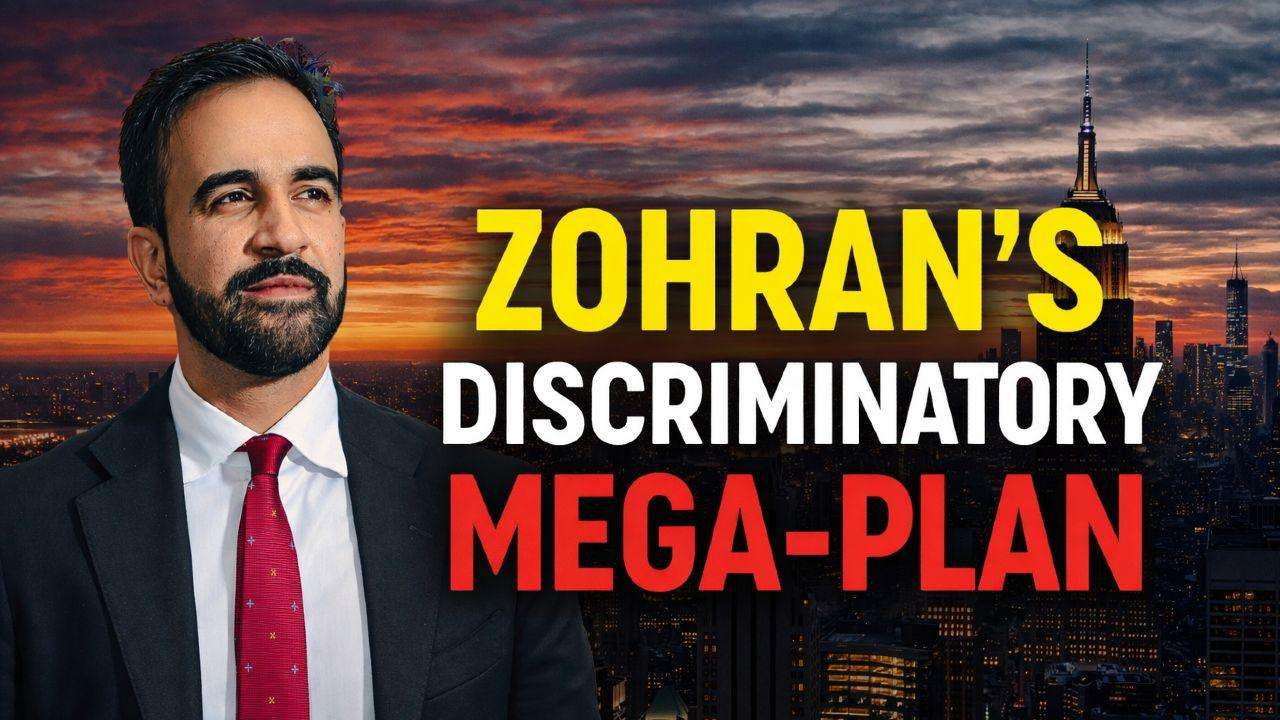

New York’s new mayor rolled out a citywide racial equity plan that ties every policy choice to race, and the Department of Justice immediately flagged it as potentially unlawful; this piece breaks down the plan’s scope, the legal risks, the political framing that links affordability to race, the moral objections, and the real-world tradeoffs for a city facing a huge budget gap and public safety concerns.
Zohran Mamdani announced a sprawling agenda that forces every major agency to adopt a racial equity lens, and the rollout was theatrical — cameras, a college stage, and a promise of sweeping change. The plan’s backbone is explicit: decisions, budgets, and programs must be evaluated by race, not simply by need or outcome. That makes it a political manifesto as much as a policy document.
The mechanics are massive and bureaucratic: hundreds of agency goals, thousands of strategies and indicators, anti-racism training, race-calibrated hiring and pay adjustments, and a new data apparatus to measure outcomes by demographic group. The city has budgeted $10.2 million a year for the new racial equity apparatus, a 42 percent increase at a time the city faces a projected $5.4 billion shortfall. At the same time, the mayor is proposing a cut of 5,000 officers from the NYPD, signaling a clear set of priorities to residents.
Those priorities are presented as moral and beyond debate, but the choice is political and legal. The plan does not offer trade-offs or alternatives; it equates equity with justice in ways that prescribe different treatment for different groups. When government sorts benefits and burdens by race, it raises constitutional red flags no matter the intention behind it.
The legal framework is straightforward: the Fourteenth Amendment guarantees equal protection, and the Civil Rights Act bars race-based discrimination in federal programs. The Supreme Court’s recent decision in Students for Fair Admissions v. Harvard reinforced that racial classifications by public institutions must meet the highest scrutiny. Good intentions do not remove constitutional problems.
DOJ reviewers flagged the plan as potentially illegal on the day it was released, and that scrutiny matters because New York depends on billions in federal funding. The mayor’s response has been to cast federal oversight as an assault on justice, but the legal question is whether federal civil rights law forbids the kind of race-conscious programming the city plans to require. That is a neutral, enforceable standard, not a political talking point.
The political sleight-of-hand is how a citywide affordability crisis becomes a racial crisis that only race-conscious remedies can fix. The city’s True Cost of Living Measure claims 62 percent of residents do not meet a threshold for financial stability, and the mayor stated plainly: “We cannot tackle systemic racial inequity without confronting the affordability crisis head-on, and we cannot solve the cost-of-living crisis without dismantling systemic racial inequity.” That pivot turns a broadly shared hardship into the justification for a race-focused administrative overhaul.
Framing most New Yorkers’ struggles primarily as the product of systemic racial inequity lets the plan avoid examining decades of local policy: zoning that constrains housing supply, heavy regulation that raises costs for small businesses, tax structures that drive people out, and public safety choices that affect quality of life. Those structural drivers cut across race and geography, and they demand structural fixes rather than a 600-indicator audit that reorganizes agency priorities around group identity.
There is also a moral argument rooted in the tradition of impartial justice. The Scriptures are unambiguous that God “is no respecter of persons” (Acts 10:34). “Ye shall do no unrighteousness in judgment,” Leviticus 19:15 commands. The case against government that privileges groups is not merely legal; it is rooted in the idea that justice should treat individuals equally, not sort them into competing categories for administrative attention.
History shows mixed results from race-conscious programs, with trade-offs in cost, efficiency, and public trust. Decades of affirmative action experiments, set-asides, and diversity mandates have not delivered unambiguous, durable gains that justify sweeping new bureaucracies. New York itself, after years of progressive governance, still faces an affordability crisis that a new equity office is unlikely to fix.
Beyond performance, the plan risks corrosive social consequences: sorting citizens primarily by race corrodes civic unity and breeds resentment across communities. A government that privileges group identity in allocating attention and resources teaches people to see themselves through group labels rather than as equal citizens. That is a dangerous civic lesson for a diverse, crowded city already strained by budget shortfalls and public safety concerns.
Politically, the move is savvy: frame a problem as moral, propose solutions that expand administrative reach, and label critics as opponents of justice. That rhetorical strategy can insulate policy from scrutiny, but citizens should ask a simple question the administration has not answered: will these measures actually help people who struggle in this city, and are racial audits the best use of scarce dollars when public safety and basic services are under pressure?




You must be logged in to post a comment Login