
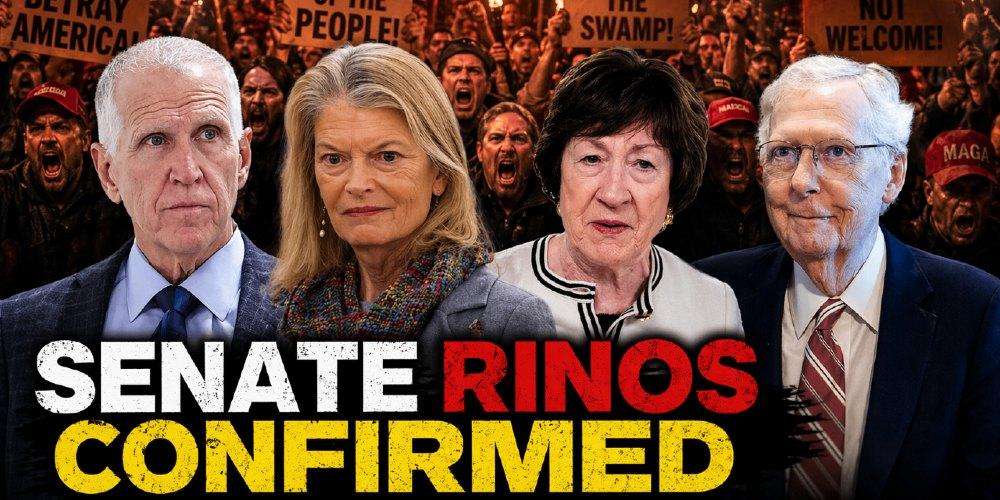

This piece calls out four Senate Republicans who voted with Democrats to block Sen. John Kennedy’s push to attach the SAVE America Act to immigration enforcement funding, explains what the amendment would have done, and argues why that vote matters to conservative voters and the president. It breaks down the political maneuvering that protected these senators from exposure, compares the proposal to ordinary election practices abroad, and highlights the consequences for party unity and accountability. The tone is pointed and plain: voters deserve to know who stands with them on basic election integrity and who does not.
Early Thursday, Sens. Thom Tillis, Lisa Murkowski, Susan Collins, and Mitch McConnell joined every Senate Democrat to defeat an amendment that would have forced the Rules Committee to draft a version of the SAVE America Act. The tally read 48 to 50, and anyone paying attention knew those four names before the vote began. That is not coincidence; it is pattern and protection at work inside the Senate majority.
Kennedy’s proposal would have required proof of citizenship to register and vote in federal contests, limited voting to Election Day, required ballots to be tallied within 36 hours, and capped implementation spending at $10 billion. Those are straightforward rules aimed at making elections verifiable and timely, changes most Americans support in polls when asked plainly. Instead of debating those points on the merits, the Senate ended up protecting a handful of senators from hard votes.
Majority Leader John Thune spent weeks rearranging floor plans to avoid forcing these senators into a recorded choice on a flashpoint issue. That kind of management looks less like leadership and more like damage control. When a majority refuses to use its numbers to advance a clear conservative priority, voters get the message loud and clear: rhetoric matters more than results.
Look past the procedure and the substance is simple. The vote opposed requiring citizenship verification to participate in federal elections, effectively choosing process over the clear preference of many Americans for secure rolls. This is not a tiny technicality; it is a basic question about who gets to pick our leaders. Refusing to require proof of eligibility is a stance on the meaning of self-government.
Other democratic nations treat basic voter identification as routine administrative hygiene. Mexico, for example, uses photo IDs and biometric markers; France requires national ID; many European countries insist on official identification before a ballot is issued. Those arrangements don’t weaken democracy, they protect it—and treating security measures as extremist in America is an odd inversion of common sense.
I respect everybody in this body, everybody. If you vote against this bill, I’m not going to say a word. And I’m sure as hell not going to go on social media and call you an ignorant slut. That’s not the way I roll, unless I’m pushed too far.
Democratic Sen. Alex Padilla dismissed the amendment as “a solution in search of a problem,” the familiar dismissive response from the left whenever election safeguards are proposed. That reflex matters because it exposes a double standard: when questions about election integrity help Democrats, the system is sacrosanct; when they hurt Democrats, the system suddenly needs reform. Voters deserve consistency, not partisan cover stories.
President Trump has drawn a line in the sand, saying he will not sign other bills until the SAVE America Act reaches his desk and rejecting watered-down versions. That pledge turns these four senators’ votes into more than a policy disagreement—they are now blocking the agenda of the president their party nominated and who remains a central force in conservative politics. Party cohesion requires more than branding; it needs action when it counts.
McConnell’s vote is especially striking because, as chair of the Rules Committee, he would have overseen the drafting of the legislation had the amendment passed. Voting against a directive that would empower his own committee raises questions about motive and priorities. Whether it is caution, calculation, or the comforts of seniority, Kentucky voters deserve to weigh that decision in the next cycle.
The practical outcome is that immigration funding will likely move forward while the SAVE America Act stalls, not because of Democratic opposition but because a handful of Republicans refused to stand with it. This pattern of protecting certain senators from accountability has become an organizing principle for the caucus, and conservative priorities are the routine casualty. The names are familiar now; the question for voters is whether familiarity will translate into action at the ballot box or in the primary.




You must be logged in to post a comment Login