
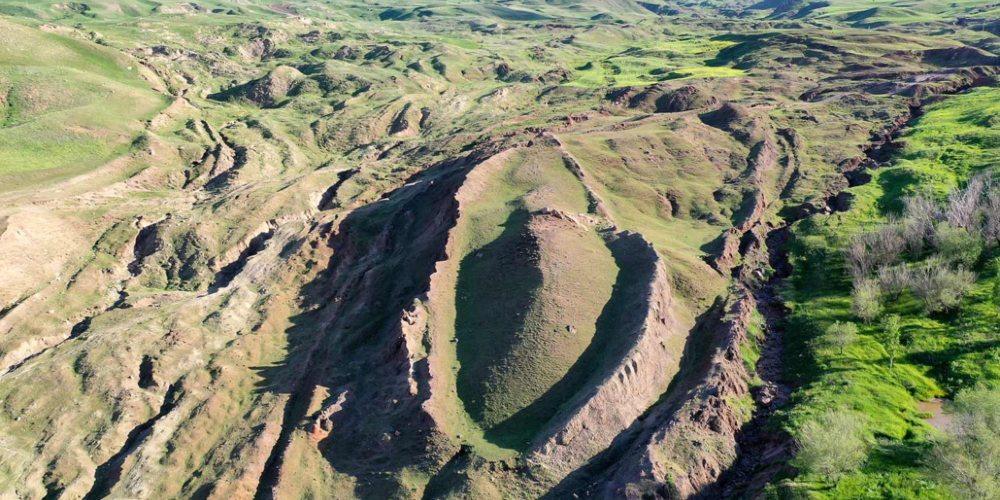

The Durupınar Formation in eastern Turkey is back in the spotlight after a new team used modern scanning tools and soil tests to probe a boat-shaped mound south of Mount Ararat, sparking renewed debate about whether it might be Noah’s Ark. The report covers the scanning results, comparisons to biblical dimensions, geological counterarguments, and a planned, university-backed excavation that promises more rigorous study. This piece lays out the facts, the claims, and the reasons for cautious interest without pretending the question is settled.
Aerial observers first noticed the unusual shape in 1959, and amateur investigators promoted the site for decades after that. What’s different now is the suite of technologies researchers are applying, including ground-penetrating radar, thermography, resistivity imaging, and targeted soil sampling. Those modern methods can reveal subsurface patterns that look very different from simple rock outcrops.
The lead team reports seeing features beneath the surface that they interpret as corridors, angular voids, and a large central tunnel, and they link these observations to the formation’s overall boatlike outline. “This is not what you would anticipate finding if the site were merely a solid block of rock or the result of random mudflow debris,” Jones told CBN. “However, it is precisely what you would expect to discover if this were a constructed boat, consistent with the biblical specifications for Noah’s Ark.”
Soil testing returned traces of clay-like compounds, marine sediments, and shell fragments at multiple locations, with radiometric dates from roughly 3,500 to 5,000 years ago. Those findings are intriguing because they suggest marine influence and ancient disturbance in a location far from today’s shoreline. Still, such materials alone cannot prove human construction or a specific historical event.
The formation’s measured length is often compared to the ark dimensions in Genesis, which translate to a vessel roughly 450 feet long in modern measurements. The visible mound is in the same ballpark at about 515 feet, and some researchers argue the apparent extra width could result from centuries of collapse and soil movement. Analogies to ship burials like Sutton Hoo are offered to explain how a wooden hull could leave only a chemical and structural imprint in the ground.
Skeptics have pushed back on both method and interpretation, and some objections come from within communities predisposed to believe in a global flood. Geologist Dr. Andrew Snelling raises two main problems: the site sits on the valley floor rather than a mountain crest, and Mount Ararat is a volcano that has had geologically recent activity. “By his own admission,” Snelling observes of Jones, the researcher “was convinced of what this site likely was before viewing the results.”
Independent academic work has raised a strong geological case that the Durupınar feature is a slumped block of Miocene limestone moved down the valley by glacial or periglacial processes. Jointing, layering, and dissolution in limestone can create linear caves and voids that look artificial to non-specialists. A ceramics find nearby indicates human activity in the region between about 3000 and 5500 BC, but that does not equate to archaeological proof of an ark.
The planned excavation is the first formally sanctioned dig at this exact spot and involves Turkish universities and a preservation plan drafted in advance. Researchers say they will begin with non-destructive core drilling across multiple points before any open excavation, and they insist preservation and transparency are priorities. “Only after we gather enough evidence and have a proper preservation plan in place will we consider excavating.”
Confirmation bias is a real danger in every discipline, and archaeology is no exception; preconceived beliefs can shape how specialists read ambiguous data. Both believers and skeptics will need to watch the methodology as closely as the headlines to judge whether conclusions follow from evidence. Rigorous peer review, open data, and reproducible methods are the clearest path to turning provocative scans into accepted science.
For people of faith, the stakes feel personal, but the absence of physical proof would not undermine religious claims about the Flood any more than a single artifact would prove doctrine. The writer of Hebrews put it this way: “Now faith is the substance of things hoped for, the evidence of things not seen.” Archaeology can illuminate context and history, but it does not settle matters of belief.
The Durupınar Formation may be an unusually shaped natural block, or it may hide evidence that changes how we think about ancient events. Either outcome matters: a null result would refine geological understanding, and a substantiated human-made structure would be a major archaeological discovery. The coming fieldwork, if conducted openly and with sound methods, promises to move the conversation from speculation to testable results.






You must be logged in to post a comment Login