
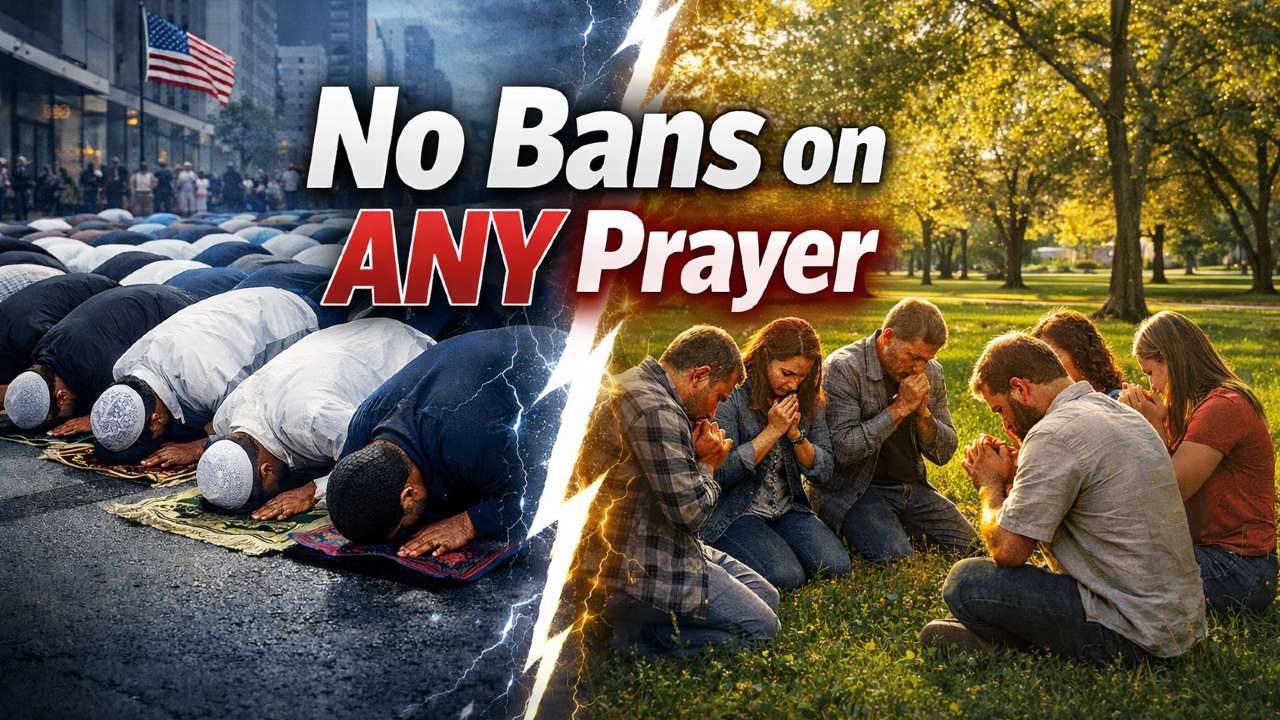

This piece argues against a government ban on Muslim public prayer, defends the First Amendment, and proposes a Republican, constitutionally grounded response: enforce existing public-order laws equally, separate Sharia as a legal concern from protected worship, and challenge Christians to reclaim the public square through visible faith and civic engagement rather than seeking state suppression of others.
There is a raw, understandable fear driving calls to ban Muslim street prayer, and conservatives should not pretend that anxiety does not exist. We see visible acts of public worship that feel like cultural claims, and those acts can be jarring to communities unused to them. But fear does not justify empowering government to outlaw religious practice.
The surface argument for a ban looks tidy: stop public prayers and keep your public spaces neutral. That logic, however, trades short-term political theater for long-term constitutional decay. If conservatives cede principle in the name of toughness, they hand opponents a tool that will be used against them when power shifts.
The First Amendment is plain and unforgiving: “Congress shall make no law respecting an establishment of religion, or prohibiting the free exercise thereof.” That protection does not come with an asterisk depending on popularity or comfort. Republican principles include standing by the Constitution even when enforcement benefits rivals.
If you give government authority to ban the public exercise of one faith, you create precedent that any government can use to ban another. Courts and political majorities turn over; the machinery of suppression does not retire when you think it has served your side. Conservatives should be skeptical of laws that look effective only until the next election cycle.
There is a meaningful distinction between enforcing public-order rules and outlawing religious exercise. Blocking highways or blasting amplified sound at 3 a.m. are nuisance problems that local ordinances already address. Apply those rules uniformly and don’t design laws that single out a faith for special punishment.
Some of the street-prayer controversy is about signaling rather than sacred obligation. Critics point out that certain public prayers in Western cities serve as a visible claim, and even within Muslim communities many leaders advise against praying where people gather. Terms used by observers like “a well-studied act of religious propaganda,” and descriptions of the practice as “a divisive issue even among Muslims,” capture that political element.
The amplified call to prayer invites sensible regulation on noise and timing just as church bells and secular concerts can be regulated. Treating loudspeakers as a public nuisance when they violate hours or volume standards is a legitimate, neutral response. That approach solves nuisance problems while preserving religious liberty.
Sharia as a legal system is a separate and legitimate concern for lawmakers. It is reasonable to insist American courts apply American law and to bar foreign religious legal codes from overriding constitutional guarantees. That line of action defends republican governance without criminalizing prayer or religious devotion.
Conflating Sharia with someone’s right to pray in a park is a category error that produces bad policy. One deals with competing legal frameworks and governance; the other deals with conscience and worship. Republican governance should protect the rule of law while protecting the free exercise of religion.
Europe’s experiments show the risks of heavy-handed state bans on religious expression. France’s 2011 prohibition on street prayer did not erase the phenomenon but gave organizers a persecution narrative and pushed practice underground. History warns that government bans often strengthen identity politics rather than resolve cultural tensions.
The best conservative response is threefold and practical. First, enforce existing laws evenly: traffic, assembly, and noise codes apply to everyone and should be used where applicable. Second, codify that American courts will not apply foreign religious law as a substitute for our legal system. Third, Christians should return to public life with confident witness, visible charity, and civic engagement rather than asking the state to silence others.
Public life is won by presence and persuasion, not by delegating censorship to the state. Scripture calls believers into the public square, and a robust Republican defense of liberty means protecting that right for everyone. Tear down the First Amendment for one, and you tear it down for all.




You must be logged in to post a comment Login