
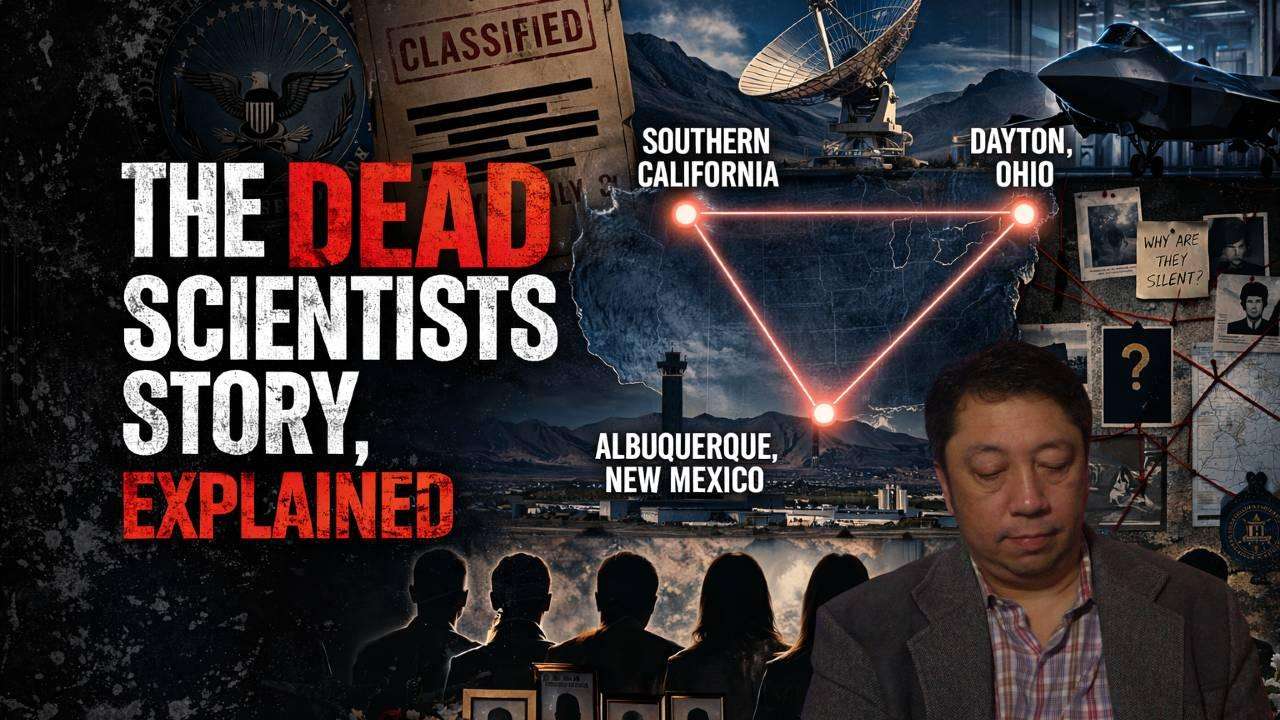

A string of unexplained deaths and disappearances among scientists and defense-connected staff clustered around three U.S. research hubs has raised serious questions about transparency, institutional silence, and whether Congress and law enforcement can get straight answers. The pattern touches Southern California, Albuquerque, and Dayton, with federal investigators involved and alarmed lawmakers pressing for more information. This article lays out the known facts, the odd commonalities, and why the public should demand accountability.
Southern California, Albuquerque, and Dayton form a clear geographic triangle where some of America’s most sensitive aerospace and defense work happens. JPL and Caltech anchor the western node, Kirtland Air Force Base and Sandia sit in New Mexico, and Wright-Patterson Air Force Base has long been the hub in Ohio. Those locations are not random when you look at the people affected.
Since July 2024, at least nine scientists, engineers, and defense-related employees linked to those centers have died under unexplained circumstances, disappeared, or been murdered. The FBI has been pulled in and members of Congress are raising alarms, yet the institutions that employed these people have often issued the bare minimum in public statements. That silence stands out as much as the incidents themselves.
Monica Jacinto Reza, an aerospace engineer at NASA and a co-inventor of heat-resistant nickel superalloys for rocket engines, vanished on June 22, 2025 while hiking in the Angeles National Forest. Search teams recovered only a beanie and lip balm after days of helicopters, drones, and dogs, and her body was never found. The lack of closure around her disappearance still gnaws at colleagues and family.
Four days later, administrative assistant Melissa Casias of Los Alamos National Laboratory was last seen walking alone on Highway 518 near Talpa, New Mexico. Her disappearance added to a mounting list of unresolved cases with connections to defense facilities. Each missing person raised new questions about whether these were isolated tragedies or part of a troubling pattern.
Carl Grillmair, a long-time astrophysicist at Caltech’s Infrared Processing and Analysis Center, was shot dead on his Llano front porch on February 16, 2026. Grillmair had spent decades validating data pipelines that help detect asteroids and protect the planet, work that sits squarely in the national interest. Caltech’s public note described him as having “passed away suddenly” without using the word shot, a choice that many observers found oddly diplomatic.
Retired Major General William Neil McCasland, who once oversaw $4.4 billion in classified aerospace R&D and chaired Special Access Program oversight, disappeared from his Albuquerque home on February 27, 2026. He left his phone and glasses but walked out with his wallet, boots, and a .38 revolver, then never returned. That sequence of choices has fueled intense curiosity in Washington and among those who understood the programs he supervised.
Nuno Loureiro, director of MIT’s Plasma Science and Fusion Center, was fatally shot at his Brookline, Massachusetts home on December 15, 2025, in an incident later linked to a suspect with prior violence. And Jason Thomas, an assistant director at Novartis with active Department of Defense contracts, went missing on December 13, 2025 and was located in a Massachusetts lake on March 17, 2026. Taken together, these cases span disciplines from fusion to biomedical work with defense ties.
Some of the incidents carry plausible nonconspiratorial explanations. Investigators determined the October 2025 deaths at Wright-Patterson involved a murder-suicide captured on security footage, and certain shootings have identifiable suspects. Reasonable analysts rightly warn against leaping to a grand coordinated plot when ordinary criminal acts or tragic accidents can account for some events.
Still, coincidence becomes a less convincing answer when you map who these people worked for and how institutions responded. The Sentinel Network documented institutional linkages through patents, contract databases, and federal records that tie these individuals into a coherent professional network. When agencies default to minimal disclosure, it fuels suspicion more than it soothes it.
Members of Congress have started to press for clarity. Representative Eric Burlison asked for FBI involvement and called McCasland’s disappearance “deeply concerning.” Representative Tim Burchett told podcaster Benny Johnson that “something dark is going on,” and said, “I know these scientists and researchers. They have testified. We’ve got to get to the bottom of it. It’s just too much, too much is going on right now — and by the way, I’m not suicidal.” Those words reflect raw political unease and a demand for answers from a Republican perspective that prioritizes oversight.
The central question is straightforward: can the government and the institutions that run the nation’s most sensitive programs provide a full, transparent accounting of what has happened to these people? Confidence in national security institutions depends on the public’s belief that lives tied to classified work are protected and that misfortune will be honestly investigated. Americans deserve clear explanations, not opaque statements and silence.



You must be logged in to post a comment Login