
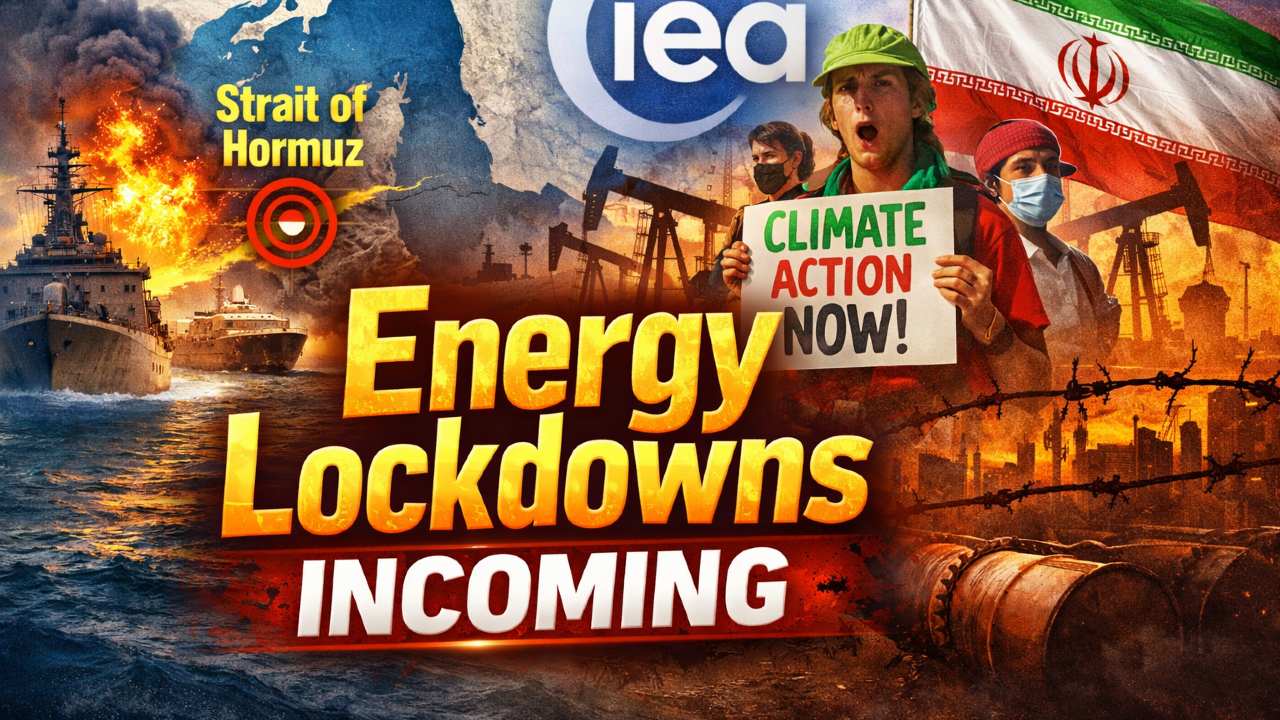

The Strait of Hormuz shutdown has forced the International Energy Agency to push a ten-point demand-reduction plan that reads eerily like old climate prescriptions, and this piece argues why that resemblance matters for energy policy, national security, and ordinary Americans. It points out the scale of the disruption, the immediate economic pain across multiple countries, the political irony of green-style mandates being offered as emergency measures, and the case for domestic energy production as the practical answer. The tone is plain and unapologetic: energy abundance is a strategic necessity, not an ideological luxury.
What we’re witnessing is not a drill. The conflict that began on February 28, 2026, has effectively shut the Strait of Hormuz and choked roughly twenty percent of global oil flows. The IEA called it, without qualification, “the largest supply disruption in the history of the global oil market.” Markets reacted fast, and people felt the consequences in kitchens, factories, and on the road.
The IEA’s ten-point emergency list, labeled with bureaucratic calm as “Sheltering From Oil Shocks,” tells governments to work from home, reduce highway speeds, alternate private-car access, expand public transit, and avoid air travel when possible. Social media has predictably nicknamed it “Lockdown 2.0.” When the agency talks about using “regulations and mandates.” to enforce these steps, it reveals the blurred line between emergency management and permanent control.
That blur is the point. For years the same institutions pushed identical behavior changes in the name of climate policy: drive less, fly less, abandon gas stoves. Those proposals met resistance because citizens value mobility and independence, not because they are ignorant of emissions math. Now the same outcomes are being pursued due to supply shortages rather than ideology, and the lived result for most people is the same: less freedom, less abundance, and more dependence on top-down allocation.
Emergency reserves were tapped. The IEA and its members coordinated a historic release of 400 million barrels, with the United States providing 172 million from its Strategic Petroleum Reserve. Those reserves are a bridge, not a fix, as experts remind us, and traders kept prices elevated because the arithmetic of lost barrels is brutal and simple.
Across Asia and beyond the human consequences mounted quickly. Factories closed, fertilizer production paused, and essential goods became scarce or more expensive. In India and Bangladesh, shutdowns threaten livelihoods and food security. In Australia and elsewhere, petrol stations ran dry and regulators relaxed standards to keep fuel flowing, a choice that would have been politically implausible under ordinary peacetime activism.
The crisis exposes a blunt truth energy realists have long made: energy underpins everything. When fuel flows stop, supply chains, manufacturing, and food distribution wobble. This is not a theoretical debate about carbon curves. It is about physical goods, heat, and transport that keep people fed and employed.
Those who cheered restrictions on drilling, pipelines, and domestic production must reckon with the strategic cost. The United States is relatively insulated because of its recent push for energy independence, policies championed under Republican leadership and criticized by the progressive establishment. That insulation is a policy outcome, not luck.
Every blocked permit and canceled pipeline narrowed national options. Countries that built energy policy around import dependence are now paying the price. When leaders substituted virtue signaling for capacity building, they gambled with their citizens’ welfare, and the ante just got called.
The economic stakes are not abstract. BlackRock’s chief warned that oil at $150 a barrel could trigger a steep recession. A full and prolonged closure of the strait would be more than a recession. It would be a shock to the real economy that shrinks production, increases hunger risk, and removes discretionary spending that sustains small businesses.
Calling these emergency measures wise is not the same as embracing them as a permanent program. In a true shortage, demand curbs make arithmetic sense. The problem is when such curbs are normalized and repackaged as progress. Americans should resist any drift from temporary crisis management toward permanent lifestyle mandates imposed in the name of an agenda that failed to convince people voluntarily.
There is a moral dimension, too. As Larry Fink has warned, “rising energy prices is a very regressive tax.” When fuel costs spike, the wealthy adapt and the poor suffer most. Policy that shrinks energy abundance is, in practice, a tax on the vulnerable and a transfer of hardship downward.
Productive capacity matters. As the Book of Proverbs says, “Where no oxen are, the crib is clean: but much increase is by the strength of the ox” (Proverbs 14:4). Energy is the ox of modern life. Without it, the crib is empty and the economy stops producing.
The political choice ahead is straightforward. Americans can double down on domestic production, pipelines, and practical energy security, or they can accept a future where shortages dictate behavior and elites justify it as inevitable. The strategic lesson of this moment is clear: abundance, not austerity, preserves freedom and prosperity.





You must be logged in to post a comment Login