
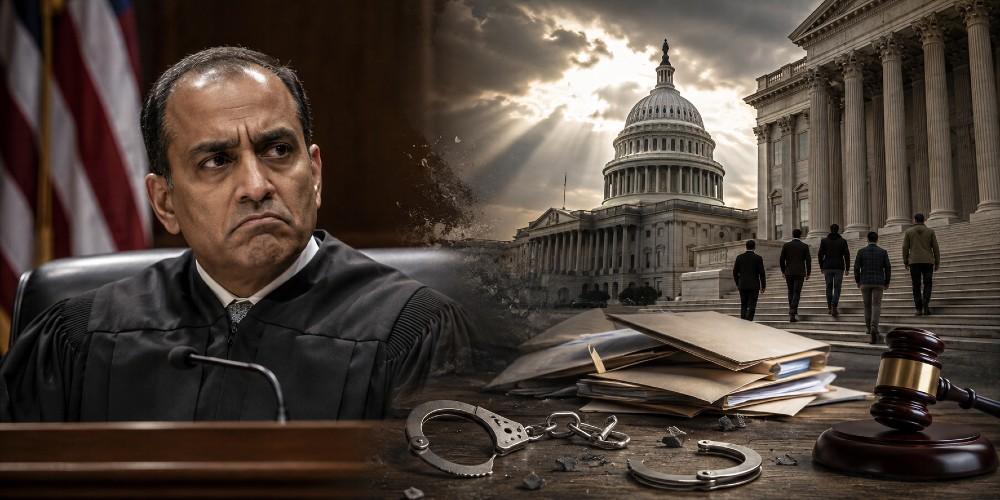

The last big January 6 prosecutions were wiped away when a federal judge granted the Justice Department’s motion to dismiss seditious conspiracy charges against Stewart Rhodes and several Oath Keepers, and that decision has exposed a wider story about prosecutorial power, presidential clemency, and political double standards in how protests are treated.
Judge Amit Mehta signed an order dismissing the superseding indictment after higher court action and the Justice Department’s request left him no legal option but to comply. His written reaction made clear he saw the dismissal as a moral loss, saying it watered down the seriousness of January 6 and overlooked the sacrifices of law enforcement. Still, the paperwork is final and the convictions no longer stand.
For years the case against the Oath Keepers was presented as proof of an attempted overthrow, with media and politicians treating convictions as vindication. Those trials resulted in prison terms that were hailed by many as necessary to protect democracy. Yet the broader context reveals a justice system that applied very different standards when violence occurred on other occasions.
President Trump’s clemency move changed the legal landscape and forced a reckoning. The executive branch, exercising its authority, pardoned or commuted the sentences of most people charged in connection with January 6 and directed a path toward dismissals. When prosecutors reopened the matter in court they framed their actions as consistent with that directive and with prosecutorial discretion, not as a concession that the evidence was weak.
The D.C. Circuit’s vacatur of convictions left the district judge bound to follow procedure, even as he lamented the result. Judges do not get to force the executive branch to keep pursuing cases that the President has effectively ended. Mehta’s words criticized the outcome, but his signature made it official: the defendants’ records are cleared and the formal chapter is over.
Defense lawyers argued something deeper was at play, describing the seditious conspiracy charge as a test of how far prosecutors can stretch old statutes to capture modern political dissent. Those defendants were described more as protestors and veterans than as shadowy plotters. The line between political disagreement and criminality is supposed to be carefully guarded, but in these prosecutions that line looked dangerously blurred.
That blurring was not accidental. For years many in the establishment insisted the real threat came from January 6 alone, while months of left-wing unrest in 2020 that included burned buildings and deadly outcomes received a very different response. That selective outrage undercuts claims that the government was being even handed, and it fuels the argument that prosecutions were political theater as much as legal action.
Scripture captures the moral twist that many see in how justice was applied: “Woe unto them that call evil good, and good evil; that put darkness for light, and light for darkness.” Those words resonate for people who watched one kind of political violence get treated as a crisis while another was minimized. The sentiment points to a deeper failure of consistent standards, not merely the fate of a handful of defendants.
Now the Oath Keepers leave federal court without a felony label and with their names cleared by the legal process that followed the President’s intervention. Critics will call the outcome unjust or troubling, and supporters will say it restores balance to an overzealous campaign of criminalization. Both sides can spin the result, but the legal facts are simple: convictions were vacated and prosecutors dismissed the charges with prejudice.
The bigger lesson is institutional. A politicized Justice Department risks weaponizing statutes to chill political speech and silence opponents, and that danger is as real when prosecutions target one side as when they aim at the other. Restoring predictable, neutral enforcement will take more than a single set of dismissals; it will require structural changes so that prosecutors and judges follow the law, not a partisan script.
Whatever one thinks of the Oath Keepers or of January 6, the episode shows why limits on prosecutorial power matter. When political questions are turned into criminal files, the consequences ripple through civic life and erode trust in institutions. The court’s order closed a chapter, but the debate over fairness, discretion, and equal treatment under the law is far from finished.



You must be logged in to post a comment Login