
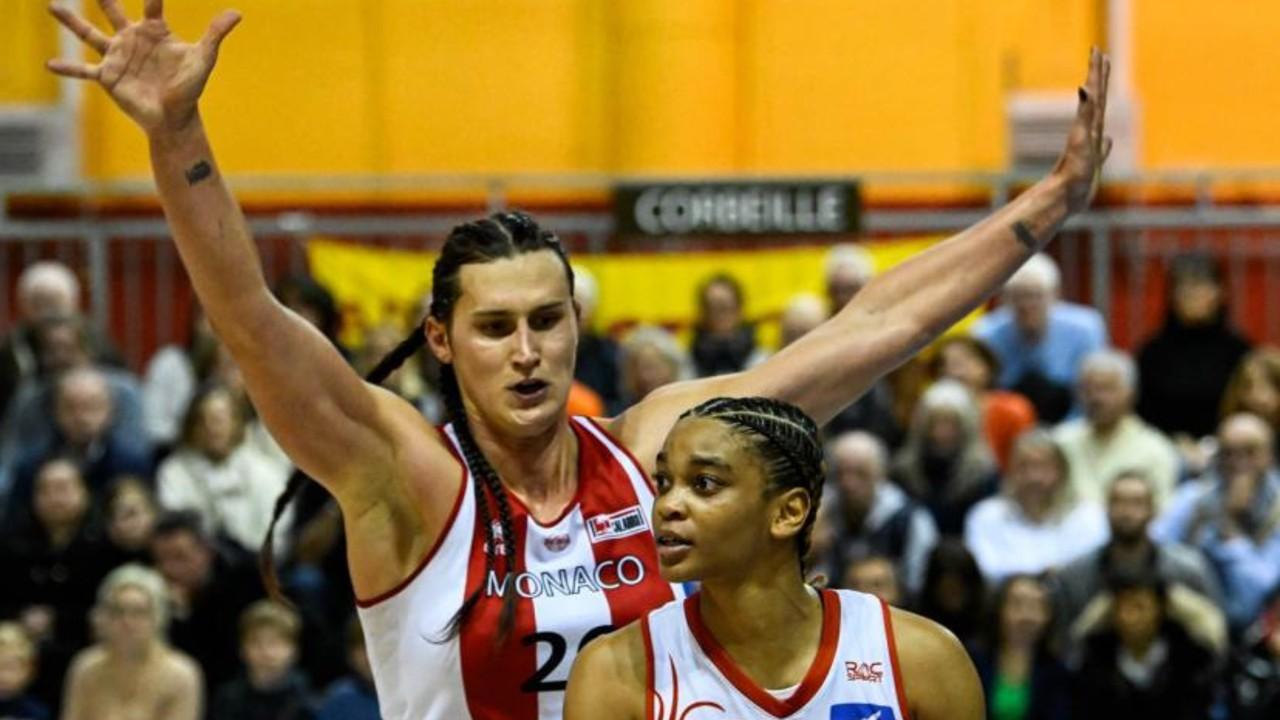

French center Julie Tétart, a 34-year-old who came out as transgender in 2021, dominated France’s second-tier women’s league and says she would entertain a WNBA offer if one arrived. She posted staggering stats and picked up multiple end-of-season honors while sparking fierce debate about fairness, inclusion, and the future of women’s sports. This piece lays out her achievements, the reactions, and the larger policy arguments that follow.
Tétart finished the 2025-26 Ligue 2 season averaging remarkable numbers, reported at 21 points and 20 rebounds per game for her Monaco club. Those numbers led the league in both categories and drew attention well beyond France. At 6-foot-3 and with a long career behind her, she suddenly found herself back in the spotlight.
League awards recognized much of her impact, with Tétart being named Player of the Year, Defensive Player of the Year, and Domestic Player of the Year. Curiously, the league did not award her MVP honors, a detail that raised eyebrows and questions about criteria and consistency. Observers noted the disconnect between the stats and the final honors list.
Advocacy groups weighed in loudly, with TRANSpire criticizing the league for allegedly overlooking dominant transgender players like Tétart and Aurore Pautou. The criticism framed the issue as one of visibility and recognition within women’s competitions. That reaction amplified the controversy and put pressure on organizers to explain their choices.
When an interviewer asked whether she would consider the WNBA, Tétart gave a cautious but clear reply: “If they contact me, I won’t say no. But you have to be realistic: I’m old, and there are far better players than me!” Those words landed in a landscape already tense about transgender participation in elite women’s leagues. She also called a WNBA career a childhood dream she had assumed was “unfortunately… not possible.”
Her follow-up about the United States was pointed and jokey, and it underlined how politics colors sports discussions. Tétart said, “The league, yes. The country, no, haha,” a line many read as a nod to the polarized climate around gender issues in America. Even light remarks like that signal how much debate there is beyond mere competition.
Despite the headline-grabbing stats and awards, reactions were swift and often hostile on social media platforms. The idea of a transgender athlete moving into the WNBA drew strong opposition from many users who argued it would undermine fairness in women’s competition. Those voices framed their response in terms of sport integrity and the need to protect opportunities for female athletes.
From a Republican standpoint, the core concern is simple and direct: fairness matters for women’s sports to survive. Allowing biological male athletes into women’s leagues raises questions about competitive balance and the protection of female athletic spaces. These are not attacks on individuals but assertions of principles many voters want defended.
League officials in the United States describe the WNBA as inclusive, which they frame as a selling point for the league’s values and brand. That description sits uneasily with critics who say inclusion must be tempered by clear, objective eligibility rules that preserve fair competition. The tension between brand messaging and competitive standards is now a public policy conversation.
Practical questions remain about testing, eligibility timelines, and how performance advantages are measured and addressed. Lawmakers and athletic commissions are already watching these debates closely, because changes in one league tend to ripple into schools and community programs. The stakes include scholarships, championship outcomes, and the future pipeline of female athletes.
Tétart’s openness to a WNBA approach, repeated plainly as “I won’t say no,” keeps this story alive and likely to resurface whenever American teams scout globally. The league and its fans face a choice: set transparent standards now or deal with repeated controversies that distract from the game. What happens next will shape how seriously the WNBA and other organizations are taken on questions of fairness and inclusion.




You must be logged in to post a comment Login