
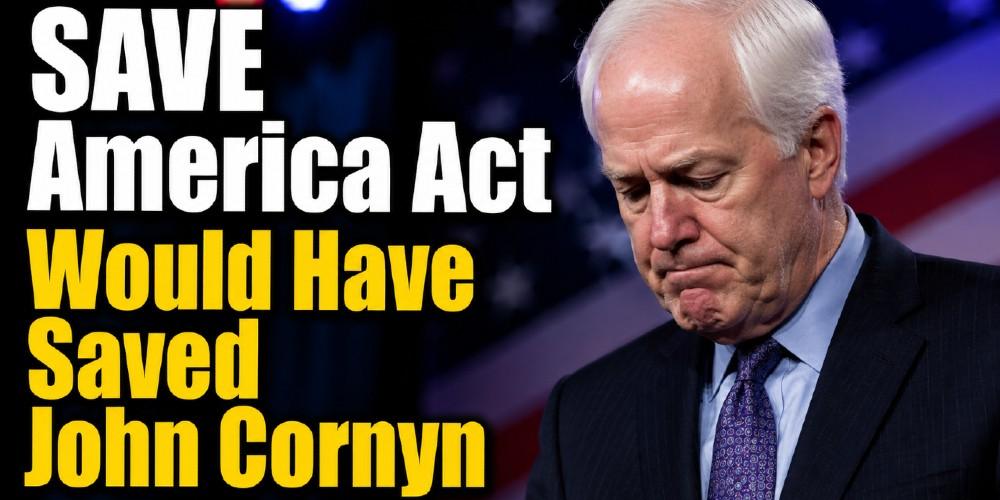

Texas voters are sending a clear message about consequences and priorities after a bruising Senate primary fight that exposed a failure of Republican leadership to act when it mattered most. This piece looks at how a single legislative choice, the SAVE America Act, and a leadership unwilling to use real leverage turned a likely Cornyn victory into a rescue for Ken Paxton. It explains the political mechanics of the challenge, the ultimatums that followed, and why the Senate conference’s reverence for process cost them a senior incumbent. The story is less about personalities and more about a party that must choose between preserving procedure and delivering results for its voters.
John Cornyn’s campaign collapsed not because voters suddenly hate establishment figures, but because Senate leaders refused to make the fight that would have secured him a Trump endorsement. The key was the Safeguard American Voter Eligibility Act, the SAVE America Act, which would require documentary proof of citizenship for federal voter registration. The House passed it twice and President Trump called it his “No. 1 priority.” That should have been enough to rally the conference, but it wasn’t.
- Cornyn led the March 3 primary 42 percent to 40.5 percent, and Trump was reportedly prepared to endorse him within days.
- On March 5, Paxton publicly offered to drop out of the race if Senate leadership ended the filibuster and passed the SAVE America Act.
- Trump seized the offer, delayed his endorsement, and made SAVE Act passage the condition for backing any candidate.
- Thune dismissed both the talking filibuster and the nuclear option, declaring the votes did not exist and refusing to whip them.
- An attempt to attach the bill to a reconciliation vehicle failed 48–50, with Murkowski, McConnell, Collins, and Tillis joining Democrats.
- After more than two months of deadlock, Trump endorsed Paxton on May 19, one week before the runoff.
- Pro-Cornyn satellite groups burned through roughly $60 million, including $18 million from the Lone Star Freedom Project, to no avail.
Paxton’s move was blunt and effective: he publicly tied his exit to passage of the SAVE Act and made sure President Trump saw it. The Texas attorney general’s March 5 post on X was not subtle. He told the country the SAVE America Act was the single most important bill the Senate could pass and invited leadership to lift the procedural barrier that protected its inaction.
That lever gave Trump leverage the conference had ignored for months. For a leader who wanted action on immigration and electoral integrity, withholding endorsement was the blunt instrument that chased votes and attention to the Senate floor where it belonged. The choice for leadership was obvious: force a test of loyalty on a top priority or accept the political cost of seeing a loyal incumbent fall.
Cornyn finally said he would back ending the filibuster to pass the SAVE Act, but the conversion came too late and rang hollow to voters fed up with rules-first politics. The incident exposed a deeper problem: Senate leaders speak reverently about norms until those norms threaten their members. When push came to shove, the conference chose the rulebook over the senator.
The math on passage was painful but not insurmountable. Four Republicans — Murkowski, McConnell, Collins, and Tillis — joined Democrats to block an attachment in reconciliation, and that was the apparent end of the road. A disciplined majority leader could have leaned on the fence-sitters, offered stakes, or used the public moment to flip the script. Instead, John Thune shrugged and told reporters critics were “creating false expectations.”
Thune also argued the talking filibuster had “never been done, or at least hasn’t been done in modern history,” and that leadership’s job was to “define reality.” What he defined was a surrender that left a four-term senator without the institutional protection the conference had spent years preaching. The only reality voters saw was leadership unwilling to make the party’s priorities real.
Conservatives recognize practical governing over ritual. Paxton’s record is messy; he has baggage and a fraught history in Texas. But voters decided that a party that will not bend its own rules to save its own members does not deserve deference. The biblical line the editor placed in the original copy still cuts to the point: “Be ye not unequally yoked together with unbelievers: for what fellowship hath righteousness with unrighteousness? and what communion hath light with darkness?”
Tonight’s loss in Texas is a warning to Senate Republicans: voters will punish a conference that places procedure above purpose. If leadership can’t translate legislative priority into action, the base will choose those who promise to change the reality — not just define it. The next incumbent who finds himself stranded by process should take note; the political cost of doing nothing has just been paid in full.





You must be logged in to post a comment Login