
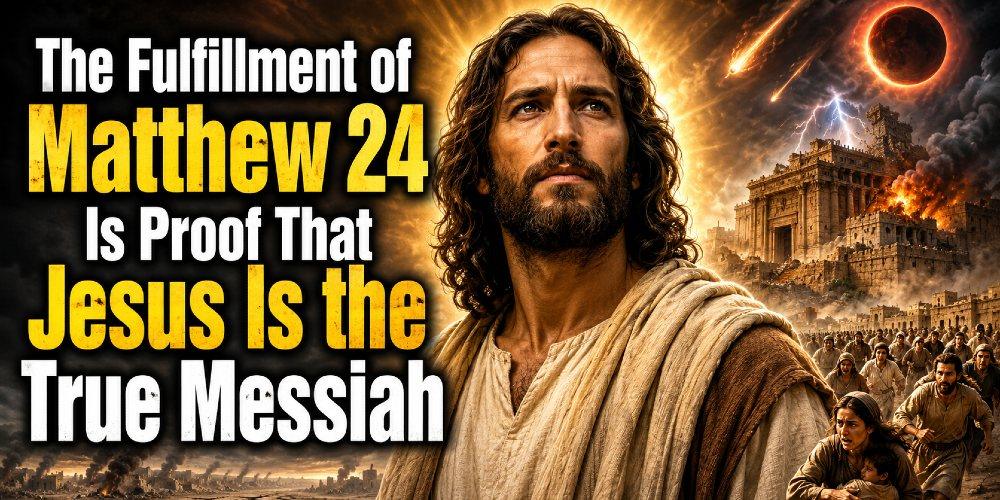

This piece argues that Matthew 24 is primarily about events within the lifetime of Jesus’ original listeners, not a distant end-of-world scenario, and shows how the language Jesus used lines up with contemporary Jewish prophecy, eyewitness history, and the way the rest of the Gospels frame the question. It tracks the disciples’ original concern about the temple, compares Matthew with Luke and Mark, and explains why cosmic imagery in prophecy often describes a kingdom’s end. The overall aim is to show that fulfillment in AD 70 strengthens confidence in Jesus’ prophetic voice while still leaving room for a completely future second coming.
Jesus walks away from the temple and drops a bomb: “You see all these, do you not? Truly, I say to you, there will not be left here one stone upon another that will not be thrown down.” The disciples then ask, “Tell us, when will these things be, and what will be the sign of your coming and of the end of the age?” and that question sets everything that follows.
We tend to hear “the end of the age” as the end of the world, but in first-century Jewish thought that phrase most often meant the end of the temple-centered Old Covenant age. Luke’s version is even clearer: “And they asked him, ‘Teacher, when will these things be, and what will be the sign when these things are about to take place?’” Mark says it similarly: “Tell us, when will these things be, and what will be the sign when all these things are about to be accomplished?”
Jesus answers with warnings and signs aimed at that generation: “And Jesus answered them, ‘See that no one leads you astray. For many will come in my name, saying, “I am the Christ,” and they will lead many astray. And you will hear of wars and rumors of wars. See that you are not alarmed, for this must take place, but the end is not yet. For nation will rise against nation, and kingdom against kingdom, and there will be famines and earthquakes in various places. All these are but the beginning of the birth pains.’” He tells them these things are precursors, not the final curtain.
He follows with a personal warning: “Then they will deliver you up to tribulation and put you to death, and you will be hated by all nations for my name’s sake. And then many will fall away and betray one another and hate one another. And many false prophets will arise and lead many astray. And because lawlessness will be increased, the love of many will grow cold. But the one who endures to the end will be saved. And this gospel of the kingdom will be proclaimed throughout the whole world as a testimony to all nations, and then the end will come.” The “you” here is pointed and immediate.
Matthew warns about an “abomination of desolation” in the holy place: “So when you see the abomination of desolation spoken of by the prophet Daniel, standing in the holy place (let the reader understand), then let those who are in Judea flee to the mountains. Let the one who is on the housetop not go down to take what is in his house, and let the one who is in the field not turn back to take his cloak.” Luke clarifies what that looks like on the ground: “But when you see Jerusalem surrounded by armies, then know that its desolation has come near. Then let those who are in Judea flee to the mountains, and let those who are inside the city depart, and let those who are out in the country not enter it.”
History matches that instruction. Roman armies surrounded Jerusalem, Christians remembered Jesus’ words, and many fled to Pella before Titus returned and destroyed the city in AD 70. That evacuation and the siege’s carnage are recorded by Josephus, a non-Christian eyewitness whose descriptions echo Jesus’ language about unparalleled tribulation.
Jesus’ next warning sounds apocalyptic: “For then there will be great tribulation, such as has not been from the beginning of the world until now, no, and never will be.” Josephus uses comparable language to describe the siege, calling it worse than the sufferings of previous nations. That parallel undercuts the idea that this chapter is only about an unknown future: the first-century record affirms the magnitude of what happened.
When Jesus speaks of cosmic signs later in the chapter he uses prophetic shorthand familiar from the Hebrew prophets. “Immediately after the tribulation of those days the sun will be darkened, and the moon will not give its light, and the stars will fall from heaven, and the powers of the heavens will be shaken. Then will appear in heaven the sign of the Son of Man, and then all the tribes of the earth will mourn, and they will see the Son of Man coming on the clouds of heaven with power and great glory. And he will send out his angels with a loud trumpet call, and they will gather his elect from the four winds, from one end of heaven to the other.”
That language is the same imagery Isaiah and Ezekiel use when announcing earthly judgments: “Behold, the day of the Lord comes, cruel, with wrath and fierce anger, to make the land a desolation and to destroy its sinners from it. For the stars of the heavens and their constellations will not give their light; the sun will be dark at its rising, and the moon will not shed its light.” And, “When I blot you out, I will cover the heavens and make their stars dark; I will cover the sun with a cloud, and the moon shall not give its light. All the bright lights of heaven will I make dark over you, and put darkness on your land, declares the Lord God.”
First-century readers heard coronation and judgment language in those images. Daniel’s “Son of Man” vision is a receiving of a kingdom, not a descent to earth. Jesus’ “fig tree” lesson makes the point: “From the fig tree learn its lesson: as soon as its branch becomes tender and puts out its leaves, you know that summer is near. So also, when you see all these things, you know that he is near, at the very gates.”
And then the line that fixes the timeline: “Truly, I say to you, this generation will not pass away until all these things take place.” That phrase, used elsewhere by Jesus to mean the living generation, fits the normal sense of the Greek. Reading it otherwise requires special pleading and breaks consistency with how Jesus speaks elsewhere.
At verse 36 the tone shifts: “But concerning that day and hour no one knows, not even the angels of heaven, nor the Son, but the Father only.” That break signals a move to a separate event, a future return without warning. The chapter therefore appears to contain both an in-generation judgment and a later, unknown-day coming.
What matters here is not squeezing every clause into one system but recognizing that the historical fall of the temple and the prophetic vocabulary Jesus used give early Christians concrete reasons to trust his word. If the generation he addressed witnessed the temple’s fall on the timetable he gave, that is powerful evidence worth reckoning with as we read the rest of his promises.





You must be logged in to post a comment Login