
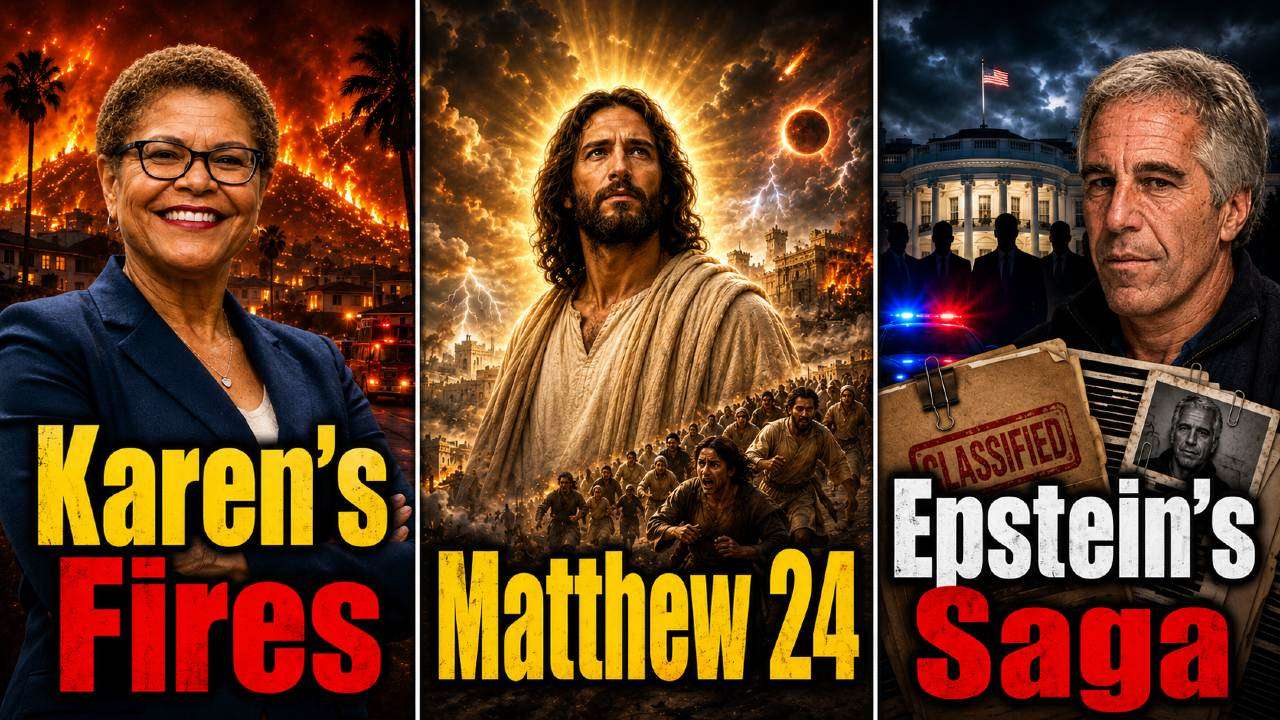

I’ll take a hard look at Karen Bass’s handling of the Palisades fire and why Republicans see it as a failure, give a clear-neutral account of the argument that Matthew 24’s fulfillment proves Jesus as Messiah, and outline the allegations around Epstein’s three tiers and why powerful people want the story buried. This piece pulls those threads together without fluff and keeps the focus on facts and implications. Embedded media and the original embed token are preserved below for reference.
The Palisades fire became a test of leadership and Karen Bass failed that test in ways voters remember. From the standpoint of accountability, her office’s response looked slow and reactive instead of decisive and commanding. Republicans argue the consequences were predictable: delayed action, public confusion, and a loss of trust that won’t be rebuilt by platitudes.
On policy and optics, Bass’s handling exposed a pattern too often seen in city leadership today, where communication trumps command. Streets were clogged, evacuations felt improvised, and the public wanted someone in charge who could move resources and direct outcomes without political calculus. For those who want effective government, the response raised real questions about competence and priority-setting.
The fallout is not just political theater; it’s practical. Firefighters and first responders deserve clearer lines of command and less political interference when minutes matter. Local residents deserve plans that work and leaders who own hard decisions instead of passing blame afterward. Republicans will use this as a lesson: crisis management is a core test of governing skill.
Shifting to a different arena, the claim that the fulfillment of Matthew 24 proves Jesus is the true Messiah is a theological argument that depends on interpretation of prophecies and historical markers. Supporters point to specific events and patterns that they say line up with the chapter’s signs, arguing those fulfillments are too precise to be coincidence. Neutral reporting recognizes these are faith claims supported by scriptural readings and historical correlation rather than scientific proof.
Skeptics counter that prophecy interpretation often reflects hindsight and selective linkage, where events are framed to fit a narrative after they occur. Scholars on both sides debate the criteria for what counts as fulfillment and how to weigh ambiguous evidence. The discussion matters to believers and historians, but it sits in a different category than public policy: subjective meaning rather than measurable outcomes.
The Epstein story, framed as “three tiers” by some observers, suggests levels of involvement that reach from street-level perpetrators up to elites who allegedly used access and influence for protection. The core allegation is that Washington’s inner circle contains people with motive and means to suppress uncomfortable truths. That claim has a natural political bite because it targets networks of power and privilege that resist scrutiny.
Why would powerful people want the Epstein story buried? It comes down to incentives: reputation, legal exposure, and the fear of damaging alliances. From a Republican viewpoint, the scandal is evidence of a double standard where the powerful dodge consequence and the ordinary do not. Transparency and accountability are demanded not as partisan catchphrases but as necessary tools to prevent systemic corruption.
Across these topics the common thread is the need for accountability—whether in crisis response, theological claim evaluation, or probing the connections around Epstein. Citizens and voters should insist on clear answers, unvarnished facts, and institutions that act rather than deflect. That pressure is the only reliable antidote to complacency or cover-up in any sphere.
!function(r,u,m,b,l,e){r._Rumble=b,r[b]||(r[b]=function(){(r[b]._=r[b]._||[]).push(arguments);if(r[b]._.length==1){l=u.createElement(m),e=u.getElementsByTagName(m)[0],l.async=1,l.src=”https://rumble.com/embedJS/u1wxk5″+(arguments[1].video?’.’+arguments[1].video:”)+”/?url=”+encodeURIComponent(location.href)+”&args=”+encodeURIComponent(JSON.stringify([].slice.apply(arguments))),e.parentNode.insertBefore(l,e)}})}(window, document, “script”, “Rumble”);
Rumble(“play”, {“video”:”v77n1vo”,”div”:”rumble_v77n1vo”});





You must be logged in to post a comment Login