
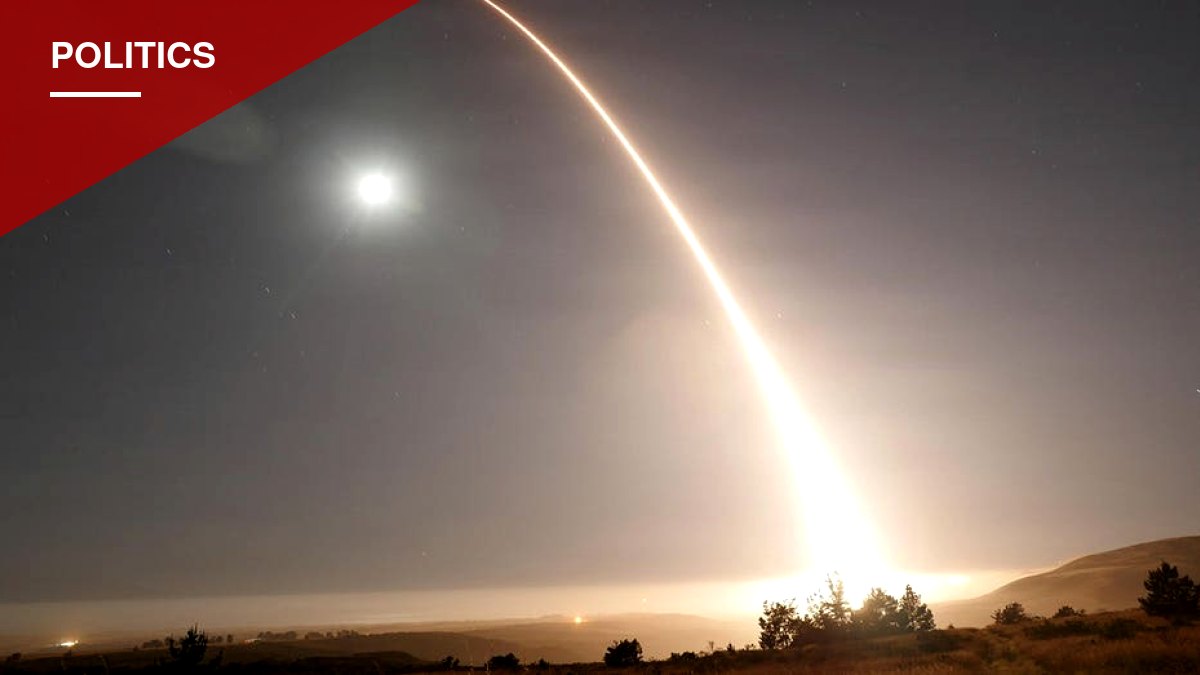

As President Trump travels to Asia for meetings with Chinese President Xi Jinping and Russian President Vladimir Putin, Sen. Deb Fischer is warning that America’s nuclear strategy needs a fundamental rethink because it was built for an era when Russia was the only serious nuclear rival.
Fischer, who chairs the Strategic Forces Subcommittee on the Senate Armed Services Committee, argues the New START Treaty, which expired earlier this year and had limited US and Russian nuclear arsenals, is no longer adequate because it left China’s expanding arsenal completely unconstrained.
“An arms control agreement that limits the United States and Russia while leaving China’s growing nuclear arsenal unconstrained is no longer sufficient,” Fischer wrote, adding that “America cannot and should not design our nuclear forces around outdated assumptions.”
New START was negotiated in 2010, when nuclear competition was seen as primarily a US-Russia issue. Since then, China has been building new missile silos, fielding advanced delivery systems, and developing capabilities that Fischer says increasingly threaten the United States and its allies.
Skepticism About Arms Control Prospects
Fischer expressed doubt that traditional arms control negotiations will succeed with either country. She said she raised the topic of nuclear dialogue directly with Chinese officials during an official Senate delegation trip to China earlier this year, and that “Chinese officials demurred when I raised this topic directly.”
She also pointed to Russia’s record, noting that Moscow “has repeatedly violated or undermined arms control commitments” and suspended its participation in New START in 2023.
“Given Russia’s track record and China’s reluctance, I do not believe arms control alone will adequately address the threat we face today,” Fischer wrote. “Arms control can complement deterrence, but it cannot substitute for it.”
Calls for a Larger, More Flexible Force
Fischer cited findings from the bipartisan Congressional Commission on the Strategic Posture of the United States, which concluded in 2023 that the country’s currently planned nuclear force posture is insufficient for the threat environment expected over the next decade.
She called for strengthening all three legs of the nuclear triad:
- At least 200 next-generation B-21 stealth bombers, well above the Air Force’s original plan for roughly 100, to counter both Chinese and Russian threats.
- A reevaluation of whether the planned number of Columbia-class submarines, which will serve as the backbone of America’s second-strike capability, is sufficient.
- An expanded arsenal of theater nuclear forces to help manage the risk of regional nuclear conflicts.
- Full replacement of the aging intercontinental ballistic missile system, which dates to the 1960s, through the new Sentinel ICBM program, while maintaining existing Minuteman III missiles in the meantime.
Fischer also argued that the credibility of US nuclear deterrence has consequences beyond American borders. She noted that as nuclear threats grow in Asia, South Korea and Japan have begun questioning whether they need their own nuclear deterrents, and that a credible American deterrent reduces the incentive for further proliferation among US allies.
“No one wants an arms race,” Fischer wrote. “But preventing one requires realistic arms control backed by an American deterrent strong enough that no adversary ever doubts our ability to defend ourselves and our allies.”






You must be logged in to post a comment Login