
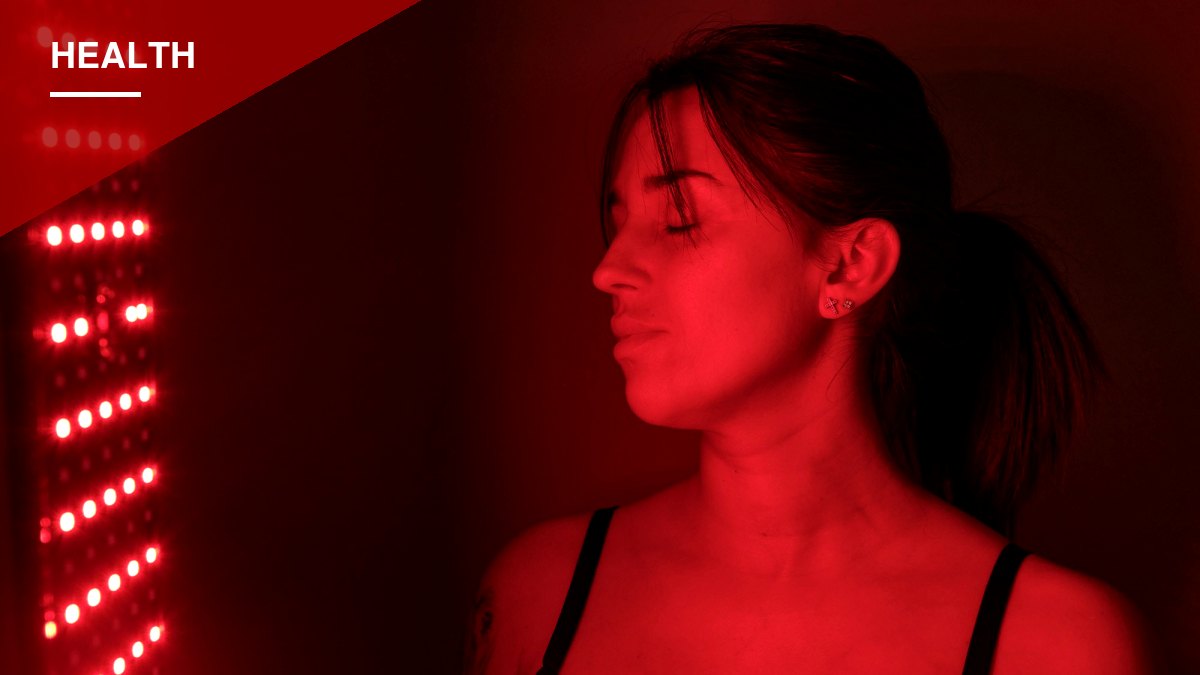

Red light therapy masks have become a familiar sight on social media, but dermatologists say the larger, full-body versions of the technology—known as panels—deserve more attention, even though they can look bulkier and more intimidating.
Panels work similarly to masks, delivering specific light wavelengths to the skin and underlying tissue to encourage cellular energy production, reduce inflammation and improve blood circulation. The key difference is scale.
“A panel’s biggest advantage is coverage. One session can treat your face, neck, chest and back at once, while a mask only covers your face,” said dermatologist Dr. Christina Marcelus. “Panels also tend to be more powerful, so sessions can be shorter. The trade-off is consistency: a mask sits right on your skin, while with a panel, how far you stand and how you position yourself change how much light your skin actually gets. I always say a mask is a spotlight and a panel is a floodlight. It depends on what you’re treating.”
What’s Actually Backed by Evidence
Dermatologist Dr. Sapna Palep pointed to devices such as Helio Nova by Helio Cure, which she described as “a medical-grade red light panel that can be used to treat the entire body.” She noted it is classified as a Class II medical device and said it “can help boost the overall appearance of the skin along with soothing joints and muscles.” The Helio Cure device emits wavelengths ranging from 630 nm at the skin’s surface to 1064 nm, a wavelength used in brain research, and is marketed as reaching roughly five centimeters into tissue.
Dr. Marcelus pointed to Celluma’s Celluma3 panel as a notable example because it has gone through formal FDA review. “If you want a panel that has actually been through FDA review, I like Celluma. Its Celluma3 panel is FDA-cleared for wrinkles, mild to moderate acne, and minor muscle and joint pain, which means the company had to submit data, not just list the device,” she said. She cautioned that an “FDA-registered” label is not the same as being “FDA-cleared.”
Her advice for shoppers evaluating any panel: “Whatever you buy, look for red light around 630 to 660 nm and near-infrared around 830 to 850 nm, the ranges used in many skin studies, plus output measured at the distance you’ll actually use it, low flicker and a solid return policy.”
Dr. Palep also mentioned a lower-cost alternative, the Hooga HG300, which sells for around $200. “For around $200, it offers both red and near infrared wavelengths of light, which can help reduce inflammation, improve skin’s appearance and boost energy levels,” she said.
How Often, and How Long, Should People Use Them
There is no single prescribed routine. “There’s no one-size-fits-all schedule. Studies have used anywhere from twice a week to daily sessions of about 10-20 minutes, so start with the manufacturer’s instructions,” Dr. Marcelus said. “Consistency matters more than intensity: longer sessions or standing closer won’t speed things up and can irritate your skin. Give it several weeks to a few months.”
She cited a study more than a decade old in which 136 participants used red light twice weekly and saw smoother skin and denser collagen after about 30 sessions, roughly 15 weeks.
Safety Considerations
Dr. Marcelus said the therapy is not risk-free. “That doesn’t mean zero risk: at very high doses, studies have seen redness and even blistering, so more is not better. Wear the eye protection that comes with your device, especially for near-infrared,” she said. “Check with your doctor first if you’re pregnant, have a light-sensitive condition like lupus, or take medications that make you sun-sensitive, and get any changing spot checked before shining light on it. If you have melasma, start low and go slow, since visible light and heat can trigger pigmentation, especially in deeper skin tones.”
She also urged skepticism toward marketing language. “‘Medical-grade’ isn’t an official FDA term, so on its own it doesn’t mean much. What matters is whether the device delivers the light it promises,” Dr. Marcelus said. “The power number on the box doesn’t always tell you how much light actually reaches your skin at the distance you’re standing. Better devices list accurate wavelengths, measure their output, manage heat well, and some have FDA clearance backed by clinical data. In-office devices are usually stronger and calibrated, with a professional setting the dose. A home panel can be a nice add-on, but it isn’t a replacement for treatments we know work for acne, aging or hair loss.”






You must be logged in to post a comment Login