
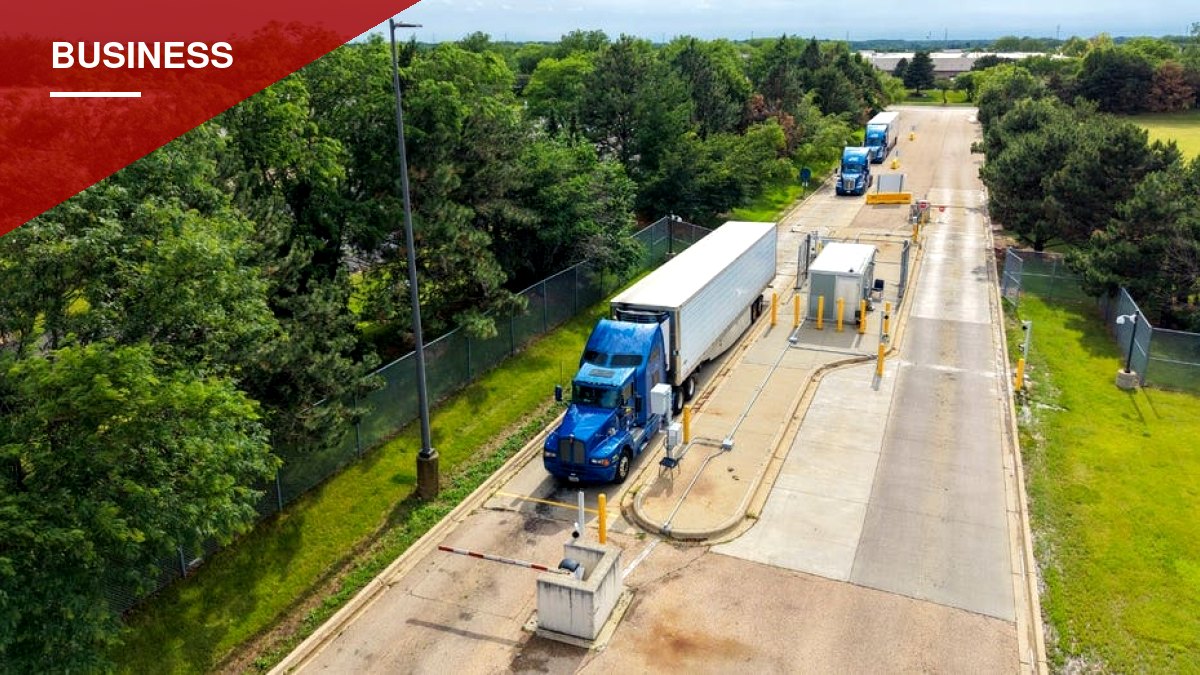

A technology company says its artificial-intelligence camera system can cut the time it takes trucks to check in at distribution centers from about 10 minutes to under 30 seconds, a change it argues could eventually ease some of the cost pressures that show up in grocery bills and shipping fees.
The company, EAIGLE, uses AI paired with existing security cameras to automate vehicle check-ins at warehouse gates. Its system, called Automated Vehicle Access Control, or AVAC, scans arriving trucks and trailers for more than 25 data points, including license plate numbers, and compares that information against facility records in under 30 seconds. If the data matches, an automated gate lets the driver through. If something looks off, the vehicle is flagged for further review.
The pitch is straightforward: trucks that spend less time idling in line at a warehouse burn less diesel, and diesel is not cheap. The U.S. Energy Information Administration put the national average diesel price at $6.13 per gallon for the week of Nov. 9. Fuel costs factor into the rates trucking companies charge, which can ripple through to retail prices.
A USDA-supported study on food transportation found that higher transportation costs generally increased food prices in the scenarios researchers examined, with potatoes shown to be especially sensitive to transportation expenses because they are often shipped long distances from growing regions to major markets.
What the company claims to save
EAIGLE estimates a facility using its technology could save approximately $726,000 annually through gate operations and related efficiencies. It also estimates that a facility processing around 200 trucks a day could cut roughly 110,000 pounds — about 55 U.S. tons — of carbon dioxide emissions annually by reducing unnecessary idling. These figures are company-provided estimates, and actual results would vary by facility.
The company also says its system can help combat cargo theft by flagging trucks whose information or paperwork doesn’t match shipping records. According to a June 2026 FBI warning, estimated cargo theft losses across the United States and Canada reached nearly $725 million in 2025. EAIGLE claims its technology can reduce theft and fraud exposure by more than 50%.
Where it’s being used
EAIGLE says its technology is already deployed at major North American distribution facilities, including operations associated with Walmart. Loblaw Companies Limited, one of Canada’s largest grocery and pharmacy retailers, announced in September 2026 that it is expanding its use of EAIGLE’s AI-powered gate technology across multiple distribution centers, citing early improvements in processing times and data accuracy as well as a better experience for truck drivers.
Wael Yehia, Loblaw’s vice president of national transportation, said the company is looking for practical ways to move products more efficiently through its distribution network.
No guarantee of lower prices
Whether any of these efficiencies translate into lower prices for shoppers remains unproven. There is currently no evidence that EAIGLE’s technology has directly lowered grocery prices or delivery fees. Retailers could instead use any savings to offset other costs or boost profit margins. Freight-yard check-ins also represent only a small slice of overall transportation costs, meaning savings would need to accumulate across many facilities before having a noticeable effect on what families pay at the register or for delivery.
Faster gate processing alone also wouldn’t solve broader supply chain issues like traffic delays or loading dock congestion that can affect product availability and delivery times.






You must be logged in to post a comment Login