
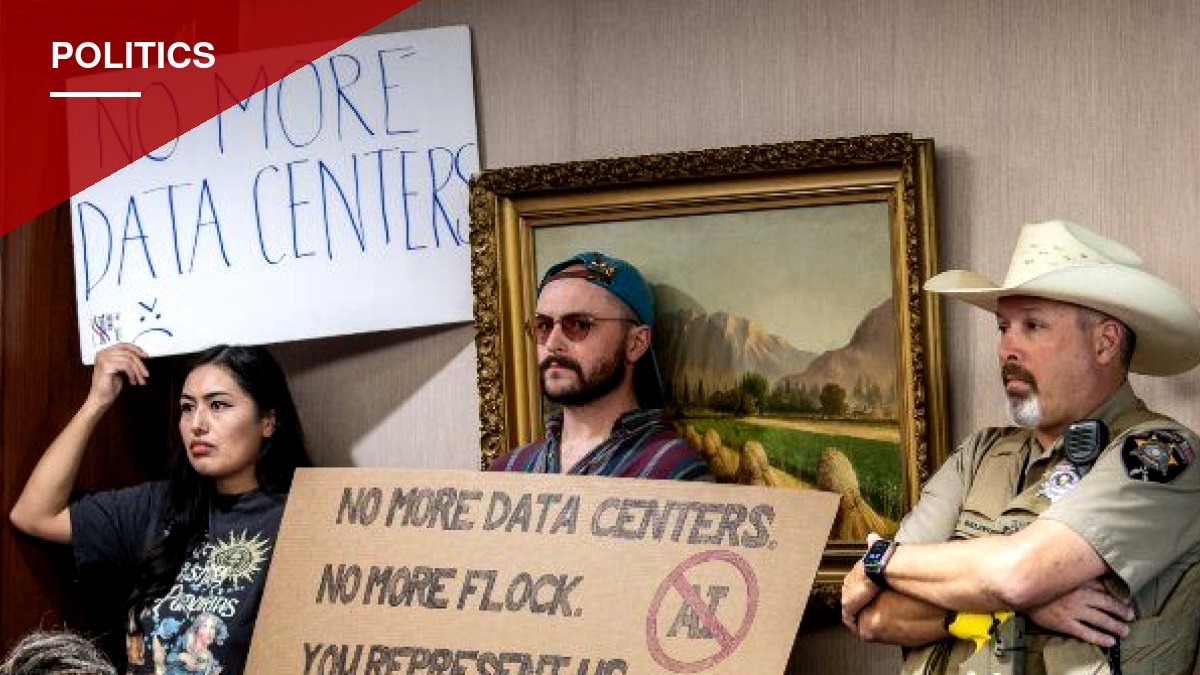

Counties that lean heavily Republican but are home to large data centers or proposed data center projects shifted more toward Democrats in last week’s midterm elections than similar GOP-leaning counties without such facilities, according to a new analysis from Humans First, a conservative advocacy group focused on AI safety and policy.
The group examined public election results alongside data center project records across 1,540 counties in 16 states, measuring what it calls a “data center penalty.” Counties with large data centers moved an additional 2.2 percentage points toward Democrats compared with data-center-free counties in the same states. The pattern appeared in 14 of the 16 states studied and in 25 of 27 governor and Senate races reviewed.
When the analysis focused only on deep-red counties — those President Donald Trump won by at least 20 points in 2024 — the gap was 2.1 points between counties with large data centers and comparable counties without them. Deep-red counties with projects still in the proposal stage showed a 1.1 percent gap after the group controlled for past voting patterns, rural or urban status, population size, racial and ethnic composition, and recent voting trends.
Humans First identified 114 proposed large AI data center projects spread across 92 heavily Republican counties, a figure the group says could lead to more local political conflicts. It also found that Republican vote totals fell an additional 1.1 percent in deep-red counties with large data centers compared with similar counties without them, while Democratic vote totals showed no significant change.
The organization was careful to note that county-level results cannot show whether individual Republican voters switched sides or simply stayed home, and that the findings point to an association rather than proof that data centers themselves changed how people voted.
‘People engage politically when issues affect them personally’
Humans First Chairwoman Amy Kremer discussed the findings with Fox News, which first obtained the analysis.
“Our analysis looked at how counties with data centers voted and how those counties moved to the left,” Kremer said. “I think this happened for the reason I’ve been warning conservatives and Republicans about for some time: People engage politically when issues affect them personally.”
“There’s nothing more personal than your pocketbook, your health care, your kids and family, your home and your community,” she added. “A data center involves all of those things, which is why I believe these counties moved away from Republicans.”
The findings arrive alongside other signs of public resistance to data center expansion. Recent polling shows a strong majority of Americans oppose having AI data centers built in their local area, and 40 of 41 data center moratoriums or restrictions on the ballot passed in the midterm elections nationwide. In the first half of this year, opponents of AI data center construction blocked or delayed a record number of projects worth nearly $130 billion.
Kremer also pointed to how some projects reach communities in the first place.
“In many places across the country, developers and companies have gone in and cut deals behind closed doors, under a cloak of darkness, using nondisclosure agreements and shell companies,” Kremer said. “By the time people in the community find out about the project, it’s too late to stop it.”
“These projects affect the quality of life and how much money people have,” she added. “They can increase the cost of electricity and water, while tax abatements are given to trillion-dollar companies — some of the wealthiest companies in the world.”






You must be logged in to post a comment Login