
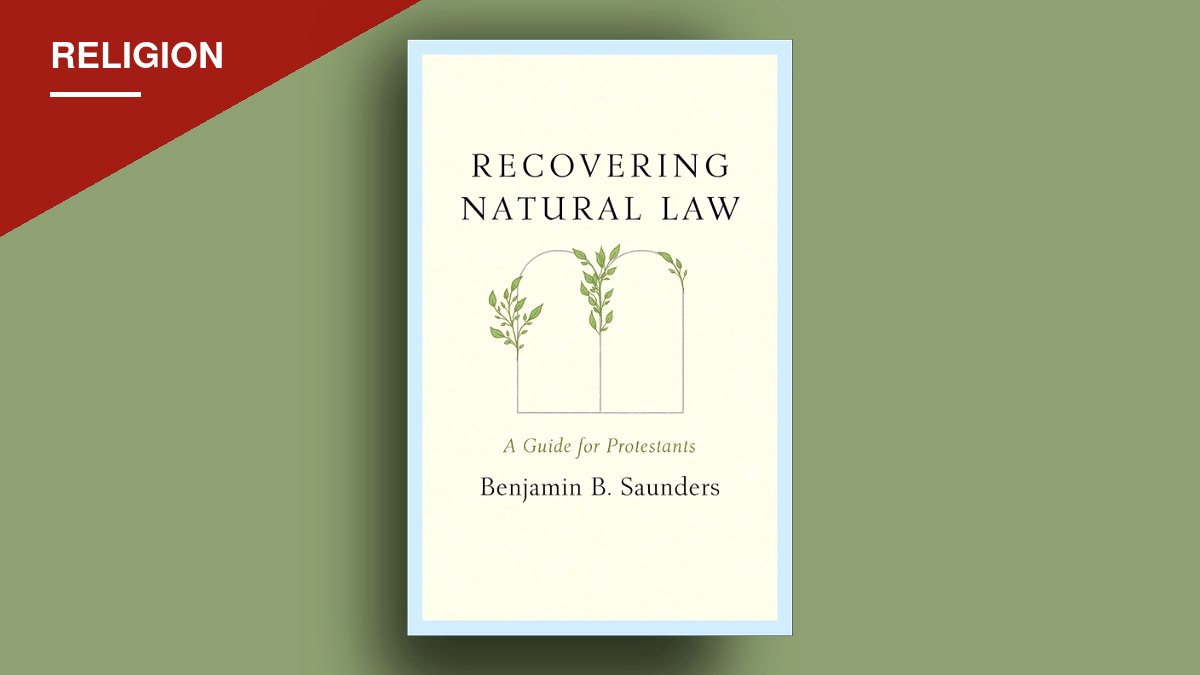

A newly published book is reigniting debate within American Protestant circles over a concept many evangelicals have long treated with suspicion: natural law, the idea that moral truth can be perceived through reason and observation of the created order, not just through scripture alone.
The book, “Recovering Natural Law: A Guide for Protestants” by Australian law professor Benjamin Saunders, argues that Protestants have unnecessarily abandoned a tradition with deep roots in their own theological heritage. According to a review published by The Federalist, natural law thinking nearly disappeared from American evangelical thought over the past century, despite being affirmed by Reformation figures including John Calvin and referenced in Paul’s epistle to the Romans.
The review traces that decline to several factors: the influence of theologian Karl Barth, who argued Christians should rely on revelation rather than reason for moral knowledge; the rise of non-denominational churches and the decline of the Protestant mainline, which the review says produced an evangelical culture distant from the broader Christian intellectual tradition; and a lingering suspicion that natural law theory is a distinctly Catholic idea prone to generating moral rules not found in the Bible.
Saunders’ book, intended as an introductory text suitable for college or seminary courses, makes the case that the two traditions were never meant to be at odds. “Anyone who takes the authority of Scripture seriously must affirm something like a doctrine of natural law,” Saunders writes, according to the review.
Scripture and reason, working together
A central theme of the book is that natural law reasoning and biblical scholarship have drifted apart from each other over time. “The literature on natural law rarely seems to overlap with biblical scholarship. Much natural law theory pays little attention to the Bible,” Saunders writes. The review points to the Book of Proverbs as an example of a biblical text that functions, in part, as an extended reflection on natural moral order — a connection it says has been underexamined.
The review also highlights Saunders’ emphasis on the limits of human reason, rooted in a Protestant understanding of how sin affects both the intellect and the will. Rather than endorsing one definitive method of natural law reasoning, Saunders reportedly treats rival schools of thought as each potentially useful, writing that “it is not always possible to define and describe the moral in watertight propositions.”
The review draws a contrast with some Catholic approaches to natural law, which it characterizes as more rationalistic by comparison, suggesting Protestant engagement with the subject could offer a useful corrective — while noting that Notre Dame theologian Jean Porter has argued for a reading of Thomas Aquinas closer to Saunders’ own view.
One criticism raised in the review concerns Saunders’ use of the terms “objective” and “subjective” to describe morality, arguing the framing risks confusion even though it is meant simply to convey that moral truth exists independently of individual will or preference.
Overall, the review frames the book as both an accessible introduction for newcomers and a useful refresher for scholars already steeped in natural law theory, concluding that the broader project of recovering natural law within Protestant thought carries theological stakes beyond the academic.






You must be logged in to post a comment Login