
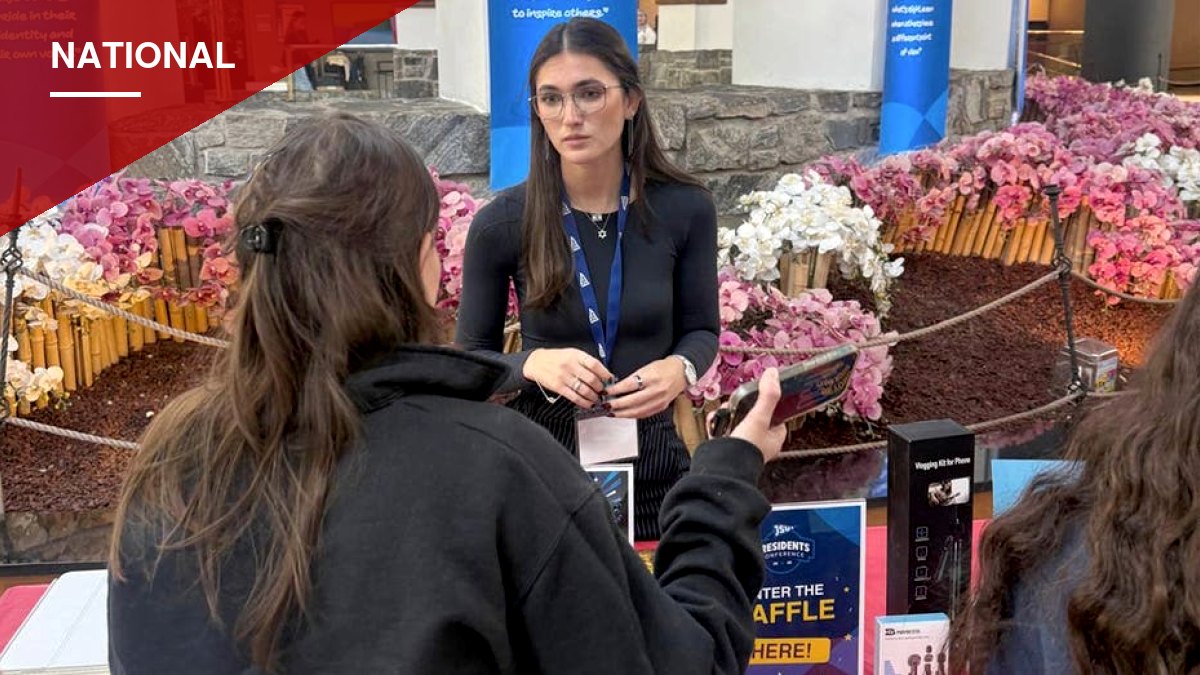

High school club presidents from across the country gathered recently for the Jewish Student Union’s (JSU) annual Presidents Conference, a three-day event aimed at preparing them to confront antisemitism both in high school and in the college years ahead.
JSU, which began at a single California high school, has grown to more than 500 clubs nationwide. Rabbi Derek Gormin, a managing director at the organization, said its approach depends on students leading the effort themselves. “Every club is run by teens,” he told Fox News Digital. “Student to student, peer to peer, there’s an unbelievable power that’s created when they work together and that movement continues to grow from that peer-to-peer power.”
Rabbi Micah Greenland, international director of the National Conference of Synagogue Youth (NCSY), said JSU clubs have become important gathering spaces as Jewish students report feeling isolated or threatened at school. “Jewish students have increasingly been feeling isolated, bullied, and threatened by students at their public high schools,” he said, adding that he hopes attendees leave able to “more effectively reach out to their peers” once they return home.
A Teenager’s Warning
Hillel Kornwasser, a high school student and activist from New Jersey, was among the presenters at the conference, despite being close in age to many in his audience. “For me, it’s a little weird. I’m getting up in front of a room with some kids my age or kids a year older than me, but the reality is there’s no waiting till tomorrow for this fight,” he said.
Kornwasser said he worries about the world his future children might inherit. “The world that we live in today, in America, in New York City, the western world as a whole, is not a world that I want my children to — my future children to — grow up in,” he said, describing a world “where they have to look behind their shoulder every single second with a yarmulke on or their Star of David out wondering if the next person is going to stab them in the back literally and figuratively for being Jewish.”
Lessons From a College Campus
Among the educators at the conference was Tessa Veksler, who was student body president at the University of California, Santa Barbara when Hamas attacked Israel on Oct. 7, 2023. She said she faced sustained harassment afterward. “I went through a year of harassment, consistently both in person and online, which culminated in a recall campaign to remove me from office because I was pro-Israel and Jewish,” Veksler said.
In 2024, Veksler said she was targeted with antisemitic signs on campus, including messages reading “Tessa Veksler supports genocide” and “Zionists not welcome,” according to ABC News. UCSB Chancellor Henry T. Yang responded with a statement saying the university was “distressed to learn of incidents” involving “offensive social media messages and signage” and that the campus was “conducting a bias incident review.” Fox News Digital reached out to UCSB for comment but did not immediately receive a response.
Veksler, who was involved with JSU in high school, told students at the conference they have “so much more to gain than to lose” by speaking out, while acknowledging the risks are real. “The hardest thing about being a pro-Israel student on a college campus right now is feeling like there is a target on your back. I think that it’s never been scarier to be a Jewish student on a college campus,” she said.
Facts, Empathy and History
Author and activist Shai Davidai, who gained national attention speaking out about antisemitism at Columbia University, ran mock debate sessions urging students to pair facts with compassion. “You cannot engage just with facts,” he said. “You have to appeal to people’s emotions, you have to acknowledge that they are humans, you have to show them a lot of empathy, and at the same time, whatever you do, the end decision needs to be based on evidence and fact.”
Drawing on research for his book, “American Intellectual Antisemitism: The Anti-Jewish Movement Tearing Through Our Universities,” Davidai said he found that the loudest campus voices criticizing Israel often represent “a minority opinion.” “What I’m trying to teach the students here is that they can stand up to them, that when someone is being loud, that just that doesn’t mean that they’re being right, and it doesn’t mean that they should go unopposed,” he said.
Charlotte Korchak, founder of the Jerusalem Education Institute, focused her sessions on grounding students in history so they can respond to false claims about Israel with depth rather than slogans. “When you know the history, and you know the contemporary situation, then it’s so easy to have a conversation because it’s not coming from a sound bite that you were taught or a one-liner, but it’s coming from deep knowledge,” she said.
Room for Joy
Not all the sessions centered on conflict. Actor and content creator Noa Bess Solomon, who co-hosts the “What Are We” podcast, encouraged students to hold onto humor and pride in their identity. “I always say that the key to surviving as a Jewish person is being able to laugh and have humor,” she said. “There’s nothing political about being Jewish. It’s your grandma’s — it’s your bubbie’s matzo ball soup, it’s camp, it’s food, it’s tradition, and that’s exactly what I want to keep reminding these kids.”
JSU organizers said the goal of the conference was to send students home with both the tools to counter antisemitism and the confidence to remain openly Jewish, without letting fear define their experience.





You must be logged in to post a comment Login