
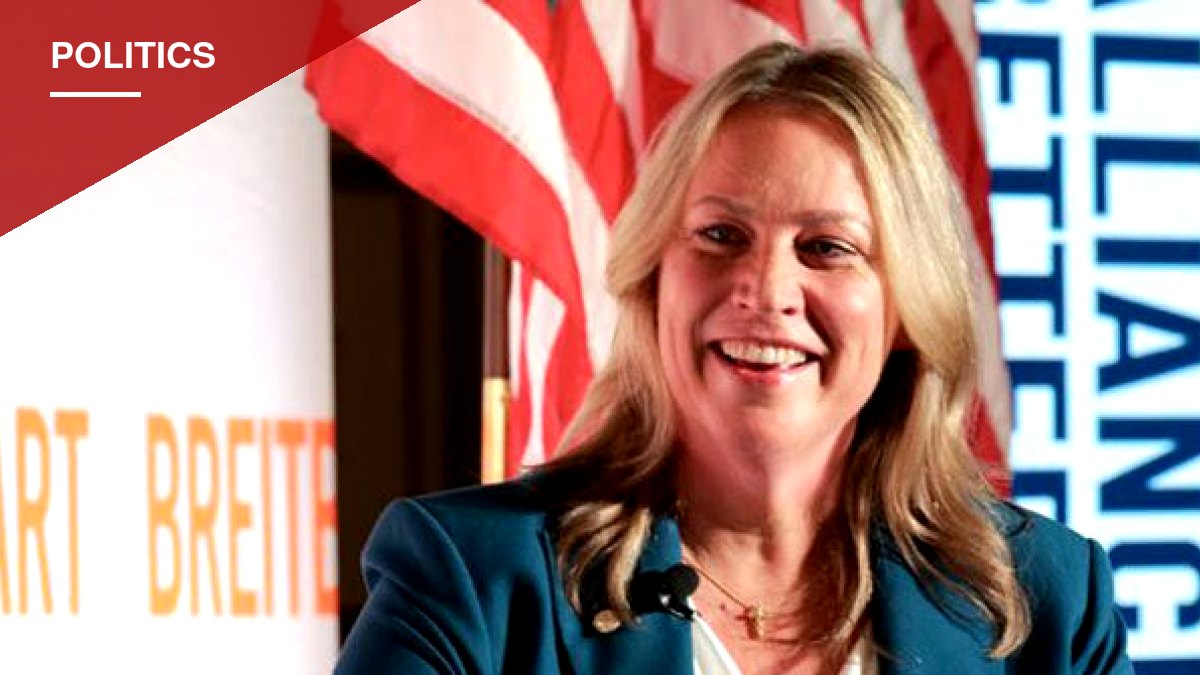

A Republican strategist says artificial intelligence policy was a decisive factor in this fall’s midterm losses, singling out Ohio’s Senate race — where Democrat Sherrod Brown defeated Republican incumbent Jon Husted — as a case study in how the issue can sink a campaign.
Janet Kelly, CEO of the group Alliance for a Better Future (ABF), laid out her findings during a virtual press conference on November 6. She presented a post-election memo titled “How Super Intelligence (SI) Policy Helped Deliver Democrat Majorities & What the GOP Needs to Do to Recalibrate Ahead of 2028,” which argues Republicans must act quickly to rebuild trust on AI before the next presidential election.
“It became apparent this fall that 2026 was going to be the first AI election,” Kelly said. “But I can assure you, based on the data that I’m going to share this morning, that it will not be the last AI election.”
According to the memo, Ohio accounted for roughly $29.9 million in Senate-race television advertising focused on AI and data centers — spending that largely targeted Husted. “Particularly in Ohio, Dems spent $30 million painting [Husted] as a corrupt big tech ally, and he definitely paid the price for that on election night,” Kelly said.
A growing voter concern
Kelly’s memo cites Navigator Research polling showing the share of voters naming AI as an important issue for Congress and the president jumped from 7 percent to 21 percent over the past year — a 14-point increase she called the largest growth of any issue this cycle.
NBC News exit polling cited in the memo found 56 percent of voters considered AI and data centers a major or crucial factor in their congressional vote, and of those, 65 percent voted Democratic versus 33 percent Republican.
Kelly argued that AI concerns are tangled up with economic anxiety. “When approximately 40% of Americans believe that one day AI could take their job, and their kid in college can’t get a job or whatever, it is inextricably linked to those economic concerns,” she said.
Trust gap and spending gap
The memo points to a September 22 Reuters/Ipsos survey finding 73 percent of respondents believe AI companies have not done enough to prevent serious harm. “Voters are very unified in that they want big tech accountability,” Kelly said. “They don’t just want accountability though; they want actual changes in how tech is done that will protect their families.”
Yet Kelly acknowledged Republicans currently trail Democrats on the issue. Navigator Research polling cited in the memo shows Democrats hold a nine-point advantage over President Trump and Republicans, 32 percent to 23 percent. “This is really hard to say for someone who’s been in conservative politics for 30 years, but voters do not trust Republicans on SI or AI,” Kelly said. “They think that the GOP is too close with big tech.” A separate Politico survey from October 19 found 47 percent of respondents view Republicans as the party of tech tax breaks, compared with 21 percent who said the same of Democrats.
Democratic-aligned groups also dramatically outspent Republican-aligned groups on AI and data center advertising, according to AdImpact figures in the memo. Across nine Senate races, $49.2 million was spent on such ads beginning September 7, with Democratic-aligned sponsors responsible for $43.5 million, or 88 percent. In 25 House districts, Democratic-aligned and independent groups spent $37.5 million of the $40.5 million total, or 93 percent.
A path forward
Despite the losses, Kelly said Republicans can still turn the issue around before 2028 by pursuing legislation on children’s safety, national security and worker protections. “It is definitely not too late to turn this around,” she said. “Two years is not a long time for an issue that is as salient and as intense in voters’ minds as AI. But it is possible to earn trust back and earn trust back quickly.”
She pointed to child safety legislation as the clearest opportunity for bipartisan action, citing polling that 93 percent of voters believe chatbots should not discuss suicide or sex with children. “My view is if American voters agree with something at a 93% level, that is not compromise. That is common sense,” Kelly said.
She also cited President Trump’s SI Accords as a foundation for national security policy. “The SI Accords is, I think, just a brilliant way to start the conversation, and anything that Congress can do to make that more permanent would be wise,” she said.
Kelly closed by framing AI as likely to dominate the next presidential race. “It would be political malpractice for Republicans not to adapt,” she said. “That is the winning message. That is what voters have said all along, but it can’t just be PR. It has to be real. Whichever party does that the best is going to have an edge in 2028.”





You must be logged in to post a comment Login