
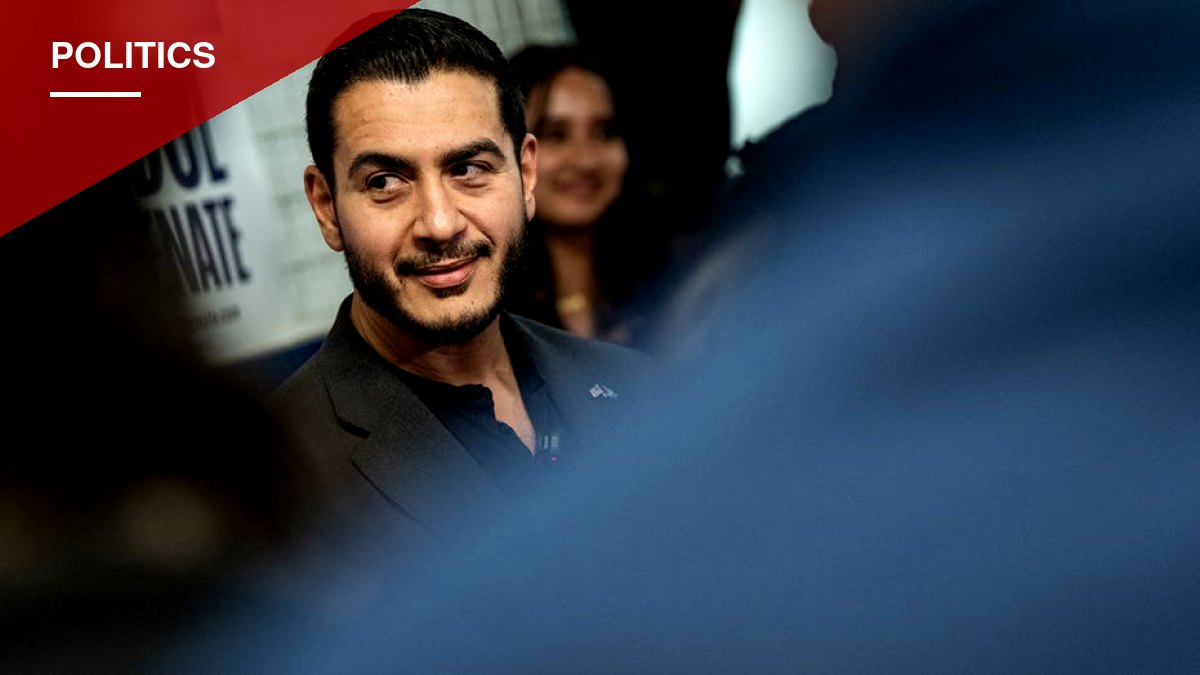

Senator-elect Abdul El-Sayed, D-Mich., is facing renewed scrutiny over his dealings with journalists after a tense exchange with a Sky News reporter went viral just hours before his victory in Tuesday’s midterm elections.
The confrontation began when Sky News correspondent James Matthews approached El-Sayed to ask questions. El-Sayed responded by asking Matthews, “Are you registered to vote in the state of Michigan?” When Matthews said he was not, El-Sayed replied, “Why would I care to have a conversation with you?”
After Matthews identified himself as a journalist, El-Sayed questioned why a reporter for a British outlet would be covering the race, at one point placing both hands on Matthews’ shoulders and asking, “A senator in where? What country? What country?” Matthews answered, “The United States,” and explained that Sky News reaches an international audience. El-Sayed dismissed that, saying “Sky News is not viewed in the United States of America” and that “like five people” watch the network domestically.
El-Sayed eventually told Matthews, “I’ve answered all the questions for the viewers of the United Kingdom. So I’m going to ask you to stop chasing me around. Please,” adding, “If you keep being in my way, I’m not going to be very happy.” Matthews denied that he had been chasing the senator-elect.
Footage of the encounter spread quickly online. Commentator Piers Morgan called it “pathetic” and “very patronizing.” Reason’s Reem Ibrahim and former Israeli government spokesperson Eylon Levy also criticized El-Sayed’s conduct, with Levy calling him a “bully.” Students for Trump founder Ryan Fournier described the behavior as “unhinged,” while commentator Spencer Pratt questioned why El-Sayed was “comfortable putting hands on another man.”
A pattern of sharp exchanges
The Sky News incident was not an isolated one. In October, El-Sayed sparred with NBC News anchor Tom Llamas after Llamas asked about allegations concerning the El-Sayed family’s ties to the Muslim Brotherhood. “I was born in 1984, down the street in Rochester Hills. I was raised here in Michigan, went to the University of Michigan, rebuilt the health department in this city, led the health department in this county, and you want to ask me about Egypt in 1970? Are you serious?” El-Sayed said, later accusing Llamas of relying on “hearsay evidence from a tweet.”
That same month, El-Sayed declined to answer Detroit Free Press reporter Audrey Fahlberg’s questions about leaked audio in which he discussed Michigan residents mourning the death of Ayatollah Khamenei. “I’m just not interested in this dog and pony show,” he told Fahlberg, calling on her to “ask smart questions.” Fahlberg later said El-Sayed appeared to grow angry whenever questioned about the Iranian regime.
El-Sayed also repeatedly interrupted Fox News “Special Report” anchor Bret Baier during an exchange about the Muslim Brotherhood, and sharply rebuffed a question about Democratic Rep. Haley Stevens, telling the reporter, “You’re really asking the questions that the people want to hear,” before adding, “Ask me a serious question.”
In a September interview with Chuck Todd, El-Sayed referenced comedian Bill Maher, saying, “You know how many terrible things Bill Maher has said about people like me? Terrible, awful things,” and adding that he would want to appear on Maher’s show to be “a guy who prays like I do” confront him on air.
Divided reaction
Heritage Foundation media fellow Tim Young drew a distinction between El-Sayed’s conduct and President Donald Trump’s long-running criticism of reporters. “El-Sayed gets angry at the media for asking actual questions about him and his relationship to organizations like the Muslim Brotherhood. He legitimately doesn’t want to answer those questions, so he snaps,” Young said. “Trump gets asked the same narrative-shaping questions all the time, then watches networks create false narratives about him on air, which makes him angry. The two are not the same.”
Not everyone views El-Sayed’s approach as a liability. Communications trainer Jocelin Martinez said his style helped carry him to victory over Republican Mike Rogers in a Senate race Republicans had hoped to flip. “El-Sayed’s communication style got him elected in Michigan because the moment requires leadership with gumption,” Martinez said.
El-Sayed’s campaign did not immediately respond to a request for comment.




You must be logged in to post a comment Login