
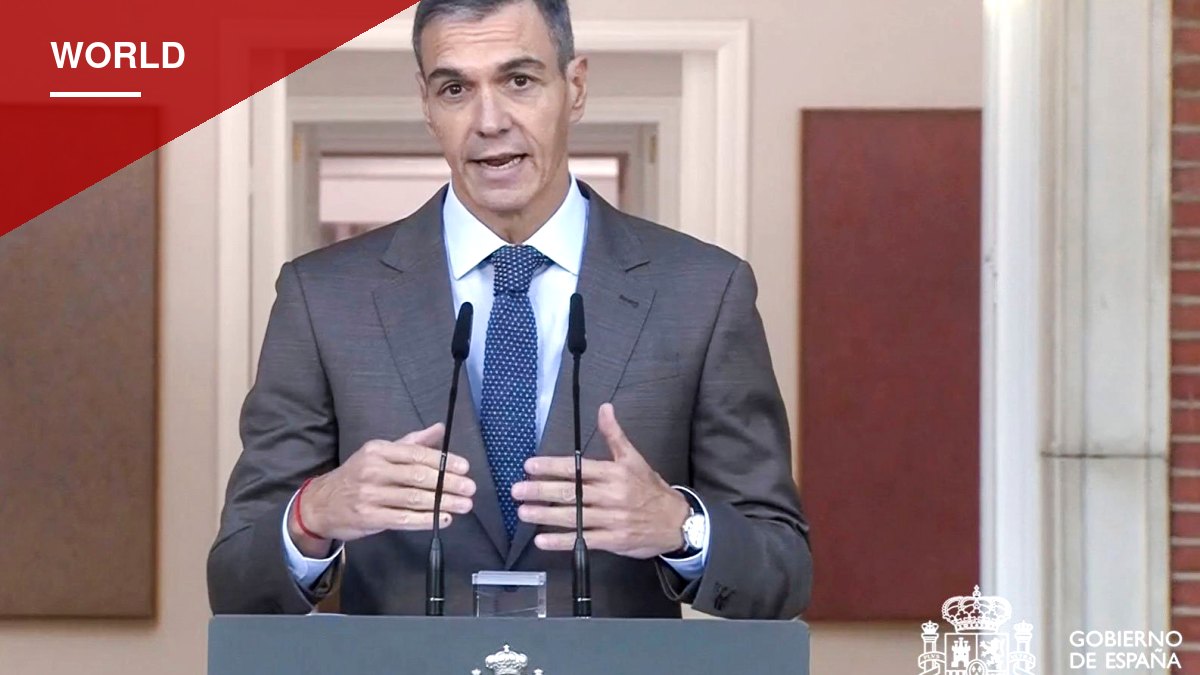

Spanish Prime Minister Pedro Sanchez announced on Monday that Spain will hold an early general election on November 29, seeking to shore up his government after a fractured parliament voted down its housing proposals last week amid mounting street protests.
“We need to renew people’s support,” Sanchez said in a televised address. “We need to mobilize and win a much larger progressive majority in parliament, one that will allow us to overcome vested interests, deliver new social advances and continue transforming Spain.”
Sanchez also conceded he had made missteps and had not delivered on all of his promises. “I also know that part of that social majority is dissatisfied today,” he said.
The call for elections comes at a precarious moment for Sanchez’s Socialist Party, which currently trails in opinion polls. Surveys suggest the most probable outcome is a government led by the conservative People’s Party in partnership with the far-right Vox party — which would mark the first time a far-right party has held power in Spain’s central government since democracy was restored following the death of dictator Francisco Franco.
A loss for Sanchez would also end one of the few remaining left-leaning governments in Europe, at a time when far-right parties are gaining ground across the continent and voters in many countries are drifting away from the political center.
A Housing Fight as Political Opening
Sanchez has gotten something of a boost from housing proposals aimed at addressing Spain’s deepening housing crisis. The plans were popular with the public but were rejected by right-wing lawmakers on Friday, a decision that has spurred plans for further protests.
Lorenzo Bernaldo de Quiros, an economist and president of the consultancy Freemarket Corporate Intelligence, said the housing fight gives Sanchez a chance to rally the left while shifting attention from more damaging issues, including the migrant situation in Ceuta and ongoing corruption scandals.
“This is a window of opportunity,” de Quiros said. “If he does not call elections fast, (those topics) will return to center stage.”
A History of Defying Expectations
Sanchez has never won enough votes outright to form a majority government, yet he has assembled a series of fragile coalitions — stitching together support ranging from the far-left to separatist parties — to hold power across three terms spanning eight years.
That fragmentation has caught up with his government in its current term, however. Lawmakers have passed little major legislation, and Spain has not passed a budget since 2023, even though its economy remains one of the strongest performers among developed nations.
Sanchez first came to power by leading the ouster of center-right Prime Minister Mariano Rajoy following corruption scandals within Rajoy’s People’s Party. In a twist, senior figures within Sanchez’s own Socialist Party have since faced their own graft allegations, further weakening a party whose approval ratings have hovered between 26% and 31% throughout his time in office.
Despite losses in earlier regional and local elections, Sanchez won a second four-year term in 2023 by negotiating backing from a loose alliance of parties. That support came at the cost of a controversial amnesty for pro-independence Catalan leaders — a decision many voters still view as a betrayal of national unity.
Earlier in his tenure, Sanchez drew praise for the exhumation of Franco’s remains from a mausoleum the dictator had built for himself outside Madrid, as well as a labor law overhaul that helped push unemployment to its lowest level in nearly two decades.
He also built a reputation on immigration policy, announcing in June 2018 that Spain would accept the Aquarius migrant rescue ship and its 629 passengers after both Italy and Malta refused to let it dock. As many European nations have hardened their stance on migration, Sanchez has continued to argue that immigration is vital to Spain’s economic growth, filling labor shortages in construction, agriculture and hospitality while generating revenue for the country’s welfare system.
More recently, Sanchez’s refusal to meet US-led calls to raise defense spending to 5% of GDP, paired with a tilt toward China, has drawn criticism from President Trump and some European leaders wary of Chinese goods flooding the continent.





You must be logged in to post a comment Login