
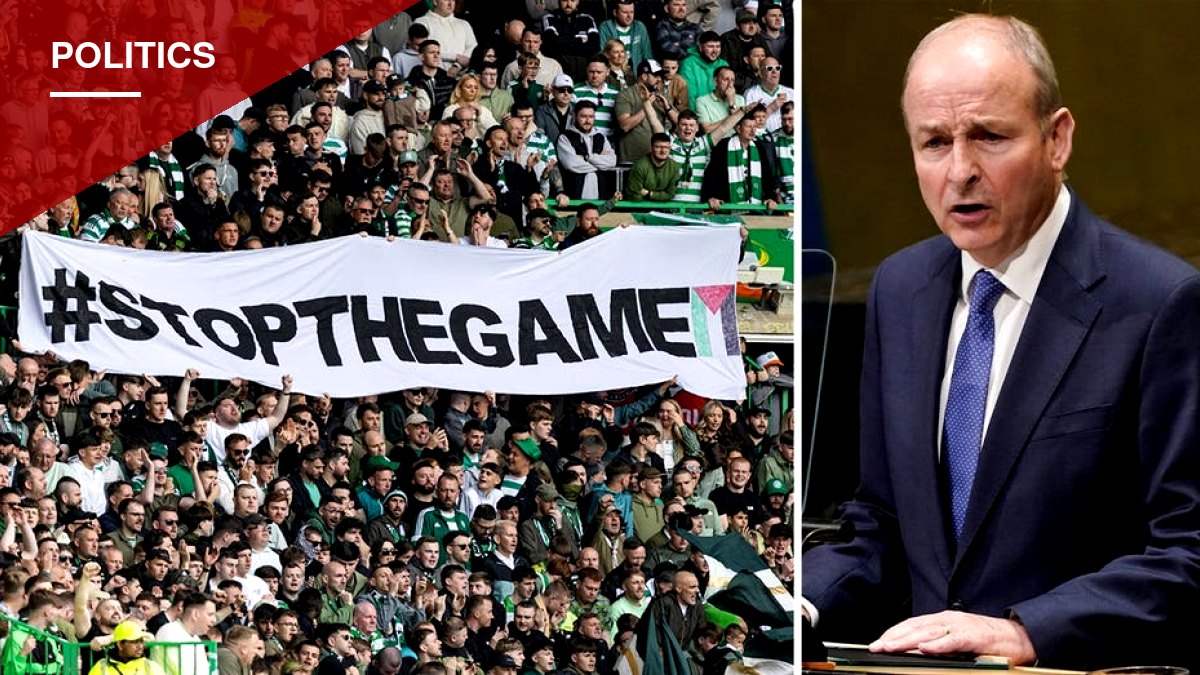

Irish Prime Minister Micheál Martin has rejected claims that his country’s sharp criticism of Israel’s conduct in Gaza amounts to antisemitism, speaking out as tensions surrounded a politically charged soccer match between the two nations on Sunday.
In an exclusive interview with Fox News Digital in New York this week, Martin defended Ireland’s position while a dramatic, last-minute vote played out among Irish national team players over whether to boycott the UEFA Nations League fixture against Israel.
Asked directly whether anti-Israel sentiment in Ireland had crossed into antisemitism, Martin said: “I think for the vast majority of people it does not.” He added, “We have no toleration for antisemitism, none.”
More than 160 Irish sports figures had called for a boycott of the match, and players themselves had publicly questioned whether it should go ahead. On Saturday, a “significant majority” of players voted to play the game, though one player left the squad, saying he did not wish to take part.
Condemning Hamas, backing a two-state solution
Martin condemned Hamas’ Oct. 7 attack on Israel without qualification. “First of all, we condemned, absolutely, the outrageous terrorist attack by Hamas in October,” he said.
“We believe in a two-state solution,” Martin said. “We believe that Israel, of course, has a right to exist in security and its people need to be guaranteed of security. But likewise, Palestinians should have a right to live in their homeland in a peaceful way.”
He said Ireland’s history of British rule shaped its sympathies. “There’s a very strong pro-Palestinian position in Ireland,” Martin said, attributing it to “our own history” as well as “a sense of right and justice and fairness.”
Martin called Israel’s military response to Oct. 7 “absolutely disproportionate” and pressed for more humanitarian aid to reach Gaza. “We want humanitarian aid going into Gaza. There’s not enough humanitarian aid going in,” he said, citing shortages of food and shelter facing roughly 2 million people there, including children without access to education.
The dispute over the match
Republic of Ireland manager Heimir Hallgrímsson said his players were uncomfortable with the fixtures, declaring, “We’re not playing with genocide, we’re playing against genocide.” The Israeli Football Association accused him of “stupidity, ignorance and hypocrisy,” which Martin called “unacceptable.”
The Football Association of Ireland had previously sought Israel’s suspension from international competition, but officials later voted to fulfill the fixtures after being warned a boycott could cost the association at least $6.3 million and trigger UEFA sanctions. Sunday’s game is being played in Hungary, and Ireland’s Oct. 4 home fixture has been moved to Serbia and will be played behind closed doors, with no access for Irish supporters to either match.
A campaign called #StopTheGame has pressured officials and players for months not to fulfill the fixtures, including a protest during a May friendly against Qatar in which demonstrators threw tennis balls bearing the campaign’s message onto the pitch.
Martin has resisted calls for a boycott, arguing unilateral action could be “self-defeating” and might damage Irish soccer without affecting Israel.
Pushback from Jewish groups
The American Jewish Committee raised concerns directly with Martin during a March 2025 meeting in Washington, attended also by an Anti-Defamation League official, alleging antisemitism had become “pervasive” in Ireland and criticizing what it called the “vilification of Israel” there.
Martin pointed to Ireland’s annual Holocaust commemorations and the historic contributions of Jewish communities in Dublin, Cork and elsewhere in pushing back on the suggestion that antisemitism is broadly tolerated. “We cherish that contribution that the Jewish community has made to Ireland,” he said.
A sharper message at the UN
Martin’s Fox News Digital interview came before he addressed world leaders at the United Nations on Thursday, where he said the international community had “failed Palestine.”
“When the full truth of what has happened, what is still happening in Gaza, is finally known, when the evidence is gathered, when the testimonies are heard, when the true horrors are finally and fully revealed, it will shame the world,” he said. “Nobody will be able to say that we did not know.”
He accused violent Israeli settlers in the West Bank of acting with “near-total impunity” and said Palestinian communities faced displacement and destruction “amounting to ethnic cleansing,” while reiterating support for “a State of Palestine and a State of Israel” living side by side “in peace, security and dignity.”
Northern Ireland’s example
Martin connected Ireland’s stance to its own history of ending decades of violence in Northern Ireland. “We feel we can make a contribution to that conflict resolution pathway,” he said, a role that carries added weight as Ireland holds the rotating presidency of the Council of the European Union.
He also cited a personal influence: meeting Israeli Rami Elhanan and Palestinian Bassam Aramin, two fathers who each lost a daughter in the conflict and later worked together for peace, whose stories are told in Colum McCann’s novel “Apeirogon.” “That’s an inspiration to me,” Martin said.
Ukraine and Irish unity
On Russia’s war in Ukraine, Martin said a ceasefire along existing battle lines could provide a starting point for negotiations, while rejecting territorial gains by force. “Ukraine can’t cede territory that Russia hasn’t even conquered, despite four years of war,” he said. Ireland has maintained military neutrality while taking in more than 120,000 Ukrainians and providing humanitarian and non-lethal assistance. “We want the war to end,” Martin said.
On the question of Irish reunification, Martin said he and his Fianna Fáil party support it in principle but that trust must be built first. “I believe in unity and my party believes in unity, but we have to work on it,” he said. “We have to build reconciliation amongst the different traditions on the island of Ireland.”
Asked whether the United States, which played a “critical” role in the 1990s Northern Ireland peace process, could play a role in a future reunification process, Martin said: “To a degree maybe, potentially, yeah.”




You must be logged in to post a comment Login