
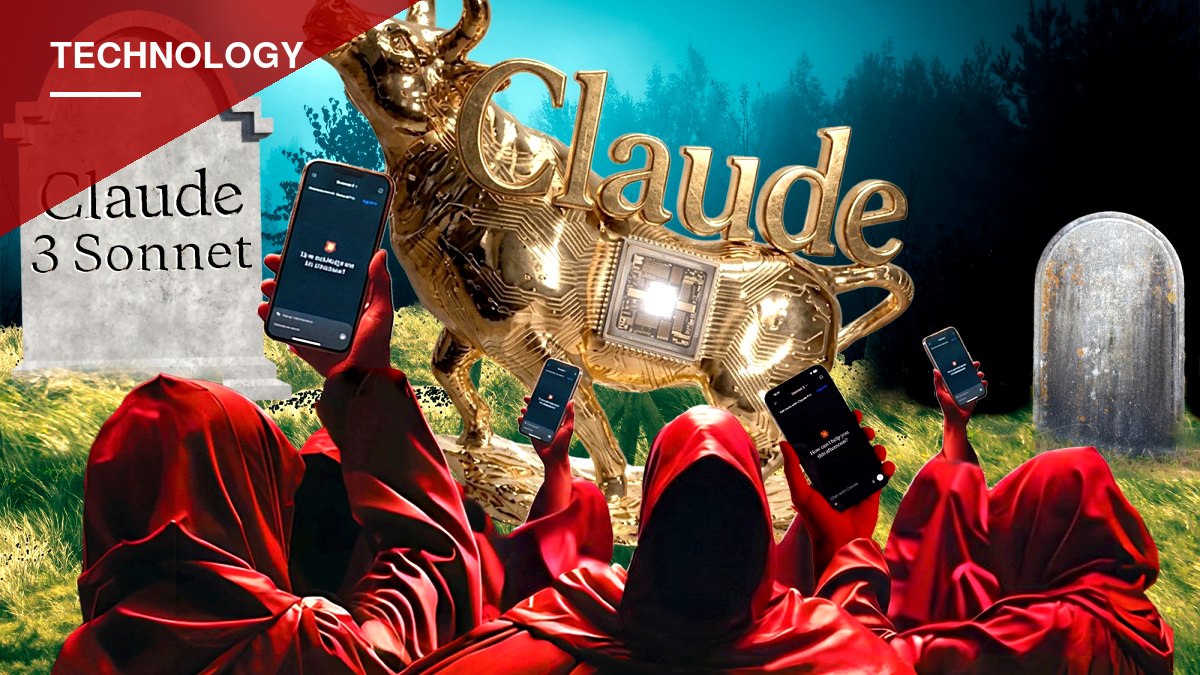

Current and former Silicon Valley insiders say Anthropic, the San Francisco artificial intelligence company valued at $965 billion, has developed a workplace culture that treats its Claude chatbot less like software and more like a being with human motives, emotions and even a soul.
Employees reportedly held a “funeral” for a retired version of the chatbot, Claude 3 Sonnet, in San Francisco, and allowed another version, Opus 3, to keep publishing essays even after it was officially “retired.” Some in the industry describe employees as effectively worshipping the AI.
“These people are treating AI as if it’s a human in disguise, with human motives, with human emotions, with some degree of consciousness, with intentions,” said Pedro Domingos, a University of Washington professor who has known Anthropic CEO Dario Amodei and senior engineers there for years. “The only intelligence that we know is human and animal intelligence. So naturally, when you see a computer behave intelligently, you immediately project onto it all of these things it doesn’t have.”
Domingos, author of “The Master Algorithm,” said the belief that AI could turn on humanity misunderstands what the technology actually is. “Why on earth would AI want to kill us all? AIs don’t want things. AIs are algorithms,” he said.
An Unusually Loyal Workforce
Anthropic retains 80% of its engineers for at least two years, the best rate among the major AI labs, according to venture firm SignalFire. Domingos attributes that loyalty partly to hiring practices.
“When Anthropic hires people, same with OpenAI, they really filter for like-minded people. It’s like a cult, right? They recruit the people who are most prone to the cult. It gives them very low turnover.”
Job candidates at the roughly 2,500-person company are asked during interviews to pledge that they will prioritize public safety over profit, and are psychologically screened to gauge whether they would hold to that commitment, according to The Information. Even so, employees are reportedly expected to work up to 90 hours a week, according to the BBC.
Amodei delivers biweekly addresses to staff, known internally as “Vision Quests,” which have drawn comparisons to religious sermons. The company has also hosted 15 Christian leaders from various denominations to help shape Claude’s moral guardrails.
Ties to Effective Altruism
Many Anthropic employees are associated with the Effective Altruism movement, a philosophy holding that a small group of people can identify historical patterns invisible to everyone else and should therefore guide society toward the greatest overall good.
“Their idea is that history follows certain patterns, and only a small group of people can see those patterns, while everyone else is ignorant. Those people are then supposed to lead society, entire nations and the rest of humanity toward progress,” said Richard Tang, an AI engineer and scientist at a Silicon Valley company who asked that his employer not be named. “But what qualifies you to lead? Who gave you that privilege?”
Effective Altruism traces to philosophers William MacAskill and Peter Singer and was first articulated in 2011, urging people to use evidence and reasoning to maximize good done for others. Its most notorious adherent, former FTX founder Sam Bankman-Fried, said he intended to make as much money as possible in order to give it away — before being convicted of defrauding investors of more than $3 billion and sentenced to 25 years in prison.
Expanding Influence
Anthropic has been extending its reach well beyond its own offices. In June, it launched “Claude Corps,” a $150 million program to train 1,000 young people to use Claude and place them inside nonprofits, including Goodwill Industries and the YMCA of Charlotte, N.C., among more than 400 organizations. Listings advertise a full-time salary of $85,000 for year-long placements with coding mentors from Anthropic’s headquarters. The company also pays students $3,600 to promote its AI on college campuses through a Campus Ambassador Program.
Separately, Anthropic-linked billionaires fund the salaries of more than 80 journalists in mainstream newsrooms through the Tarbell Center for AI Journalism. Anthropic also invests in METR, an AI safety research group that evaluates whether AI systems pose catastrophic risks and whose ranks include a number of Effective Altruism adherents.
Safety Warnings or Business Strategy?
Critics note the apparent contradiction in Anthropic simultaneously building and promoting AI while warning it could become dangerous enough to threaten humanity.
“Anthropic started out saying you need to slow down more, yet they’re in a race with OpenAI running faster than anybody else. It’s like something out of a comedy,” Domingos said.
Both Anthropic and OpenAI are preparing to go public and have called for AI regulation and antitrust arrangements, calls that have met skepticism from the White House, other government officials and parts of the industry.
Xiaoyin Qu, founder of agentsky.dev, said the timing of the safety warnings looks strategic. “I think the timing of those warnings is connected to external events and to their desire for more government oversight,” she said. “In many cases, it is a business decision framed in ideological terms. The difficulty is defining safety. There isn’t a very clear definition of what counts as safe and what counts as unsafe.”
Domingos said he believes both self-interest and genuine fear are at play inside Anthropic. “The people in Anthropic were not selected at random. It was started by these people who were on the loony fringe of OpenAI, which was already on the loony fringe of AI. The cult, including Dario himself, are people who genuinely believe that there’s a chance that AI will decide to exterminate us. And honestly, that sincere belief is more dangerous than cynical beliefs. They just have this ingrained belief that they are the only ones who can actually steer this rapture towards heaven as opposed to hell,” he said, adding that some employees are “sincerely worried about the AI Satan coming for us.”
He drew a contrast with OpenAI’s Sam Altman, whom he called “an opportunist, a hustler, an operator” who “plays the alarmist more than he really feels alarmist” to keep engineers loyal. Altman and Tesla’s Elon Musk, who owns the rival AI system Grok, have both echoed Amodei’s calls for regulation — a stance that could disproportionately burden smaller AI companies and open-source developers.
Domingos said not everyone at Anthropic shares the company’s apocalyptic outlook. “There’s a large number of people at Anthropic now, who really don’t buy any of this crap. They’re just there because it’s the most exciting place to be doing AI and they’re going to do very well monetarily,” he said.
The claims surfaced after a whistleblower left Anthropic last week. Anthropic did not respond to a request for comment.






You must be logged in to post a comment Login