
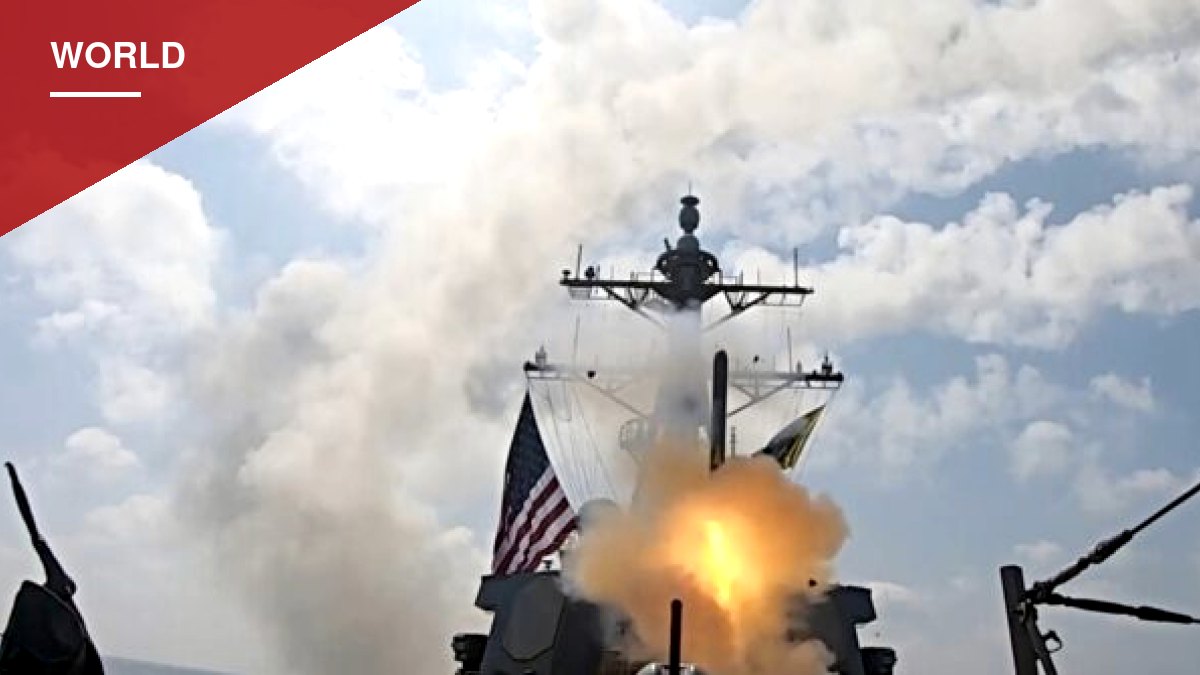

Fighting between the United States and Iran intensified sharply on Tuesday night, with U.S. forces destroying five Iranian oil tankers and Iran retaliating by striking civilian vessels in the Persian Gulf and firing missiles at U.S. forces based in Jordan. Global oil prices climbed above $100 a barrel for the first time since July as the escalation rattled markets.
U.S. Central Command said the tankers were destroyed by American airstrikes after Iran’s Islamic Revolutionary Guard Corps launched ballistic missiles at a U.S. Navy warship on two separate occasions within two days.
“The U.S. warship successfully evaded the attempted Iranian attacks and continued to patrol regional waters. No American personnel were harmed,” CENTCOM said.
CENTCOM identified the vessels destroyed in the Gulf of Oman as the M/T Kaviz, M/T Charminar, M/T Horizon 1 and M/T Riesco, along with the M/T Derya near Kharg Island. The military said crews were ordered to abandon ship before the strikes.
Those five tankers, combined with three others struck on September 5, bring the total destroyed in the past week to ten. CENTCOM described the vessels as part of a “multibillion-dollar shadow network that funds the IRGC and its regional proxies,” adding that “Iran has no means by which to defend these vessels.”
Secretary of State Marco Rubio, speaking during a trip to Colombia on Tuesday, warned that the strikes would continue. “Iran continues to try to hit U.S. naval ships, and for every time they do that or try to do that, they’re going to lose tankers,” he said.
Iran Claims Retaliatory Strikes
The IRGC claimed it struck at least ten ships near the Strait of Hormuz in response. The U.K. Maritime Trade Operations center said it had received unconfirmed reports of several merchant ships in the Persian Gulf and Gulf of Oman hit by “disabling fire,” including one vessel off the coast of the United Arab Emirates reported to be listing and possibly taking on water.
Iraqi officials said a Panama-flagged tanker, the New Andros, was struck by a drone in Iraqi territorial waters and caught fire. Iraqi rescue boats extinguished the blaze, and no casualties were reported.
Iranian state media published a statement from the IRGC warning oil tanker crews near the ports of Kuwait and Bahrain to evacuate their vessels immediately, accusing the two countries of hosting American forces and being “complicit in their actions.”
The IRGC also claimed it struck two U.S. warships in addition to eight tankers and ten other vessels it described as “non-compliant” in waters it claims to control. CENTCOM rejected that claim outright, calling it “completely false.”
“No U.S. Navy warship has been struck; all IRGC attempted attacks failed. Meanwhile, U.S. forces have successfully destroyed 10 Iranian tankers in just the last week,” CENTCOM said.
Missiles Fired at Jordan Intercepted
Iran also launched twenty ballistic missiles at Jordan, which hosts an American military base and is a key U.S. ally in the region. Iranian state media claimed the strike caused “heavy damage,” but Jordanian and American officials said the attack caused no casualties or damage.
The Jordanian military said its air defense systems intercepted 18 of the 20 missiles, with the remaining two landing in unpopulated areas. U.S. officials called the Iranian attack “ineffective” and said all American personnel in Jordan were accounted for.
Oil Markets React
Brent crude, the global benchmark, rose above $100 per barrel in trading Wednesday as the conflict escalated, though it remains below the $126-per-barrel peak reached since the war began at the end of February.
PVM analyst Tamas Varga said the price surge reflects investor concern that shipping through the Strait of Hormuz will remain disrupted. “Oil investors are expressing their view about the impact of the latest bout of escalation in the Middle East in an unambiguous way. They are voting with their dollar, and this vote strongly indicates that unless the Strait of Hormuz re-opens, and oil starts flowing again uninterruptedly, supply will not be aligned with demand in the foreseeable future,” Varga said.






You must be logged in to post a comment Login