
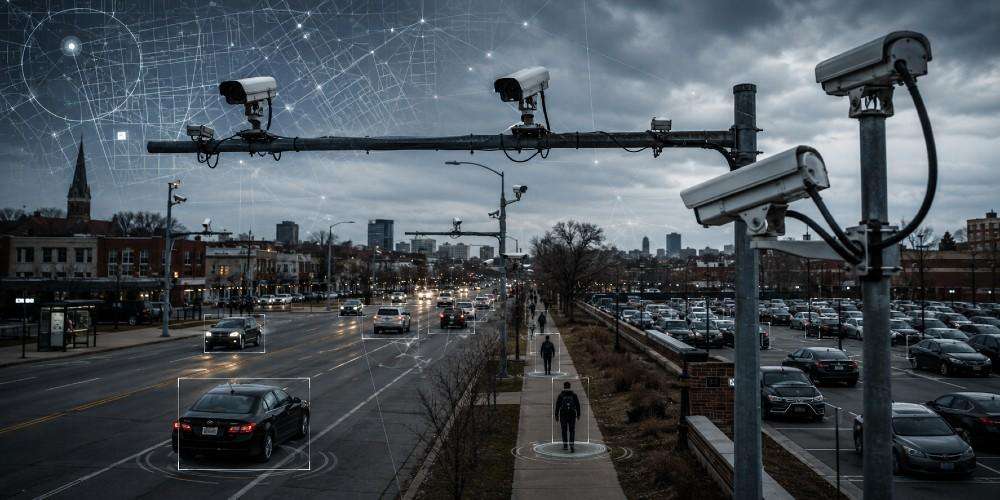

Americans are waking up to a quiet, sprawling surveillance project masquerading as public safety: private companies’ license-plate readers tied into a national lookup that logs where we drive, when we go to church, and who we visit. This piece looks at how the cameras work, why ordinary people pushed back harder than pundits expected, the real abuses we already know about, and why short retention windows or local rules don’t solve the core problem. The stakes are simple: either we accept a permanent national driving diary or we dismantle the network that makes it possible.
The devices on light poles are not traffic cops checking a stolen Buick. They are automated readers run by private firms that photograph plates and record vehicle details to a searchable database. That database gets queried by police and other agencies, turning every trip into a traceable event. If you drive, those scans probably include your daily life.
The usual sales pitch promises stolen cars and missing kids, and who would argue with that? The problem is the system does not limit itself to criminals. It captures everyone, and the moments that matter to you — church, doctor visits, a late-night stop — become entries in a file someone with access can pull up. Which officer, which purpose, and which oversight matters a lot more than the vendor’s brochure.
Ordinary people stopped buying the safety sermon. Homeowners painted, cut, and ripped cameras down. City councils canceled contracts. Governors and members of Congress suddenly sounded skeptical, and that anger spread across ideological lines. When a vendor faces a grassroots map of its own cameras and sees poles being sawed down, it means the politics have shifted in a very visible way.
The evidence of misuse is not hypothetical. Records show officers have used plate-reader systems to stalk exes and romantic interests, and innocent drivers have been stopped at gunpoint because software guessed wrong. Those are not glitches you can paper over with a new checkbox in the user interface. They are predictable consequences of giving warrantless access to movement logs.
Flock and similar companies have offered fixes: shorter retention periods, required case codes, and audits. Those are marginal improvements, and they matter for damage control. They do not get to the heart of the matter, which is whether the network should exist at all and whether private contractors should run a national lookup for every car trip in America.
Put not your trust in princes, nor in the son of man, in whom there is no help.
The caution is timeless because it responds to a modern temptation: trade liberty now for safety later and assume the bargain will be honored. History shows the machinery of power tends to outlast the crisis that justified it. Once a capacity to surveil is built, future officials can repurpose it for whatever emergency they claim is urgent.
People across the political spectrum are asking the right question: how could this be used by the next administration we dislike? That skepticism is not paranoia; it is basic political hygiene. You do not hand your opponents a loaded grid and trust they will never aim it at you.
This fight is bigger than one brand. The issue is a government-adjacent surveillance layer that treats movement as presumptive evidence and turns ordinary life into searchable data. A sheriff who needs help finding a killer is understandable; entrusting every trip to a permanent archive is not.
Local limits are being passed or proposed, but the network is a physical fact. Contracts are terminated and cameras reappear under new names, technicians install units after shutdown orders, and data pipelines can persist despite rules on paper. A statute can be written; a nationwide mesh of recorders is harder to erase once it is built.
We should raise the bar for victory now: take the cameras down, void the contracts, purge the files, and prevent replacement networks from rising. Citizens can accept slower, constitutional policing to solve crimes; they cannot accept a permanent national movement log handed to government and private contractors. This is a defensive fight for liberty, and it matters more than a few convenience claims about safety.
“Then these men assembled, and found Daniel praying and making supplication before his God” (Daniel 6:11). Surveillance historically precedes the crime it is supposed to stop, and that sequence should make us cautious about building capacities we may regret. A free people should not wake up one day and discover their comings and goings are a permanent state asset.





You must be logged in to post a comment Login