
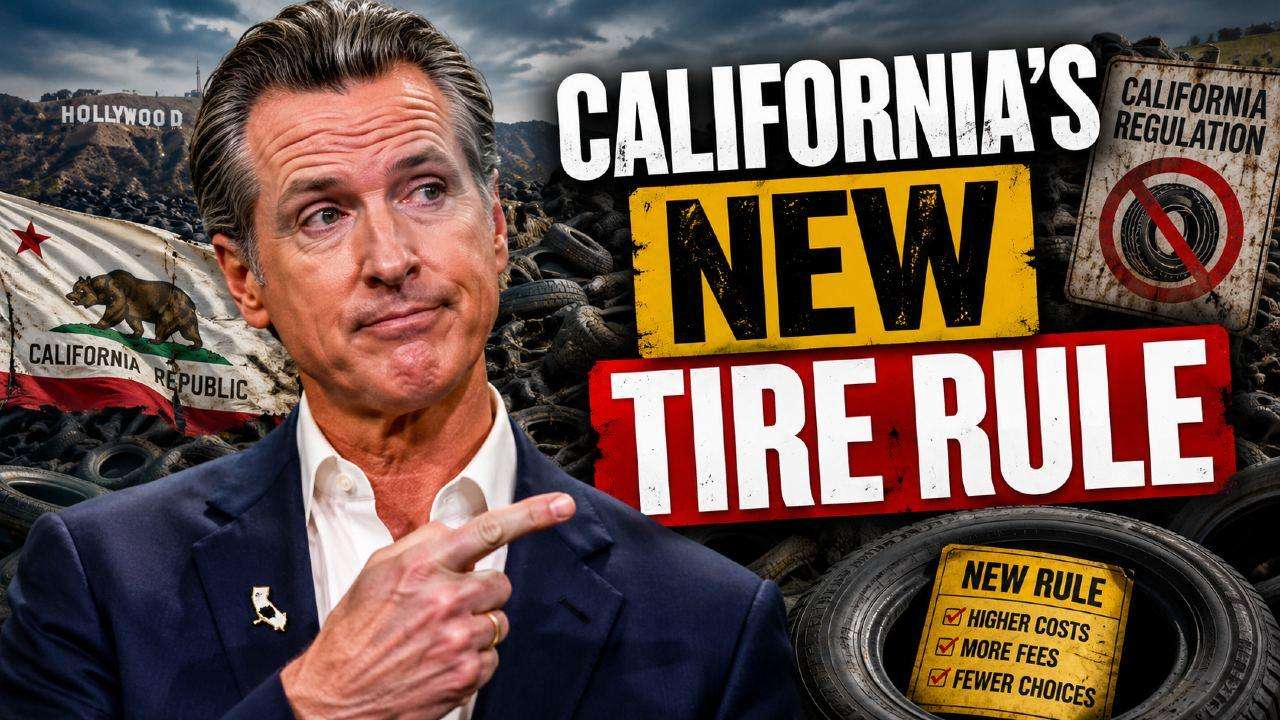

California’s new rules to phase out replacement tires that fail rolling-resistance standards have sparked sharp pushback from industry leaders who say the policy could raise costs, shrink choices, and deliver uncertain benefits; Dunlop North America’s CEO warned officials not to repeat the mistakes of the state’s high-speed rail experiment and asked for real-world proof before forcing a marketwide shift.
The California Energy Commission approved a plan that will ban sales of many replacement tires that do not meet stricter energy-efficiency thresholds, with the prohibition slated to begin in 2029. The goal is straightforward: lower rolling resistance so cars use less fuel and electric vehicles get farther between charges, trimming emissions as a result. That sounds sensible on paper, but the industry points out that rolling resistance is only one part of a tire’s job.
Critics argue the mandate could effectively eliminate a wide chunk of the current replacement tire market, with some estimates suggesting up to 70 percent of options could be affected. When regulators pick a single performance metric and push it hard, manufacturers must change designs across the board, and those changes often carry trade-offs for traction, wet-weather behavior, and tread life. Consumers could end up paying more for tires that perform differently than what drivers expect in everyday conditions.
Tire industry groups have raised alarms about price impacts, saying the average cost per tire could jump substantially, adding hundreds of dollars for a full set on many vehicles. For budget-conscious drivers and owners of older cars that rely on replacement tires rather than new-vehicle options, that is a real hit to household budgets. Even small increases per tire add up fast when millions of replacements are sold every year.
Dunlop’s CEO pointed to the high-speed rail project as a cautionary example of grand promises meeting disappointing outcomes, noting billions spent without assured emissions or fuel-use benefits. His argument is about process more than technology: yes, low-rolling-resistance compounds exist, but regulators are asking one uniform solution to work across a highly varied market. He urged that lawmakers prove consumers will get better overall results, not just improved numbers on a lab test.
Beyond the technical objections, the company has proposed practical alternatives that could improve efficiency without forcing wholesale redesigns. One idea is stronger emphasis on tire-pressure monitoring and public education about proper inflation, which can boost mileage and safety without raising sticker prices. Targeted incentives and smart labeling could steer buyers toward efficient choices while preserving options that matter for winter roads or heavy-duty use.
The wider debate highlights a recurring tension in regulation: balancing ambitious environmental objectives with the messy reality of diverse consumer needs and market economics. Policy that treats every tire as if it serves the same driver on the same road risks unintended consequences for safety and affordability. A staged rollout with rigorous, transparent field testing would give regulators the evidence they need to justify sweeping rules.
History complicates the case for hasty action, since large, costly projects with political momentum have sometimes underdelivered on promised environmental benefits. Calling for additional study and real-world validation is not obstruction, it is a request for accountability so families, fleets, and retailers are not left footing an unnecessary bill. If the efficiency gains are real and durable, they will survive rigorous testing and public scrutiny and then deserve a policy floor rather than a blunt mandate.






You must be logged in to post a comment Login