
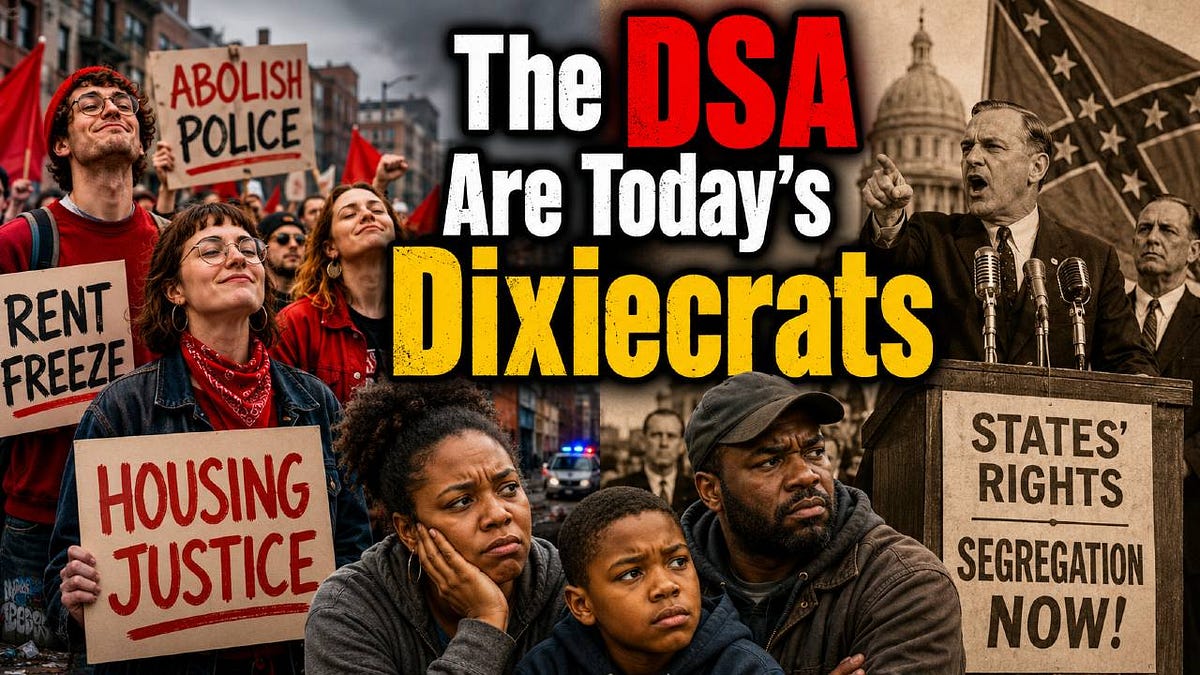

The Democratic Socialists of America claim to speak for the working poor and minority communities, but a close look at membership, tactics, and results shows a very different reality: a largely white, well-off activist class pushing policies that often harm the people they claim to defend. This piece peels back the rhetoric and lays out how a movement’s self-confidence, demographics, and policy choices collide with the real world in ways that matter most to Black and low-income Americans.
The DSA talks like a grassroots movement built around the oppressed, yet its membership tells another story. A large majority of members identify as white, most hold college degrees, and a notable share report comfortable household incomes. That profile doesn’t match the image of an organization rooted in factory floors or rowhouse neighborhoods; it looks more like an educated activist cohort confident in its moral authority.
I will be discussing this topic further on today’s episode of The JD Rucker Show.
That mismatch matters because politics is not defined by intentions but by who shows up and whose lives are reshaped by policies. Chapters across the country admit they struggle to recruit Black and Hispanic members even where those communities are the majority. When the people you claim to champion decline to join, you should ask why instead of assuming you already know their needs.
The DSA has embraced radical criminal-justice reforms that sound compassionate in speeches but have predictable effects on neighborhoods facing concentrated violence. National platforms and working groups call for deep cuts to police funding and eventual abolition of police and prisons. Those proposals have real consequences when enacted, and experience shows those consequences fall hardest on vulnerable communities.
They have healed also the hurt of the daughter of my people slightly, saying, Peace, peace; when there is no peace.
That biblical line fits when reformers offer bold promises without reckoning with practical trade-offs. Research linking police staffing to reductions in homicide is not a partisan talking point; it is an empirical pattern that too often gets ignored by advocates who prioritize ideology over outcomes. When officers leave the street, homicides rise, and the victims are disproportionately Black men and women in high-crime neighborhoods.
Minneapolis provides a recent, cautionary case study. After policing was demonized and budgets were slashed, violent crime spiked and municipal leaders scrambled to rebuild capacity. The activists who cheered the initial contractions of policing did not shoulder the same risks as people living in impacted neighborhoods. That disconnection between policy zeal and lived experience is central to the critique.
Housing policy is another area where the DSA’s prescriptions backfire on the very people it insists it defends. Enthusiasm for rent freezes and strict controls rides against decades of economic research showing that hard price caps reduce supply and accelerate displacement in desirable markets. When landlords convert regulated units or stop maintaining properties, the result is fewer affordable options for newcomers and lower-quality housing for residents who remain.
Policy makers who prioritize control over supply often create winners and losers: a handful of incumbents hold onto valuable controlled units while would-be tenants—often young, immigrant, or minority—face thinner markets and higher prices on unregulated housing. Those outcomes run opposite to the stated goals of equity and access the DSA markets to voters.
The DSA’s pattern is about power and posture as much as policy. An affluent, educated cadre presumes authority to define liberation for communities it cannot recruit and cannot protect from the consequences of its own ideas. That posture breeds resentment and fuels the question that should trouble any movement that calls itself progressive: by what authority do you speak for people who are not in the room?
History offers an uncomfortable parallel. There have been other factions that claimed moral clarity while making decisions for marginalized groups without their consent. The tactics differ, but the result is the same when elites speak on behalf of outsiders without building genuine partnerships or listening to local priorities.
Politics should be judged by results, especially when lives and livelihoods hang in the balance. Good intentions are not enough when policy produces more danger and less housing for the communities you claim to defend. A movement that genuinely serves the poor would cultivate real representation, accountability, and respect for empirical evidence, not just louder slogans.
As the DSA grows in influence inside the Democratic coalition, that simple question keeps returning: will leaders who are so much like each other finally stop presuming they know what’s best for everyone else? Until they start listening, the gap between rhetoric and real-world impact will keep widening, and the costs will be paid by the people said to be at the center of the cause.





You must be logged in to post a comment Login