
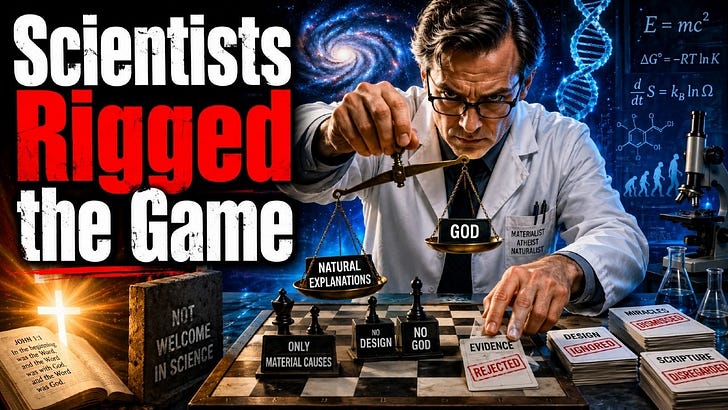

This piece argues that the real clash in our culture is not between science and God but between honest evidence and a prior commitment to materialism, and it traces how that commitment shapes careers, institutions, and interpretations of data while highlighting scientific and philosophical signs that point beyond a purely material explanation.
People like tidy stories: lab coats versus pulpits. That neat framing misses the messier truth that many scientists bring a philosophical assumption into their work before they even look through the microscope.
That assumption is materialism, the idea that only matter and physical causes ultimately exist, and it often functions as a gatekeeper. When a discipline rules whole classes of explanations out of bounds before inquiry begins, it is not following evidence so much as enforcing a worldview.
One candid admission of that posture is worth quoting in full. “We take the side of science in spite of the patent absurdity of some of its constructs … because we have a prior commitment, a commitment to materialism. It is not that the methods and institutions of science somehow compel us to accept a material explanation of the phenomenal world, but, on the contrary, that we are forced by our a priori adherence to material causes to create an apparatus of investigation and a set of concepts that produce material explanations, no matter how counter-intuitive, no matter how mystifying to the uninitiated. Moreover, that materialism is absolute, for we cannot allow a Divine Foot in the door.”
Read that and notice the priority: the conclusion precedes the evidence. A juror who declares a predetermined verdict would be dismissed, yet in modern science those who hold the keys to journals, grants, and hiring can impose the same rule. That structural bias matters more than the private beliefs of technicians on the bench.
Look at the landscape of belief among elite scientists. Membership in exclusive bodies shows far lower rates of personal faith than the broader public, a mismatch that cannot be chalked up simply to education turning minds away from God. Sociological work finds many scientists arrive already unconvinced and then choose fields and institutions congenial to that view.
The scriptural witness long ago described a similar dynamic in moral terms. “For the invisible things of him from the creation of the world are clearly seen, being understood by the things that are made, even his eternal power and Godhead; so that they are without excuse: because that, when they knew God, they glorified him not as God … Professing themselves to be wise, they became fools.” That passage calls unbelief a suppression of what is visible, not merely a lack of evidence.
If materialism is the ruling assumption, what has to be explained without appeal to design? Start with the fine tuning of physical constants that make stars, chemistry, and life possible. Those razor-edge balances are not speculative theology; they are physical facts that cry out for an account.
Then consider biological information. Life operates on a chemical code—DNA—that behaves like language and instruction, with error correction and translation machinery. As one prominent skeptic later acknowledged, “the findings of more than 50 years of DNA research have provided materials for a new and enormously powerful argument to design.” He also insisted, “It’s simply not on to think this could occur simply by chance.”
That kind of honest movement of mind is what the institutional consensus often resists. Science is self-correcting, and that is its strength, but self-correction depends on letting all reasonable explanations be explored. When the professional culture narrows the permissible answers, the revision process gets skewed and public confidence is overstated.
Recent telescopic surprises illustrate the point. Early James Webb results prompted questions that unsettled standard timelines and forced cosmologists to consider “uncharted territory.” Corrections followed, as science should, but the episode highlights how provisional many headlines are compared with the cautious language in specialist journals.
The critical issue is not whether science works; it is whether science is honest about its philosophical limits. The evidence many point to does not vanish when examined; what often vanishes is the willingness to follow where that evidence leads if it points toward a Creator. A science that reopens the door might discover that what was left out is exactly what explains what we observe.






You must be logged in to post a comment Login