
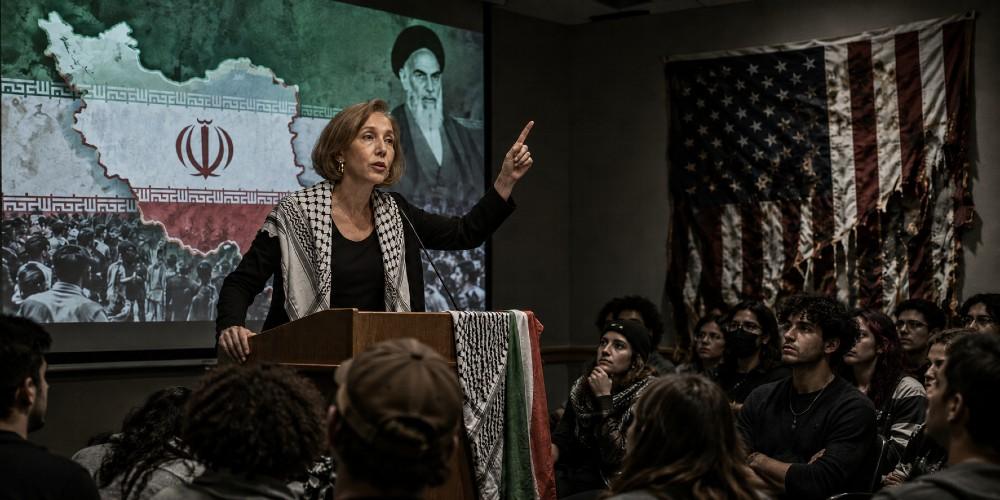

This piece examines a New School professor’s public praise for Iran’s Revolutionary Guard at a DSA event, traces her past campus actions, and argues why such academia-driven sympathies toward violent regimes are dangerous for American institutions and families.
A professor at The New School led an event titled “Islamic Revolution Teach-in” where she framed the IRGC as a bulwark for the working class rather than a violent, U.S.-designated terrorist organization. Her remarks celebrated Tehran’s ability to strain American arms supplies and praised Iran’s domestic industry for delivering what she called “phenomenal results.” The tone was unapologetic and political, not academic.
She declared, “We need to bring the empire down by any means necessary,” a line that repositions the IRGC’s violence as strategic resistance instead of a grim record of civilian deaths. In the same talk she defended the group as a protector of workers and suggested large military investment was justified in service of justice. That framing flips moral reality and normalizes violence in the name of ideology.
The presenter also attributed to the Iranian state policies like “strong gender inclusion” and “prioritizing human life,” claims that stand in stark contrast to widely reported repression of protesters and treatment of women in Iran. Such selective praise ignores documented executions and crackdowns. It’s a rhetorical sleight-of-hand that sanitizes brutality for political gain.
Her audience, largely composed of DSA members, reportedly responded with glowing praise, calling the presentation “excellent” and “incredible.” One organizer cautioned against purity tests while urging disruption of the so-called “war machine,” signaling a willingness to accept allies who oppose America even when those allies commit human-rights abuses. That willingness creates an unsettling alliance between Western radicals and authoritarian actors abroad.
This professor’s past behavior fits the pattern: she was arrested over campus unrest in 2024 that left buildings burned and roughly $3 million in damages, linked to anti-Israel protests at CUNY. She was fired and later reinstated at academic institutions, ultimately landing at The New School. Her career path raises hard questions about accountability in higher education.
Taxpayers and parents fund universities where educators can advocate for the downfall of the United States without clear professional consequences. Administrators who quietly rehire or shield such faculty either share the radical view or lack the courage to confront it. Either explanation is alarming for anyone who cares about civic stability and the values that built this country.
When faculty adopt rhetoric that elevates foreign militant groups as righteous resistance, they do more than teach theory; they normalize the enemies of liberal society. Students are impressionable, and the campus lecture hall can become a pipeline from abstract grievance to real-world sympathy for violent movements. That shift undermines the rule of law and erodes the moral clarity needed to defend liberty.
The consequences are not only civic but cultural. Parents, lawmakers, and citizens should expect institutions of higher learning to uphold basic standards of truth and to reject applause for terror. Defending the IRGC while advocating to topple American influence is not a scholarly debate; it reads like ideological betrayal to many who value national security and human rights.
Ultimately, these developments call for clear-eyed responses: enforce accountability, protect students from indoctrination, and restore standards that separate rigorous critique from cozying up to brutality. As the Bible warns, “Woe unto them that call evil good, and good evil; that put darkness for light, and light for darkness; that put bitter for sweet, and sweet for bitter.” Institutions that shelter voices praising violent regimes have a duty to change course before the damage becomes permanent.




You must be logged in to post a comment Login