
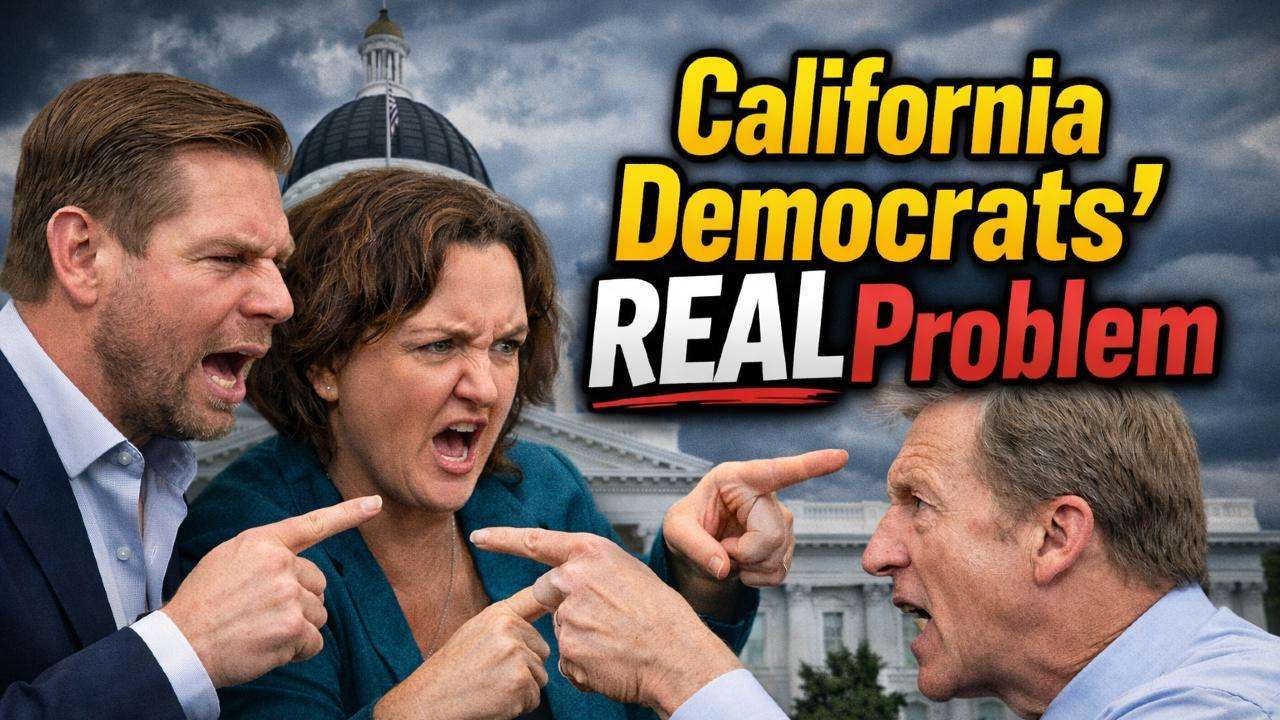

California Democrats are stumbling through a self-inflicted crisis as a crowded gubernatorial field and the quirks of the top-two primary threaten to hand the state to Republicans, while a recalled former governor, Gray Davis, reappears offering the blunt advice that candidates under pressure should “stay in” and ignore pleas to withdraw.
There is a sharp irony in a party that spent decades preaching competent governance now watching its own primary dissolve into chaos. A man ousted in a humiliating recall, Gray Davis, has resurfaced to tell current hopefuls that when party leaders urged him to quit, “Tons and tons of people asked me to drop out,” and that the pressure “was fuel for the fire,” as he went on to win the primary “pretty handsomely.”
That memory cut both ways for Democrats. Davis’s comeback story is true in its narrow facts, but 1998 is not 2026 and the ground rules have changed. Back then there was no top-two primary slicing votes into countless tiny shares, so the same playbook does not translate cleanly into a contest where dozens of candidates can hand victory to the other side simply by staying put.
The Democratic machine in California controls every statewide office and a supermajority in the legislature, yet it looks helpless as the governor’s race fragments. Instead of debating policy that affects people’s daily lives, the discussion has drifted into disputes over debate lineups and identity checklists, a spectacle that left USC withdrawing from a planned event after critics said the candidate roster raised questions about representation.
Party leaders have publicly urged those without a “viable path” to step aside to avoid splitting the vote, and most candidates have shrugged and kept their campaigns alive. That defiance reflects a broader political culture that has spent years telling every interest group and every faction that its voice must be heard above all else, and now that ethic has become a practical liability.
The top-two primary system is the structural trap here. With more than twenty Democratic contenders slicing the liberal electorate, two Republicans could plausibly finish first and second and advance to the general election. Polling has put Republican Steve Hilton and others near the top, while Democratic support is spread thin across a crowded field, turning arithmetic into a real threat.
That a Republican could win California’s governorship because Democrats could not stop competing with one another is already being spoken of as a distinct possibility. The party’s inability to coordinate or persuade marginal candidates to exit shows a lack of discipline, not merely a failure of strategy, and it plays into the hands of an opposition that has been shut out of statewide victories for years.
Veteran Democrats admit the party has no obvious playbook to fix this. One consultant summed it up plainly: “I have no idea and anybody who tells you they do, they don’t know either.” That admission isn’t just embarrassing; it highlights how institutional confidence can crumble when incentives are misaligned and personal ambition trumps collective calculus.
Davis’s counsel to stand firm feeds a narrative of personal grit, but it also masks another reality: candidates at 2 or 3 percent are not reruns of the 1998 Gray Davis. They’re often seeking exposure, issue platforms, or future career capital rather than a genuine path to victory, and their persistence increases the odds that Democrats will fragment themselves into irrelevance on the ballot.
Meanwhile, the voters whose lives are supposed to be the focus are concerned about material problems like inflation, housing, and daily costs. Surveys show the economy and housing top the list of voter worries, yet the dominant media story remains internal party mechanics and process fights, a mismatch that makes politics look more like theater than governance.
Republicans, for their part, have done little to earn a statewide comeback beyond seizing on Democratic disarray. Their unusual opportunity this year is less the product of a broad shift in Californian opinion than the consequence of a progressive coalition tearing itself apart at the seams. If two Republicans advance, the November contest will be hard for any Democrat to win in a state already struggling with high living costs and visible public policy failures.
The old proverb that “a house divided against itself cannot stand” captures the moment without any need for partisan flourish. California’s one-party dominance has papered over internal contradictions for years, and now the payoff for that approach is chaos at the ballot box and a reopened pathway for the opposition. Gray Davis, who once won and then lost spectacularly, has offered his take — whether the lesson fits modern rules or not, his return to the conversation is a sober reminder that political victories can be fragile.




You must be logged in to post a comment Login