
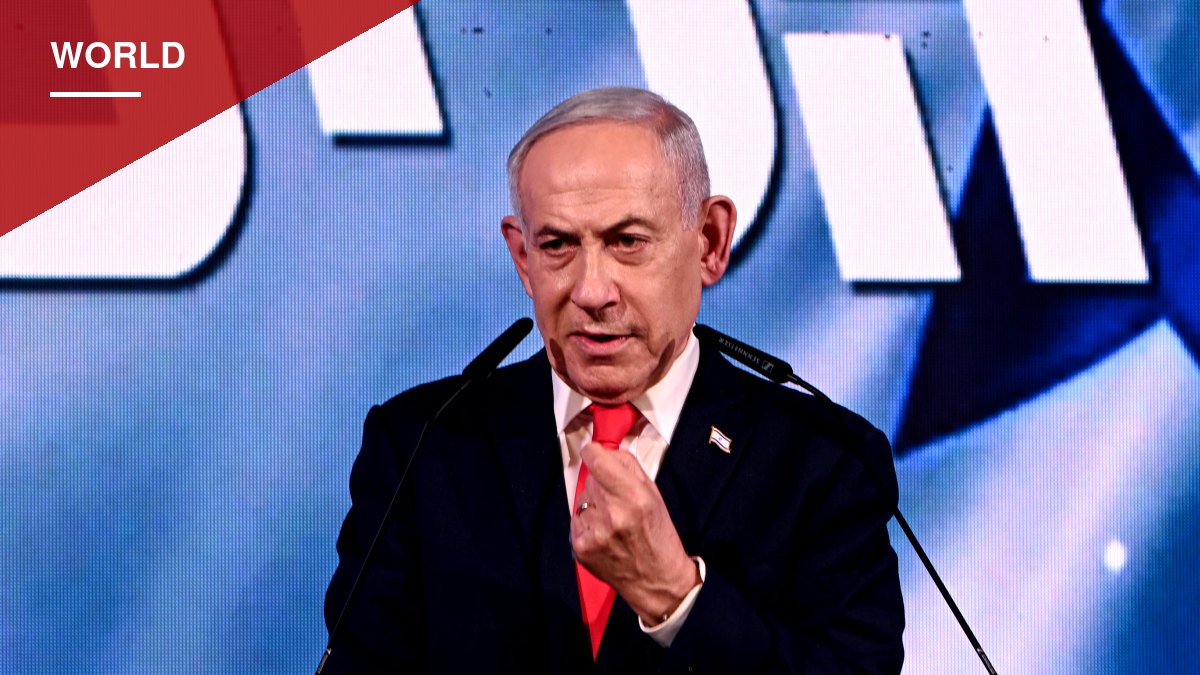

Israeli Prime Minister Benjamin Netanyahu’s coalition of right-wing and religious parties maintained a lead over its rivals Thursday morning as election officials continued tallying votes from the country’s general election, though the final shape of Israel’s next government remains unsettled.
According to an update from the Central Elections Committee issued at 9:08 a.m., Netanyahu’s Likud party had captured 1,085,162 votes, or 20.65%, out of 5,278,597 ballots counted at 12,032 polling stations.
Netanyahu’s broader bloc, which includes United Torah Judaism (293,990 votes, 5.59%), Otzma Yehudit (292,985 votes, 5.58%), Shas (277,689 votes, 5.28%) and Religious Zionism-Zehut (250,996 votes, 4.78%), had a combined 2,200,822 votes, or 41.88%.
The opposition, led by Gadi Eisenkot’s Yashar party with 849,121 votes (16.16%), trailed with a combined 1,978,268 votes, or 37.64%, when paired with B’Yachad (476,857 votes, 9.07%), the Democrats (340,562 votes, 6.48%) and Yisrael Beiteinu (311,728 votes, 5.93%).
Based on the partial count, Israeli media projected Netanyahu’s bloc would win 53 seats, against 48 for the opposition and 19 for Arab parties — though those figures could still shift as counting continues.
Netanyahu Claims Vindication
Netanyahu declared victory early Wednesday morning, insisting the results proved Likud’s dominance despite polling that had suggested a tighter race.
“Do you remember how the propaganda channels manipulated public opinion? Likud — 18 seats, 19 seats — they knew all along that it was a lie,” Netanyahu said.
He argued that pre-election polling was designed to suppress turnout among his supporters. “They tried to discourage you, simply discourage you, from going to the polls. That’s what happened here. Well, the first thing that has become unequivocally clear is that Likud is the largest party in Israel. There is no disputing that,” he said.
Netanyahu also argued the results showed broad support for his camp among Jewish voters. “The second thing that has become clear is that the right-wing bloc has a clear, overwhelming majority among the Zionist public, among the Jewish public, and among all those who support a Jewish state,” he said, adding that any future government must exclude “anti-Zionist parties — parties that oppose our very existence.”
Path to Government Still Unclear
Even with the apparent lead, Netanyahu’s bloc has not yet reached the 61 seats needed to form a governing coalition in the 120-seat Knesset. If the current trend holds, however, he would likely be in a strong position to get the first shot at forming a government — though that opportunity is not guaranteed to automatically go to the leader of the largest party.
Official results are expected to be certified on Nov. 4. After that, President Isaac Herzog will consult with party leaders before designating a lawmaker to attempt to build a coalition.
Herzog urged parties to keep an open mind during that process, warning against the prospect of yet another election. “We must do everything possible, certainly after yesterday, to avoid another election,” he said during a meeting at the President’s Residence in Jerusalem. “I expect everyone who comes here to come with an open mind.”
He added that he would receive certified results from Central Elections Committee Chairman Noam Sohlberg before beginning formal consultations. “I will receive the official results next week from Justice Sohlberg,” Herzog said. “Afterward, I will begin the consultation process here, hear from each faction, ask questions and hold discussions.”
What Comes Next
Israeli law sets a strict timetable for forming a government. The candidate Herzog first designates gets 28 days, with a possible 14-day extension, to assemble a coalition. If that effort fails, the president can hand the task to another candidate for another 28 days.
Should that also fail — or if Herzog concludes no government can be formed — a coalition of at least 61 Knesset members would have 21 days to request a different candidate, who would then get 14 days to try to form a government. If all of that fails, a new election would be triggered roughly 90 days later.
Herzog has said he will work to avoid that scenario. “I really, truly will do all I can so there won’t be repeat elections,” he said.
This election, for the 26th Knesset, was the first general vote held in Israel since the Hamas-led attack on Oct. 7, 2023.



You must be logged in to post a comment Login