
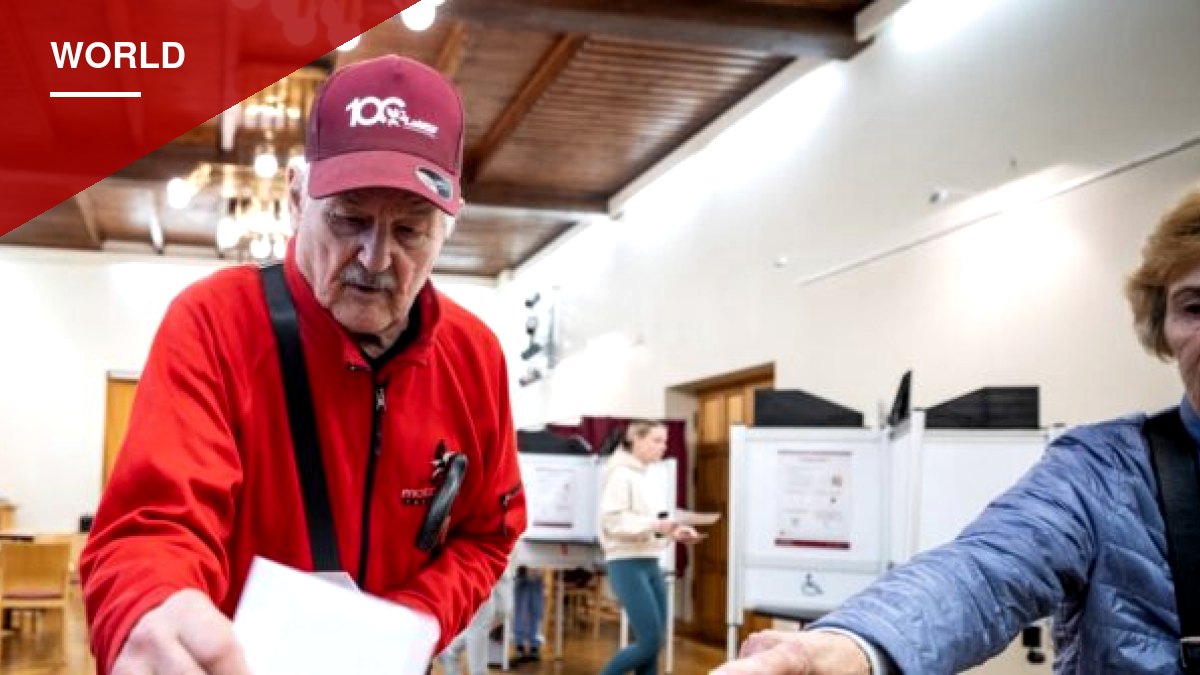

Voters in Latvia went to the polls on Saturday to elect a new parliament, in a contest shadowed by concerns over Russian aggression and hybrid warfare along NATO’s eastern flank.
Prime Minister Andris Kulbergs, 47, leader of the centrist United List party, is seeking a full term after taking office following a political crisis. The previous governing coalition collapsed in May amid disputes over how to handle stray drones suspected of coming from Ukraine, compounding strains that had already weakened the government. The Saeima, Latvia’s single-chamber parliament, subsequently approved a four-party coalition led by Kulbergs, whose party had been in opposition.
Latvia shares borders with both Russia and its ally Belarus, and alongside fellow Baltic states Lithuania and Estonia, has been a firm supporter of Ukraine in its war against Moscow’s invasion.
Speaking outside a Riga polling station after casting his ballot, Kulbergs said he hoped for a strong result that would let him steer the country forward.
“I hope we get a good result. This would give us an opportunity to make changes, put Latvia on the right track for defense and economy,” he said. “A strong economy can only bring strong defense, so that is the mission for the next four years if I’m given the right to lead the country. Our party is ready to make changes.”
About 1.56 million people out of Latvia’s population of more than 1.8 million were eligible to elect the 100 members of the Saeima to four-year terms. Because the political landscape is fragmented and parties need at least 5% of the vote to enter parliament, a multiparty coalition is almost certain to be required to form the next government.
Some voters framed the election as a test of democratic participation itself. Janis Artis Briedis, who voted in Riga, said he wanted to see citizens turn out and express their views on who should lead the country.
Another voter, Reinholds Pirags, called it “a very decisive election” and said he expected Latvians to back parties that would make sound decisions on defense and the economy, even if the resulting coalition proved imperfect.
“I think the coalition will be maybe not ideal, but it will be still OK and we’ll be moving in the right direction,” Pirags said.
Security on alert
Worry over Russian hybrid attacks — a catch-all term covering sabotage, cyberattacks, disinformation campaigns and other non-conventional hostile acts — has grown across parts of Europe in recent months. Latvia, given its proximity to Russia, is considered especially exposed.
NATO bolstered protection of Latvian airspace for the duration of the election, with Germany deploying four Eurofighter jets to the country for roughly a week.
Latvia’s State Security Service said last week it had not detected any significant or systematic effort by Russia or other actors to sway the election toward any particular party or candidate, according to the LETA news agency.






You must be logged in to post a comment Login