
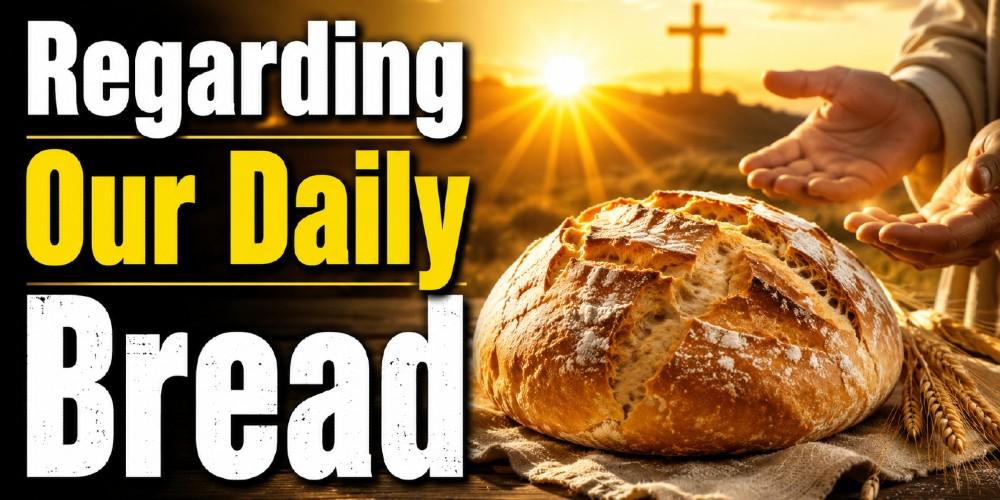

The Lord’s Prayer contains sharp, deliberate words that steer us away from stockpiling and toward daily dependence, link mercy outward with what we receive, and use unlikely Greek phrasing to make the point vivid and unforgettable.
We say “Give us this day our daily bread” until the phrase blends into background noise, but that would miss what Jesus intends. The prayer deliberately frames need as immediate and recurring, not as a request for surplus or a lifetime supply. It forces attention back to today, to the ordinary rhythm of receiving what is needed right now.
The Greek makes the point even stranger and stronger. The word rendered “daily” is *epiousios*, a word found nowhere else in all of Greek literature. That uniqueness suggests the Gospel writers didn’t reach for the everyday term for ordinary provision; they chose something crafted to unsettle and to sharpen the idea.
The image behind the petition is the manna in Exodus 16, bread that came in the morning and could not be hoarded. As the ancient account warns, “some of them left of it until the morning, and it bred worms, and stank” (Exodus 16:20). The miracle was not just the bread itself but the lesson: God’s people were meant to live moment by moment, trusting the daily refill.
So the request is quietly disruptive to common instincts. We’re built to accumulate, to prepare, to build barns for safety and control. Jesus answers that drive a few verses later: “Take therefore no thought for the morrow: for the morrow shall take thought for the things of itself” (Matthew 6:34), nudging us away from anxiety and toward present reliance.
This does not condemn work or sensible planning. It simply relocates our ultimate security from what we store to who provides. The prayer reshapes priorities: provision is a present gift designed to keep dependence alive and attention fixed on the giver rather than the granary.
Then the petition pivots outward, tying provision to relationship: “And forgive us our debts, as we forgive our debtors” (Matthew 6:12). Notice the communal language from the start—us, our, we—so the prayer never speaks of individuals as isolated consumers but as members of a mutual household of need and mercy.
Jesus lingers on the mercy side because it reveals the heart of reciprocal dependence. “For if ye forgive men their trespasses, your heavenly Father will also forgive you” (Matthew 6:14) links what we receive with what we give, tying daily sustenance and daily pardon into the same practice of openness. The bread we ask for and the mercy we extend are meant to be handed out with open hands, not clutched as personal insurance.
That is also why the rhythm matters: the meal and the mercy both must be renewed. Yesterday’s supply is gone; the grace you needed yesterday shouldn’t be hoarded like leftover bread. Holding onto old resentments or old self-protective stashes contradicts the very pattern the prayer rehearses.
Shifting from a future-focused hoarding mindset to a present-focused dependence changes behavior, not by removing prudence but by recalibrating trust. If the center of security is a relationship that provides daily, our choices follow—generosity, quick forgiveness, and an attention to needs around us. The prayer trains a daily posture that keeps us responsive rather than withdrawn.
Reading that simple line with fresh ears reveals an economy of grace built into everyday life. It asks for what is needed, expects to receive it, and calls for a matching posture toward others. The result is a practice that keeps mercy and provision flowing day by day, refusing to let yesterday’s leftovers harden into tomorrow’s barricade.





You must be logged in to post a comment Login