
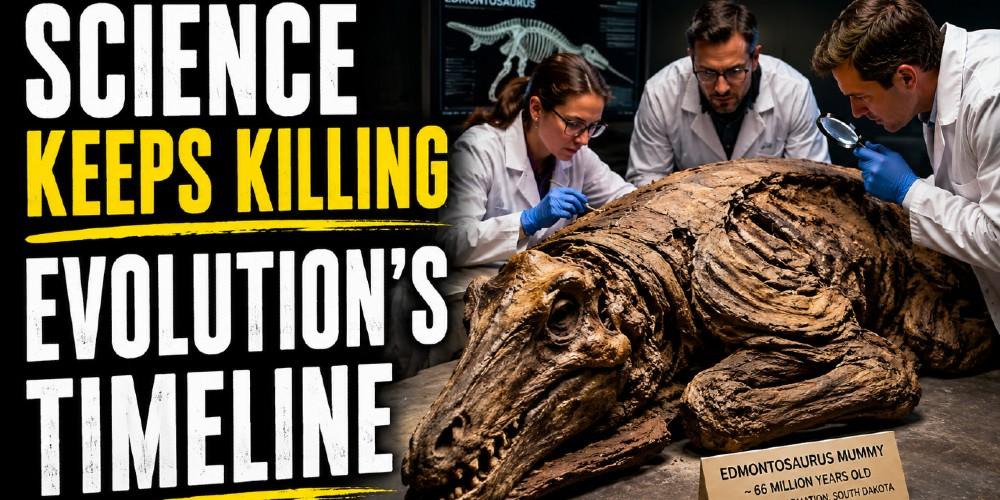

Scientists recently reported finding collagen sequences inside the fossilized bones of an Edmontosaurus, a discovery that has stirred debate about how organic molecules can persist in ancient fossils and how different worldviews interpret that evidence.
Researchers described detecting endogenous collagen using high-resolution mass spectrometry and protein sequencing, and they reported multiple checks to rule out modern contamination. The analyses were detailed enough to convince some scientists that the peptides recovered match what one would expect from dinosaur collagen. These results were published in a peer-reviewed chemistry journal and discussed in mainstream science outlets, prompting renewed scrutiny.
From a purely chemical standpoint, proteins are expected to break down relatively quickly under surface conditions, so finding intact sequences inside mineralized bone raises hard questions. Critics point out that laboratory contamination or bacterial activity can sometimes mimic ancient biomolecules, which is why independent replication and strict controls are central to the debate. Supporters of the findings emphasize the variety of orthogonal tests applied, arguing those controls reduce the contamination hypothesis.
One camp frames these soft tissue discoveries as consistent with a rapid, catastrophic burial scenario, suggesting that quick entombment could preserve delicate structures that would not survive long-term exposure. In that view, preserved collagen, flexible blood-vessel-like structures, and remnants interpreted as red blood cells form a pattern that favors short timescales for fossilization. Proponents say such a pattern aligns with a historical flood model that would promote rapid sedimentation and preservation.
Other scientists offer different preservation mechanisms that operate over long intervals, such as mineral stabilization, iron-mediated crosslinking, or microbial biofilms that shield organic molecules. These hypotheses do not require a revision of conventional timelines but instead invoke biochemical and geochemical processes that can, in rare cases, greatly slow degradation. The field remains split, with ongoing experiments trying to reproduce preservation pathways in the lab and in the rock record.
The tension around these finds highlights a broader methodological point: scientific interpretations are shaped by background assumptions about time, process, and causation. Some researchers approach data assuming uniform rates and slow change, while others allow for more variable, high-energy events in the past. When surprising data emerge, both camps either adjust their models or push for additional verification, and that iterative process is how scientific consensus evolves.
Public interest in these discoveries is high because the implications touch on deep questions about Earth’s history and biological origins. For many non-specialists, clear imagery like “soft tissue in a dinosaur bone” challenges simple narratives and invites closer inspection of the evidence. Scientists on all sides have called for more samples, transparent data sharing, and independent replication to resolve outstanding uncertainties.
“For in six days the LORD made heaven and earth, the sea, and all that in them is, and rested the seventh day: wherefore the LORD blessed the sabbath day, and hallowed it.” (Exodus 20:11)
The biblical quotation above is cited by those who read such fossil discoveries through a scriptural lens, and it serves as a historical touchstone for some communities interpreting the fossil record. Whether one views the collagen find as a fatal challenge to deep-time thinking or as another fascinating puzzle for taphonomy, the discovery has clearly energized discussion across disciplines. Expect a steady stream of follow-up studies that aim to clarify preservation mechanisms, test reproducibility, and refine our understanding of how proteins can persist in the rock record.
Ultimately, the Edmontosaurus collagen report is a prompt for better science: more rigorous sampling, blinded testing, and interdisciplinary collaboration among chemists, paleontologists, and geochemists. As additional data arrive, the scientific community will weigh competing explanations and adjust models accordingly, which is exactly how science advances in the face of unexpected evidence.





You must be logged in to post a comment Login