
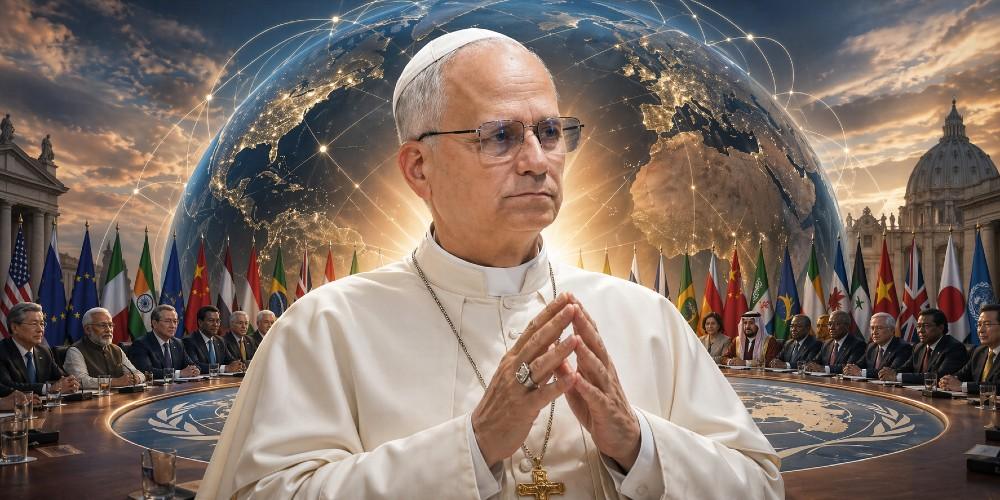

The Vatican has quietly shifted from defender of tradition to cheerleader for an open-borders global agenda, and that change matters to anyone who cares about national identity, public safety, and the future of Western civilization. This piece walks through how multiculturalism became the modern vehicle of globalism, how Vatican policy and influence have helped normalize mass migration, and why conservatives see the Pope’s posture as a political choice with real consequences. It highlights specific statements, institutional ties, and programs that tie the church to wider elite efforts to reshape nations and boundaries. Expect plain talk about ideology, policy, and the stakes involved for ordinary families.
Multiculturalism has been pushed as inevitable, dressed up as compassion while operating as a political tool to reorder societies. What looks like tolerance on the surface can act as a conveyor belt for deeper changes to culture, law, and demography, and many conservative observers view that dynamic as deliberate. For decades cultural institutions nudged public opinion toward accepting mass migration as a moral default rather than a contested public policy. That shift did not happen by accident.
The modern church’s role in this shift is hard to ignore, because the Vatican speaks with influence few institutions enjoy. Recent papal remarks criticizing certain national security actions and praising open migration are being read by conservatives not merely as pastoral opinion but as political alignment. When spiritual leaders take positions that track with elite globalist priorities, voters and policymakers notice and react accordingly.
Two papal quotes have become touchstones for critics because they encapsulate the tone driving Vatican messaging. One reads exactly, “I know that in Europe there are, many times, fears that are present, but oftentimes generated by people who are against immigration and trying to keep out people who may be from another country, another religion, another race. And in that sense, I would say we all need to work together…” and the other states, “The Church, like a mother, accompanies those who are walking. Where the world sees threats, she sees children; where walls are built, she builds bridges… She knows that in every rejected migrant, it is Christ himself who knocks at the door of the community.” These words are powerful and politically charged, and they have been seized on by both supporters and critics.
The tendency to treat migrants almost as sacred symbols, rather than as individuals whose arrival carries complex social and security questions, is central to the controversy. The comparison of modern refugees to biblical travelers is historically shaky, since the Holy Family moved within a single imperial domain rather than crossing modern international borders. Yet the imagery persists and shapes policy debates in a way that many conservatives find misleading and politically motivated.
It is striking that the Vatican itself sits inside a fortress of security, yet advocates policies that impose risks on communities that must absorb mass migration. This gap between elite safety and popular exposure fuels suspicions that globalist policies are designed from the top down without regard for local consequences. When institutions champion open migration but do not live with its day-to-day effects, people rightly ask who benefits and who pays the cost.
Church organizations have been involved in migrant resettlement programs and partnerships with governments, and those activities have real scale and budgetary support. In the U.S., Catholic organizations played a major role in receiving refugees and asylum seekers during recent years, and in Europe a sizeable portion of integration funding has flowed through church-affiliated groups. Those facts matter because institutional participation turns philosophical commitments into concrete demographic outcomes.
The Vatican’s engagement with elite networks extended into projects formed at the height of the pandemic. One such initiative was the Council For Inclusive Capitalism, a coalition that linked corporate leaders, NGOs, and religious institutions around a shared program of economic and social reforms. The Vatican’s contribution to this effort was portrayed as moral framing for broader policy experiments that blend social justice language with centralized planning.
Critics argue the Council’s aim was to mainstream a model where corporations and governments use social and financial levers to enforce ideological priorities. The Vatican’s involvement helped give the project a veneer of moral legitimacy, which made it easier for policymakers to promote coordinated agendas under the guise of charity and interfaith unity. When moral authority and financial power team up, policies that would otherwise provoke resistance become easier to sell.
For conservatives who care about national sovereignty and cultural continuity, the Vatican’s tilt feels like a betrayal of an older mission. Historically the papacy stood as a bulwark of Western religious identity; now many see it as accommodating forces that want borders dissolved and traditions sidelined. That perception drives a sharp political reaction: skepticism toward church endorsements of political programs and a renewed focus on elective leaders who will restore national control.
Many Americans and Europeans worry that mass migration has been weaponized as a tool to soften national resistance and reshape electorates. Political leaders who benefit from demographic change have little incentive to address the social strains that follow, and institutions aligned with those leaders become symbols of the broader policy. As debates heat up, conservatives are pledging to defend the institutions and communities most directly affected by these choices.
The stakes in this argument are not abstract. Public safety, cultural cohesion, and democratic accountability hinge on whether migration is treated as a policy to manage or a moral imperative to celebrate without limits. When religious institutions lend their prestige to one side of that debate, they alter the playing field in ways that affect every town and family. That is why this issue keeps rising to the top of political conversations for those who want secure borders and a culture that respects local norms.




You must be logged in to post a comment Login